Kyushu 7-Day Itinerary: A Local's Honest Guide to Japan's Best Island
Written by a local in Oita · June 2026 · 28 min read
Most Kyushu itineraries are written by people who visited once. This one is written by someone who lives here. The difference matters more than you think.
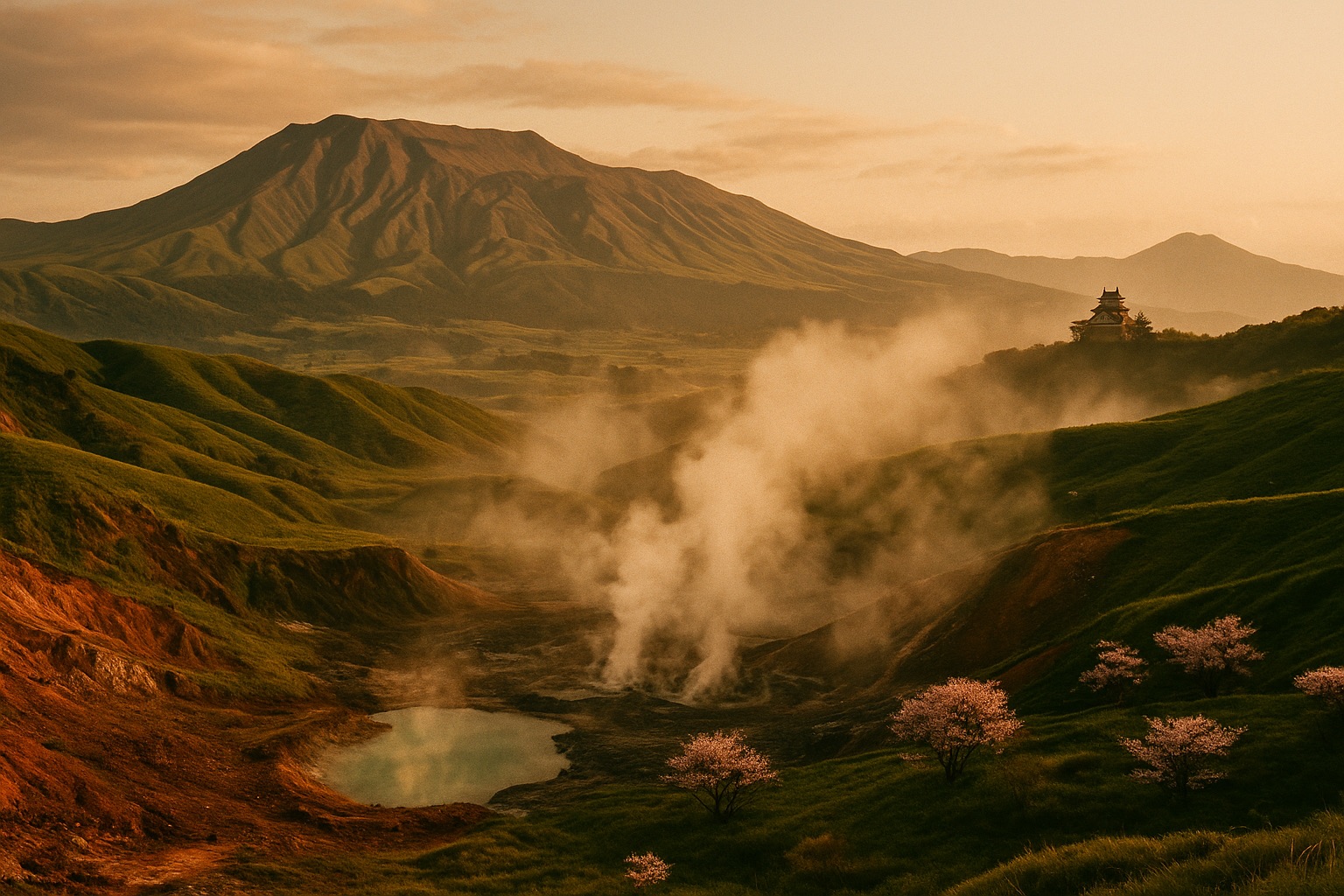
✦ AI-generated illustration — not a photograph of the actual site
After years living in Oita Prefecture — 15 minutes from Beppu by train — I've watched tourists follow the same itineraries, miss the same things, and eat at the same overrated restaurants. I've had visitors who spent a week in Kyushu and never once had a proper meal. I've had others who followed a popular blog's advice and skipped Kurokawa Onsen because “it's hard to get to.” It is. That's partly why it's worth it.
This guide is different. It's written from the perspective of someone who has driven every road in this region, eaten at the places locals eat, and can tell you honestly which famous spots are worth the hype and which ones you can skip entirely.
I'll give you two routes: one entirely by train using a JR Kyushu Pass, and one that mixes trains and rental car for a deeper experience. I'll tell you what to eat every single day. And I'll tell you what this itinerary deliberately leaves out — and why that makes it better.
In this article
- 1Before You Start — The Honest Truth
- 2Day 1 — Fukuoka: Arrival and the City That Eats
- 3Day 2 — Fukuoka Deep: Dazaifu, Karatsu, or the Food Trail
- 4Day 3 — Nagasaki: Christians, Traders, and the Atomic Bomb
- 5Day 4 — Kumamoto: The Impregnable Castle
- 6Day 5 — Aso & Kurokawa: Volcanic Heart of Kyushu
- 7Day 6 — Beppu: The Onsen Capital, From a Local
- 8Day 7 — Return via Kitakyushu or One Last Detour
- 9The Two Routes at a Glance
- 10Budget Guide
- 11Honest Assessment: What to Skip and What Not to Miss
Before You Start — The Honest Truth About Kyushu Travel
JR Kyushu Pass: Which One to Buy
Two passes matter for this itinerary. The Northern Kyushu Pass (3 days, ¥10,000) covers Fukuoka, Nagasaki, Kumamoto, and Beppu — everything in Days 1–4 and Day 7. The All Kyushu Pass (5 days, ¥15,000)adds Miyazaki and Kagoshima, which this itinerary deliberately avoids (more on that below). If you're doing Route A entirely by train, the All Kyushu 5-day pass at ¥15,000 is likely your best value. Buy it before arriving in Japan or at major JR stations.
Fukuoka Airport: Japan's Best Airport Access
Fukuoka Airport is 5 minutes by subway from Hakata Station and 11 minutes from Tenjin. The fare is ¥260. This is genuinely the best airport access of any major Japanese city — better than Narita (60–90 minutes), better than Kansai (75 minutes), better than everything. Land at 6pm, check in to your hotel, and be eating ramen by 7:30pm. This matters.
The Rental Car Reality
Aso, Kurokawa Onsen, and the deeper parts of Oita are genuinely difficult without a car. Buses to Kurokawa run a few times per day and require careful planning. Aso's crater and Kusasenri meadow are 30+ minutes from the nearest train station. If you're doing Route B — which I recommend for anyone who wants the real Kyushu — rent a car in Kumamoto for Days 4–6, return it in Beppu.
The Honest 7-Day Limitation
Seven days sounds like a lot. It isn't. If you try to include Miyazaki and Kagoshima, everything becomes shallow — you'll spend half your time on trains and arrive at each place too tired to appreciate it. This itinerary focuses on northern and central Kyushu, covers it properly, and leaves you wanting to come back for the south. That's the right outcome.
Best Season to Visit
🌸 Spring (Mar–Apr): Cherry blossoms at their peak at Kumamoto Castle and Aso. Crowded but worth it.
☀️ Summer (Jul–Aug): Too hot. Onsen in August is genuinely uncomfortable. Skip if you can.
🍂 Autumn (Oct–Nov): The best season. Kurokawa's foliage, Aso's golden grass, cool onsen weather.
❄️ Winter (Dec–Feb): Underrated. Fewer tourists, cheaper accommodation, onsen in cold air is a different experience entirely. The onsen villages feel most like themselves in winter.
Fukuoka: Arrival and the City That Eats
📍 Stay overnight in Fukuoka (Hakata or Tenjin area)
Most itineraries tell you to hit the ground running on Day 1 — squeeze in a temple, a castle, a market. I'm telling you the opposite. Fukuoka is one of the best food cities in Japan, possibly in Asia, and the first night here should be spent doing exactly one thing: eating. Don't waste your Fukuoka arrival on sightseeing. Save that for Day 2.
Why does Fukuoka have such extraordinary food? Because it sits at a maritime crossroads. For 2,000 years, every trade route between Japan and the continent passed through this city. Chinese noodle techniques arrived here before anywhere else. Korean spice culture crossed the strait. Portuguese missionaries brought tempura. The result is a food scene that's simultaneously ancient and constantly reinventing itself. I've written about this in detail in why Fukuoka has the best food in Japan.
Afternoon
Check in, drop your bags, and walk. The Nakasu-Kawabata area is a 15-minute walk from Hakata Station — a compact urban island between two rivers where you'll find covered shopping arcades, small shrines tucked between buildings, and the first signs of the evening yatai stalls being set up. Don't eat anything substantial yet. You're saving your appetite.
Evening: The Yatai Experience
Fukuoka's yatai — open-air food stalls — are the city's most distinctive tradition. There are about 100 of them, clustered along the rivers and in Tenjin. I recommend the Tenjin area over Nakasufor your first yatai experience — it's slightly less touristy and the stalls are more spread out, so you can walk between them more easily.
The correct approach is to visit two or three stalls rather than camping at one. Start with yakitori and beer at the first stall. Move to a second for gyoza or oden. Then — and this is important — end the night at a proper ramen shop. The yatai ramen is fine, but the real late-night Hakata ramen experience is at Ganso Nagahamaya (元祖長浜屋), where a bowl costs ¥500 and has been the same price for decades. The broth is milky white tonkotsu, the noodles are ultra-thin, and the experience of eating at 11pm in a cramped counter surrounded by locals is one of the most authentically Fukuoka things you can do. Read more in our full Fukuoka ramen guide.
For a deeper dive into the yatai world — which stalls to visit, what to order, how much to budget, and the unwritten rules locals follow — our Fukuoka yatai guide covers everything.
🍽️ What to Eat Today
- Lunch: Hakata ramen at Shin Shin (博多らーめんShinShin) — the most approachable introduction, clean tonkotsu broth, near Hakata Station
- Evening: Yatai hopping (Tenjin area) — yakitori, gyoza, beer
- Late night: Ganso Nagahamaya — ¥500 bowl, historic, local
Fukuoka Deep: Dazaifu, Karatsu, or the Food Trail
📍 Stay overnight in Fukuoka
Day 2 is a choose-your-own-adventure. Fukuoka rewards staying put for two nights — the city is bigger and more layered than most visitors realize, and there's a credible argument for not leaving at all. But if you want a day trip, two options stand out.
Option A: Dazaifu + Kamado Shrine (Demon Slayer Route)
Dazaifu Tenmangu is one of Japan's most important shrines — dedicated to the scholar-poet Sugawara no Michizane, who was exiled here and died in 903 AD. Students across Japan pray here before university entrance exams. The main shrine is beautiful, but what most visitors miss is Kamado-jinja, a 20-minute bus ride away.
Homangu Kamado Shrine sits on Mount Homan, surrounded by old-growth forest, and it became famous when Demon Slayer fans recognized it as the spiritual inspiration for the Kamado family home. The atmosphere — ancient cedar trees, mist, a sense of otherworldly quiet — is completely unlike the crowds at the main Tenmangu. If you're interested in the anime pilgrimage connection, I cover it in detail in the Kyushu anime holy lands guide.
From Dazaifu, consider extending to Karatsu by bus (1.5 hours) — a small castle town on the sea with one of the most graceful castle sites in Kyushu. Karatsu Castle sits on a promontory overlooking Nishikaratsu Beach, and the old town behind it has an unhurried, lived-in quality that bigger cities have lost.
Option B: Fukuoka Food Deep Dive
If temples and day trips don't appeal, spend Day 2 eating your way through Fukuoka. A lunch omakase sushi counter (¥15,000–¥25,000) at one of the restaurants I cover in the Fukuoka sushi guide — Kyushu-mae style, where fish is served fresh rather than aged, with kabosu citrus instead of soy — is an experience that most visitors to Japan never have because they go to Tokyo instead.
In the evening: motsunabe or mizutaki. These are Fukuoka's two great hot-pot traditions. Motsunabe (offal hot pot with garlic and chive) is the rougher, more soulful option — deeply flavored, rich in collagen, a meal that feels like it was designed for a cold night after hard work. Mizutaki (chicken hot pot with ponzu) is subtler and more elegant. Either one is a better dinner than anything you'll find in an international hotel.
🍽️ What to Eat Today
- Option A: Dazaifu's umegaemochi (grilled rice cakes with red bean) at the entrance path / Karatsu seaside seafood
- Option B: Fukuoka sushi counter lunch (¥15,000+) / Motsunabe dinner (¥2,500–4,000/person)
Nagasaki: Christians, Western Traders, and the Atomic Bomb
📍 Fukuoka → Nagasaki (Kamome Limited Express, ~1hr 50min, ¥4,000) · Stay in Nagasaki
I put Nagasaki third for a reason. It's emotionally the heaviest day on this itinerary. After two days of eating and enjoying Fukuoka, arriving in Nagasaki and spending a morning at the Peace Park and Atomic Bomb Museum requires a certain mental preparation — and it's better to do that while you still have energy and headspace, rather than at the end of the trip when you're tired.
Nagasaki's history is stranger and more layered than almost anywhere in Japan. It was the only port open to foreign trade during Japan's 250 years of isolation. Dutch traders lived on an artificial island in the harbor. Chinese merchants had their own district. The largest Christian community in Japan was here — and was almost entirely destroyed, first by persecution, then by the atomic bomb. The castles, Christian martyrs, and Western traders of this prefecture have their own deep story, which I cover in the castles and Christian history of Nagasaki.
Morning: Peace Park and the Atomic Bomb Museum
Spend 2–3 hours here. The museum is meticulous and unflinching. The hypocenter park, where the bomb detonated 500 meters above the ground, is surprisingly quiet — a neighborhood park with a black pillar marking the spot. Take the tram from Nagasaki Station (Line 1 or 3, ¥140). A note to American visitors: this is not a place that blames or accuses. It is a place that records. Come with an open mind and you'll leave with a more complex understanding of what happened.
Afternoon: Glover Garden and the Western Quarter
Thomas Glover was a Scottish merchant who arrived in Nagasaki in 1859 and proceeded to help build modern Japan — supplying weapons to the anti-Tokugawa forces, establishing Japan's first mint, helping found Kirin Brewery. His house, the oldest Western-style wooden building in Japan still standing, looks out over the harbor from a hillside above the city. Oura Cathedral, a 10-minute walk away, was built in 1864 and is the oldest Gothic-style building in Japan still in use — a national treasure.
Finish the afternoon at Nagasaki Chinatown(Shinchi) — one of Japan's three historic Chinatowns, smaller than Yokohama's but more concentrated, with actual restaurants rather than just souvenir shops.
Evening: The Night View from Inasa Hill
Nagasaki's night view from Inasayama is ranked one of Japan's top three. Take the ropeway from Fuchi Shrine. The city spreads across a narrow valley that opens to the sea, and the lights trace the exact shape of the topography.
🍽️ What to Eat Today
- Lunch: Nagasaki champon at Kouzanrou (江山楼) — the thick, milky noodle soup that originated here, not in China
- Snack: Nagasaki castella at Fukusaya (福砂屋) — the original recipe, denser and more buttery than the mass-market versions
- Dinner: Shippoku cuisine — the multicultural Nagasaki banquet tradition that blends Japanese, Chinese, and Dutch elements
Kumamoto: The Impregnable Castle and the Last Samurai's Cave
📍 Nagasaki → Kumamoto (express ~2.5 hrs) · Stay in Kumamoto
The common mistake in Kumamoto is spending half a day at the castle and calling it done. Kumamoto has two sites that are genuinely unlike anything else in Japan — and one of them almost nobody visits.
Morning: Kumamoto Castle
Enter at 9am when it opens and you'll have the first hour relatively to yourself. Kumamoto Castle was designed by Kato Kiyomasa — a general who had survived sieges during Hideyoshi's invasion of Korea and understood, better than anyone, what made a castle fall. He incorporated everything he had learned: the famous musha-gaeshi (warrior-turning) curved stone walls that make climbing impossible; an underground water system capable of supplying the garrison indefinitely; 49 wells, 120 cisterns, and enough edible plants in the gardens to feed thousands for a year.
The proof of his design came in 1877, when 20,000 rebel samurai under Saigo Takamori tried to take the castle. A government garrison of 3,000 held out for 50 days until relief arrived. The besiegers never broke through. Read more in the full guide to how Kato Kiyomasa designed Kumamoto Castle.
Note: the 2016 earthquake damaged 50 locations across the castle complex. The main tower was reopened in 2021. Full restoration is expected to be completed around 2038. What you see now is partially scaffolded, partially restored — which is itself something to see, a living document of how Japan rebuilds.
Afternoon: Reigando Cave — Japan's Most Overlooked Site
This is the site I most often recommend to people who say they've “already seen everything.” Reigando is a cave on Mount Iwato, 40 minutes from central Kumamoto by bus or taxi, where Japan's greatest swordsman — Miyamoto Musashi — lived between 1643 and 1645, writing the Go Rin no Sho (Book of Five Rings) in the two weeks before his death. He was 62 years old, dying of cancer, and wrote perhaps the most influential treatise on strategy and martial philosophy ever produced in East Asia.
Very few tourists go here. The stone steps up to the cave are steep. The cave itself is small and dark. But the silence, the view of the valley below, and the knowledge of what happened in that cave — it has a gravity that the crowded castle grounds don't.
🍽️ What to Eat Today
- Lunch: Kumamoto ramen at Komurasaki (こむらさき) — wider, straighter noodles than Hakata, with mayu (black garlic oil) and a cleaner broth
- Dinner: Basashi (horse sashimi) + karashi renkon (lotus root stuffed with mustard miso) — Kumamoto produces more horse meat than any other prefecture in Japan, and the quality here is genuinely exceptional
Aso & Kurokawa: The Volcanic Heart of Kyushu
📍 Kumamoto → Aso → Kurokawa · Stay in Kurokawa Onsen (recommended) · Car strongly recommended
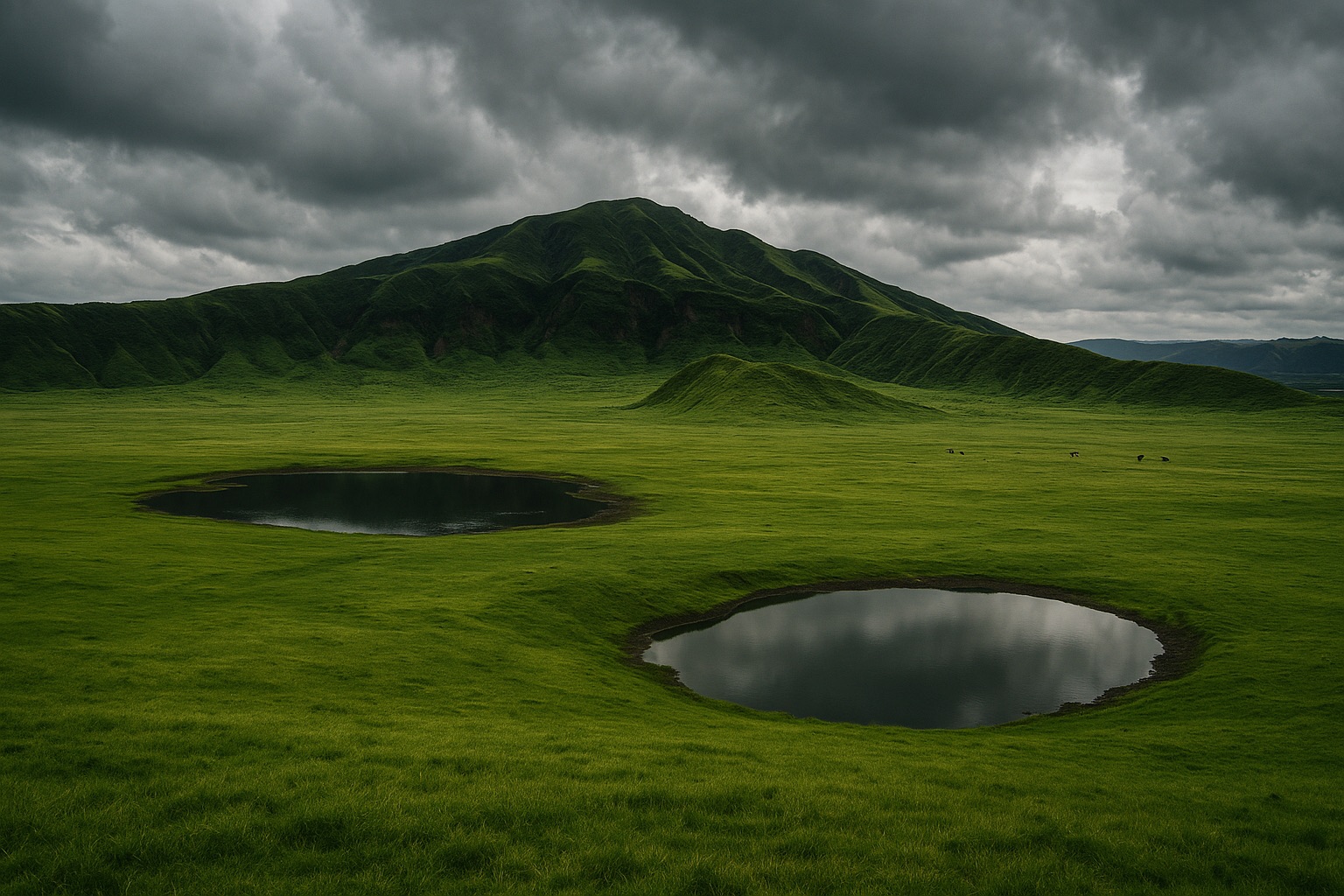
✦ AI-generated illustration — not a photograph of the actual site
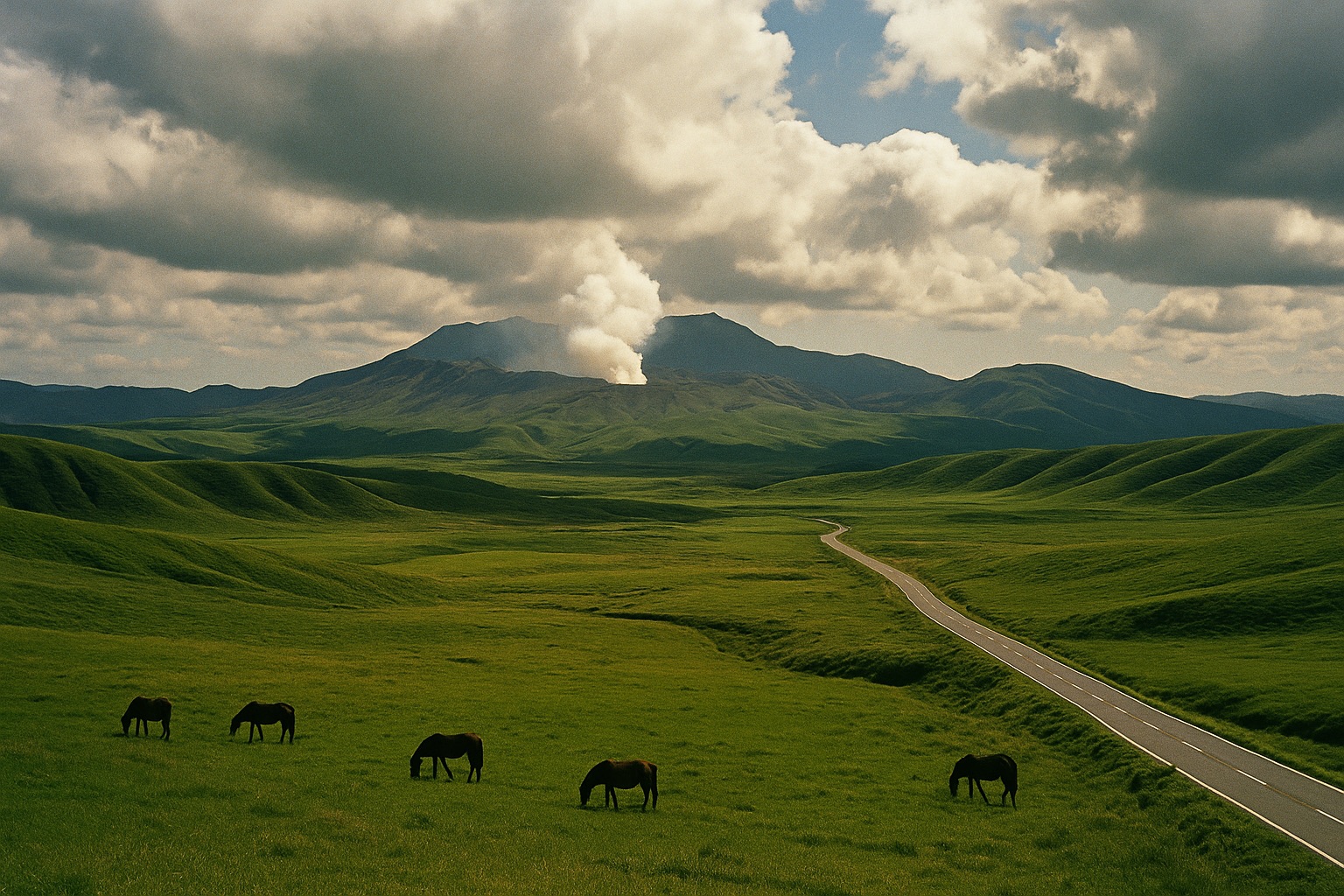
This is the day that justifies the rental car. Aso is one of the largest volcanic calderas in the world — so large that five towns exist inside it, surrounded by a rim of mountains that was the outer wall of an ancient volcano. The scale is difficult to communicate in words. When you drive up to the crater rim and the grasslands open in front of you, it feels unlike anything else in Japan.
Morning: Mount Aso
Drive up to Nakadake Crater(or take the ropeway from the parking area). Check current volcanic activity status before visiting — the crater is closed when SO₂ levels are too high, which happens unpredictably. If the crater is accessible, you'll look down into an active volcanic vent, aqua-green acid lake at the bottom, steam venting from the crater walls.
Kusasenri, 1km from the crater, is a flat grassland inside the caldera — a perfectly circular meadow with two ponds. Wild horses graze here. It looks like something from a fantasy film, and it's real.
Afternoon–Evening: Kurokawa Onsen
Kurokawa is 1.5 hours from Aso by car. It is, without qualification, the most beautiful onsen village in Japan. In the 1980s, the village collectively decided to ban neon signs, vending machines, and anything that didn't fit the traditional aesthetic. Every ryokan maintains a consistent visual language of wood, bamboo, and stone. The effect — especially at night — is unlike any other hot spring town in the country. I wrote the full guide at the Kurokawa Onsen guide.
Buy the Yumeguri Tegata(湯めぐり手形, ¥1,500) upon arrival — a wooden entry pass that gets you into any three of the village's 24 outdoor baths. The baths differ dramatically in character: some are in riverside caves, some perched over the gorge on wooden platforms, some in bamboo groves. Don't just stay in your ryokan's bath. The walk between them in the evening lantern light is half the experience.
If you've never used a public onsen before, read the guide to using a public onsen in Japan before you arrive. The etiquette matters and the locals notice.
⚠️ Important Notes
- Kurokawa has no train service. Buses run a few times per day from Hita and Beppu but require advance planning. A car is the practical solution.
- Aso's crater can close without warning due to volcanic activity. Check JMA volcanic alerts the morning of your visit.
- Book Kurokawa ryokan 2–3 months in advance for autumn (Oct–Nov) and cherry blossom season.
🍽️ What to Eat Today
- Lunch: Aso red beef burger or takana-meshi (pickled mustard leaf rice) at the Aso crater area restaurants
- Dinner: Ryokan kaiseki — typically 8–10 courses using local mountain vegetables, river fish, and Aso beef. Most ryokan include dinner in the room rate.
Beppu: The Onsen Capital, Explained by Someone Who Lives Here
📍 Kurokawa → Beppu (car: ~1.5hrs / bus: ~2hrs) · Stay in Beppu or Yufuin
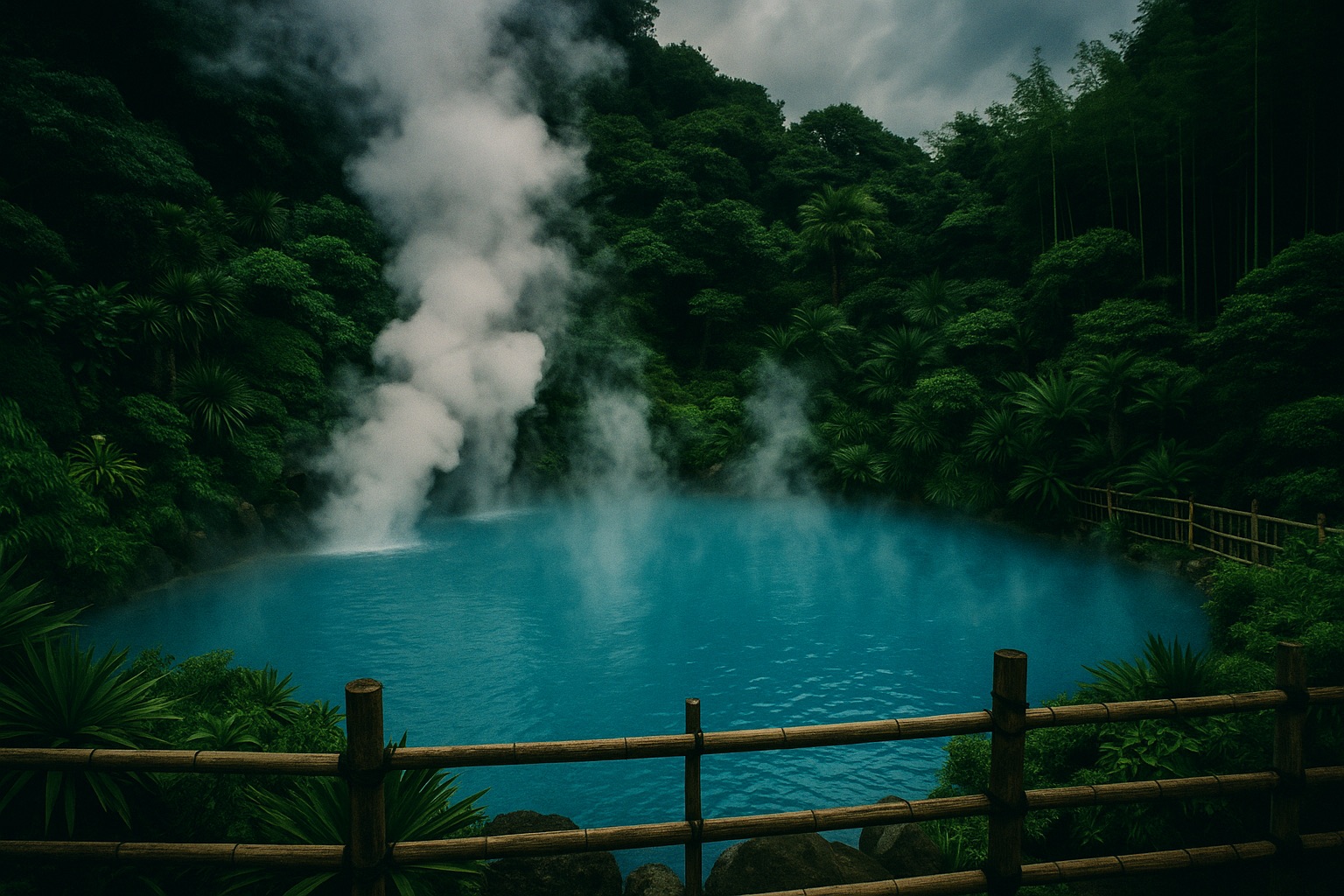
✦ AI-generated illustration — not a photograph of the actual site
I live 15 minutes from Beppu by train. I am, in the most literal sense, a local here. So let me give you the honest assessment that no travel guide will give you: Beppu is simultaneously more impressive and more tourist-trap-y than you expect.
The numbers are real: Beppu has more hot spring sources than any other city in Japan, and among the highest thermal output on Earth outside of Iceland. The entire city is geothermally active — you can see steam venting from drains, from cracks in the road, from the sea. On cold mornings, the city looks like it's on fire. This is genuine and extraordinary.
Morning: Jigoku Meguri (Hells Tour) — Done Correctly
There are eight jigoku (hells) in Beppu — themed hot spring pools that you view rather than bathe in. Every guide tells you to visit all eight. I'm telling you to visit two or three. The best are Umi Jigoku (cobalt blue, otherworldly color, genuinely stunning) and Chinoike Jigoku(blood red from iron oxide, dramatic). The others are variations on a theme and the admission prices add up. A combined ticket for all eight costs ¥2,200, which is fine if you have the time and interest — but don't rush through all eight just to say you did.
Afternoon: The ¥110 Onsen — The Real Beppu
This is the experience most tourists miss entirely. Beppu has dozens of city-operated public baths, some as cheap as ¥110. Takegawara Onsen(竹瓦温泉), built in 1879, charges ¥300 for the regular bath and ¥1,500 for a sand bath — you lie buried in geothermally heated sand while the minerals work on your body. This is a completely different experience from a private ryokan onsen, and it's how the locals actually use their hot springs. Bring a small towel and your own toiletries. The etiquette guide I mentioned on Day 5 applies here.
Alternative: Yufuin Instead
If your priority is atmosphere over variety, consider staying in Yufuin (30 minutes from Beppu by car) instead. Yufuin is smaller, more curated, and the morning mist over Kinrinko Lake is one of the most photographed scenes in Kyushu. But read Yufuin vs Beppu: a local's honest comparison before deciding — the tradeoffs are real and the right choice depends on what you want from the day.
If you're planning to return to Fukuoka from Beppu, the Sonic Limited Express takes about 2 hours and is covered by the JR Kyushu Pass. Details and timetable in the Fukuoka to Beppu transport guide.
🍽️ What to Eat Today
- Lunch: Beppu reimen (cold noodles) — one of Japan's three great cold noodle dishes, almost unknown outside Kyushu. Clear broth, bouncy noodles, served with half a hard-boiled egg and thin-sliced beef.
- Dinner: Seki saba / seki aji — mackerel and horse mackerel caught in the strong currents off Cape Seki in Oita. The fastest-caught, freshest fish in Japan. Worth the ¥3,000–5,000 price at a good restaurant.
- Dessert: Jigoku-mushi purin (steam-cooked custard pudding) near the hell tour area — custard cooked by volcanic steam, deeply flavored, available at multiple stalls
Return to Fukuoka via Kitakyushu — Or One Last Detour
📍 Beppu → Fukuoka (Sonic ~2hrs) or Beppu → Hita → Fukuoka
Three options for the final day, depending on your flight time and what you haven't done yet.
Option A: Hita — Attack on Titan Pilgrimage
Hita is a small inland city in Oita Prefecture, about 1 hour from Beppu by the Yufuin no Mori scenic train. It's best known locally for its Edo-period merchant district (Mameda-machi, largely preserved) and its Ayu river fish cuisine. But in recent years it has become famous for something else entirely.
Hajime Isayama, the creator of Attack on Titan, grew up in Hita. The Oyama Dam, 40 minutes from the city center, was the visual inspiration for Wall Maria — the enormous outer wall that falls in Episode 1. Full-size bronze statues of Eren, Mikasa, and Armin stand near the dam. The surrounding landscape, with its forested hills and wide valley, matches the anime's setting closely enough to be eerie. I cover this and more in the Attack on Titan pilgrimage in Hita section of the Kyushu anime holy lands guide.
Option B: Kokura and Shimonoseki — The Bridge Between Islands
Kokura (part of Kitakyushu City) is 1 hour from Beppu on the Sonic. Kokura Castle is where Miyamoto Musashi arrived to fight his famous duel with Sasaki Kojiro on Ganryujima Island — Musashi arrived 3 hours late by boat, deliberately rattling his opponent before defeating him in moments. The full story is in the Kokura Castle and Musashi's famous duel guide.
From Kokura, cross to Shimonoseki (10 minutes by shinkansen or train over the Kanmon Strait) for a final meal at Karato Market — fugu(pufferfish) sashimi on a weekend, fresh seafood in the covered market on a weekday. It's an unexpectedly perfect final meal before flying home.
Option C: Fukuoka Final Day
Take the Sonic directly to Hakata (2 hours), spend the afternoon at Hakata Station's basement food halls buying omiyage (gifts) — mentaiko (spiced cod roe), Hakata torimono (chicken confectionery), and the utterly reliable Hakata Torimon white bean paste cakes — then have one final dinner before flying out.
If you have energy for one last serious meal, the Fukuoka yakiniku guide covers the best wagyu yakiniku restaurants near the station. Fukuoka sits at the center of Kyushu's wagyu country — Saga, Miyazaki, and Kagoshima beef all available within a 2-hour radius.
🍽️ What to Eat Today
- Option A (Hita): Hita yakisoba — thick fried noodles with lard and vegetables, a local specialty you won't find elsewhere
- Option B (Shimonoseki): Fugu sashimi at Karato Market (¥400–800 for a small plate on weekends)
- Option C (Fukuoka): One final wagyu yakiniku dinner at a butcher-owned counter
The Two Routes at a Glance
Route A: Train-Based
JR Kyushu All Pass · ¥15,000
- 1Day 1: Fukuoka (arrive)
- 2Day 2: Fukuoka (Dazaifu day trip)
- 3Day 3: Nagasaki
- 4Day 4: Kumamoto
- 5Day 5: Kumamoto → Aso (bus) → Kurokawa (bus)
- 6Day 6: Kurokawa → Beppu (bus)
- 7Day 7: Beppu → Kokura/Fukuoka (Sonic)
Route B: Train + Rental Car
JR Northern Pass + Car · ¥30,000–40,000
- 1Day 1: Fukuoka (arrive)
- 2Day 2: Fukuoka → Karatsu (rental car)
- 3Day 3: Karatsu → Nagasaki (drive)
- 4Day 4: Nagasaki → Kumamoto (return car, express)
- 5Day 5: Kumamoto (new rental) → Aso → Kurokawa
- 6Day 6: Kurokawa → Yufuin → Beppu (return car)
- 7Day 7: Beppu → Hita → Fukuoka (express)
Cost Comparison
| Item | Route A | Route B |
|---|---|---|
| JR Pass | ¥15,000 (All Kyushu 5-day) | ¥10,000 (Northern 3-day) |
| Rental Car | — | ¥8,000–15,000/day × 2 days |
| Total Transport | ¥20,000–25,000 | ¥30,000–40,000 |
| Freedom | Medium | High |
| Aso & Kurokawa depth | Shallow (bus-dependent) | Deep |
Budget Guide — What to Expect to Spend
| Category | Budget | Standard | Luxury |
|---|---|---|---|
| Accommodation/night | ¥3,000–5,000 | ¥8,000–15,000 | ¥20,000–50,000 |
| Food/day | ¥2,000–3,000 | ¥4,000–8,000 | ¥10,000–30,000 |
| Transport/day | ¥1,000–2,000 | ¥2,000–4,000 | ¥4,000–8,000 |
| Sightseeing/day | ¥500–2,000 | ¥2,000–5,000 | ¥5,000–15,000 |
| Daily total | ¥7,000–12,000 | ¥16,000–32,000 | ¥40,000–100,000 |
7-day total estimate (inc. transport, accommodation, food): ¥80,000–230,000 depending on travel style.
What This Itinerary Deliberately Leaves Out
- Miyazaki: Extraordinary — Nichinan coastline, Takachiho Gorge, aoshima — but 7 days isn't enough. Add 3–4 days for a separate trip.
- Kagoshima: Sakurajima volcano and Ibusuki sand baths deserve their own visit. Including them here means cutting Kurokawa. That's the wrong trade.
- Iki & Tsushima Islands: These are separate trips by ferry or plane. Don't try to incorporate them.
Honest Assessment: What to Skip and What Not to Miss
❌ Skip These (Or Keep Them Short)
- All 8 Beppu Hells: Two or three is plenty. The novelty decreases rapidly.
- Glover Garden's full circuit: The main Glover House and the view are the point. The inner gardens are unremarkable.
- Yufuin's Yuno-Tsubo Kaido main street: On a weekend, it's a tourist trap with soft-serve ice cream queues. Kinrinko Lake at 7am before the crowds — that's the real Yufuin.
- Fukuoka Tower: Nice view, but the city doesn't need a tower to understand it. Walk the city instead.
✅ Do Not Miss These
- Kurokawa Onsen overnight: Cannot be replicated with a day trip. The lantern walk between baths at 9pm is the whole point.
- Reigando Cave (Kumamoto): Almost no tourists. Genuine historical gravity. Worth the taxi fare.
- Ganso Nagahamaya ¥500 ramen: A piece of Fukuoka history that still functions as a real restaurant.
- A municipal onsen in Beppu (¥110–¥310): The local experience that all the luxury hotels are imitating at 100× the price.
- Karato Market on a weekend: The “Ikiiki Bakankai” weekend market is one of the best food experiences in all of western Japan.
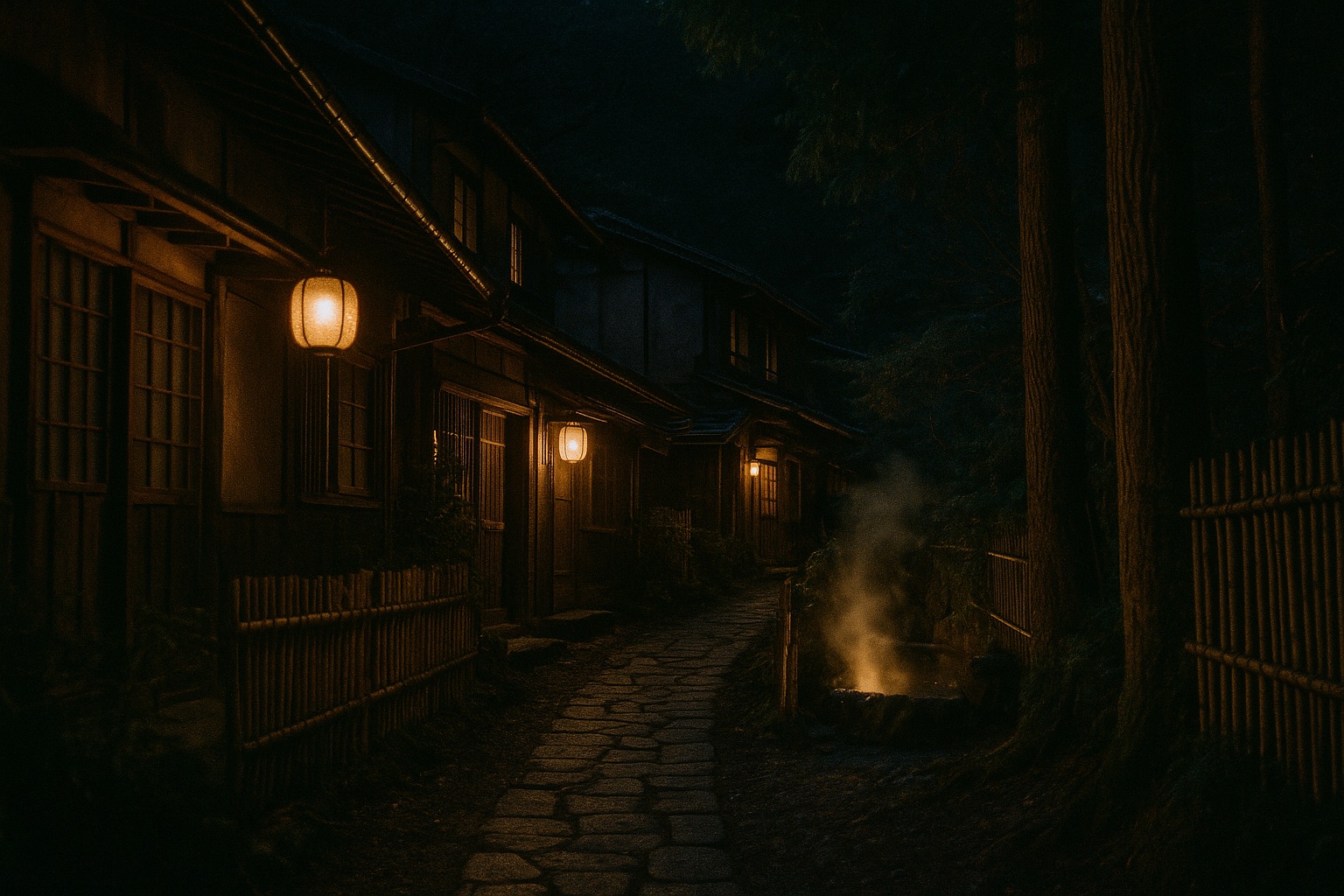
✦ AI-generated illustration — not a photograph of the actual site
“On the last day of a Kyushu trip, on the Sonic express heading back to Fukuoka, the carriage goes quiet as the train curves along the coast and the Kanmon Strait appears through the window — the narrow channel where Japan and its history have crossed for 2,000 years. Most people I've spoken to who make this journey say the same thing at that moment: I need to come back.
That's the correct response. Seven days is a beginning. It's enough to understand why Kyushu is different from the rest of Japan — volcanic, maritime, independent-minded, with food that doesn't care about being fashionable. Come back for Miyazaki. Come back for Kagoshima. Come back for the islands. Kyushu earns it.”
All Articles Referenced in This Guide
Written by
A Local in Oita, Japan
A Japanese local born and raised in Oita, Kyushu. Sharing the Japan that guidebooks miss — from someone who actually lives here.
About this site →Related Articles
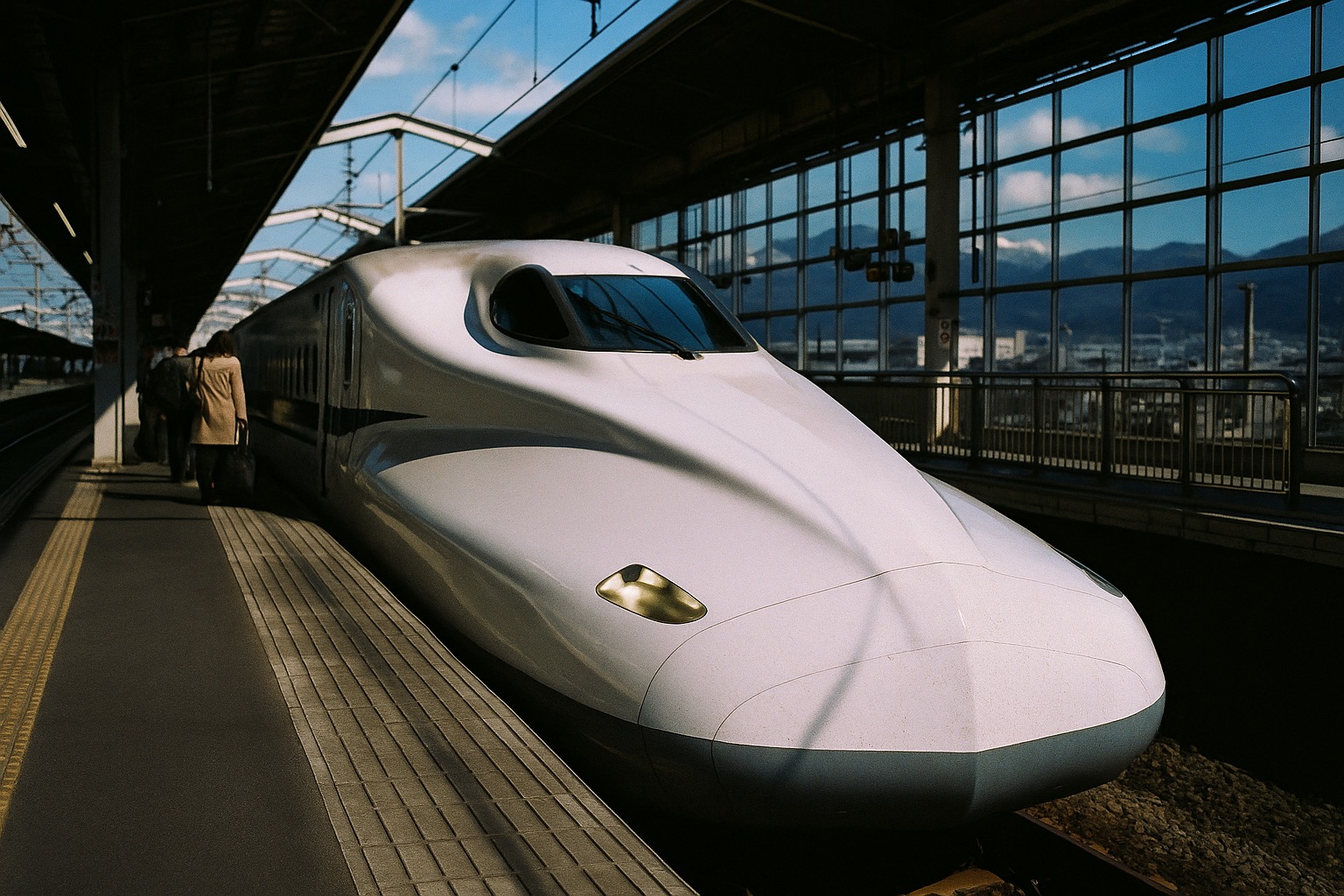
JR Kyushu Rail Pass: Is It Worth It? A Local's Honest Guide
A local breaks down the JR Kyushu Rail Pass — the 3, 5, and 7-day options, what's covered, real price math for popular routes, how to buy and use it, and the honest answer to whether it's worth it for your trip.
Best Time to Visit Kyushu: A Month-by-Month Season Guide
When should you visit Kyushu? A local walks you through the seasons month by month — cherry blossoms, the rainy season, summer heat, golden autumn, and mild onsen winters — so you pick the right time for your trip.
Driving in Kyushu: Renting a Car & the Best Road Trips
Should you rent a car in Kyushu? A local explains the license you need, what driving here is really like, costs and tolls, where a car beats the train — and the island's most beautiful road trips.