Fukuoka Sushi Guide: Why This City Has Better Sushi Than Almost Anywhere(Including Tokyo)
If you've eaten sushi in Tokyo — or in the US — and think you understand Japanese sushi, Fukuoka will change your understanding. Not because it's better than Tokyo. Because it's genuinely different. The difference has a name: Kyushu-mae. Understanding it before you sit down at a counter here will transform what you taste.
Written by a local in Oita · May 2026 · 16 min read
✦ AI-generated illustration — not a photograph of the actual site
Quick Facts: Fukuoka Sushi
- Style
- Kyushu-mae (九州前) — freshness-first
- Key difference from Tokyo
- Kabosu & salt instead of soy sauce
- Fish source
- Genkai Sea, Ariake Sea, Suo-nada
- Price range
- ¥18,000–50,000+ (omakase)
- Booking lead time
- 2–8 weeks depending on counter
- Best for English speakers
- Sushi Gyoten (chef speaks English)
Kyushu-mae vs Edomae: The Philosophy Behind the Fish
Most English-language sushi guides skip this entirely and just list restaurants. This article won't. Because if you don't understand the philosophy, you'll eat a ¥35,000 omakase and wonder why there's no soy sauce on the table.
Edomae — Tokyo-style sushi — is built around the concept of work (shigoto). Historically, before refrigeration, chefs in Edo (old Tokyo) had to preserve fish from Tokyo Bay long enough to serve it. They developed a repertoire of techniques: curing fish in salt, marinating in soy sauce (zuke), half-cooking (aburi), and aging for days or weeks. The result is a cuisine of complex, layered flavour — the chef's craft is visible in every piece. Edomae is, as one Fukuoka chef put it, a philosophy of subtraction: you remove moisture, you reduce, you concentrate.
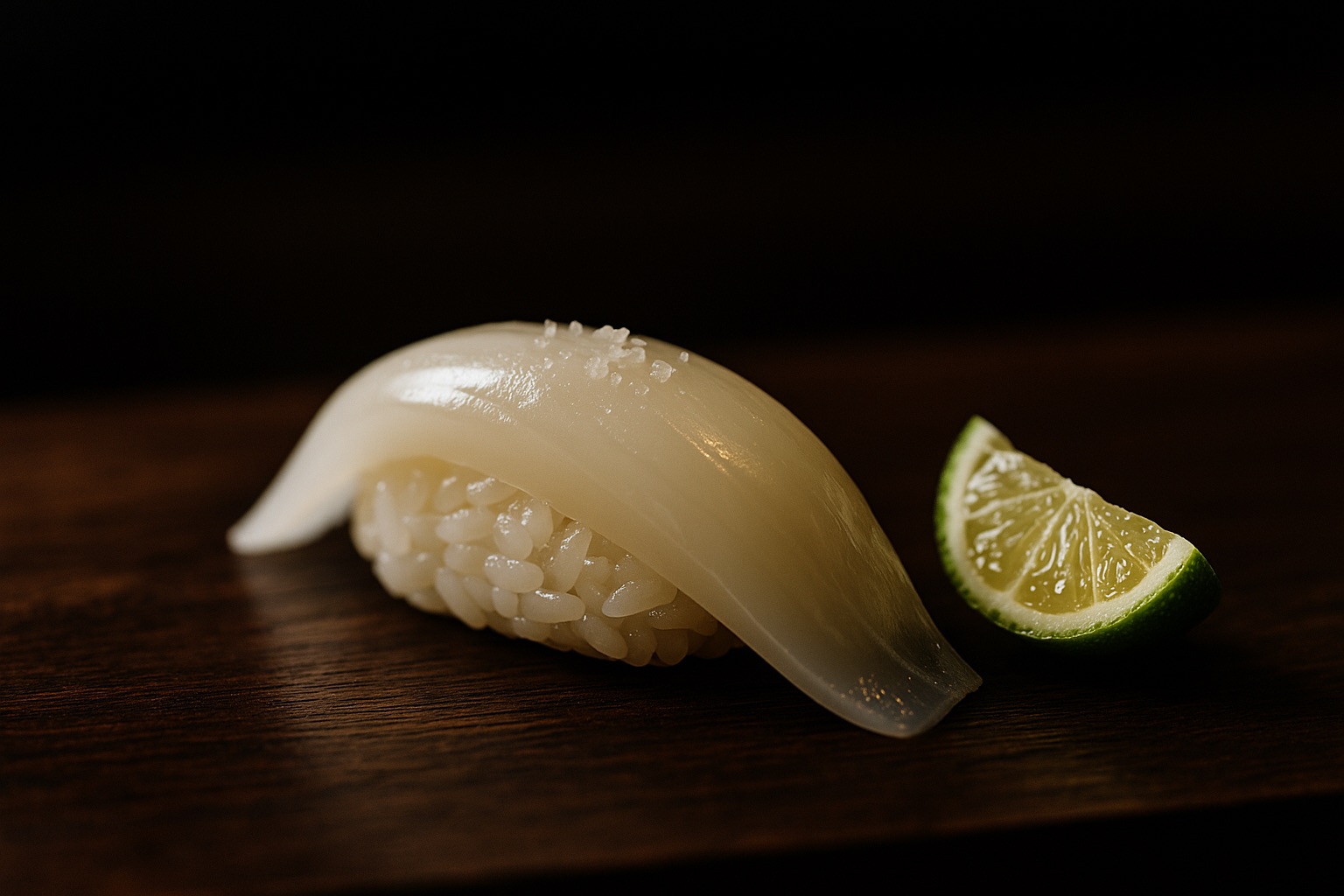
Kyushu-maeis the opposite. When the sea is thirty minutes away and fish arrive at the counter the same morning they were caught, the question "how do we preserve this?" never arises. The question becomes: how do we make the freshness visible? The answer: you add things — a squeeze of kabosu citrus from Oita Prefecture, a pinch of flaky sea salt, a light dusting of powdered soy sauce. You eat the fish at the peak of its transparency and sweetness. Nothing is hidden under a marinade. Nothing is aged into complexity. The complexity is already there, in the fish itself.
“If Edomae subtracts, we add.”— Isao Amano, head chef, Tenzushi Kyomachi (founded 1939)
This isn't a claim that Kyushu-mae is better. Tokyo's top sushi chefs have spent decades mastering a tradition of extraordinary depth. But it is a fundamentally different art form — the difference between a slow-braised dish and a perfect piece of sashimi. Neither is superior. They are solving different problems with different fish in different geographies.
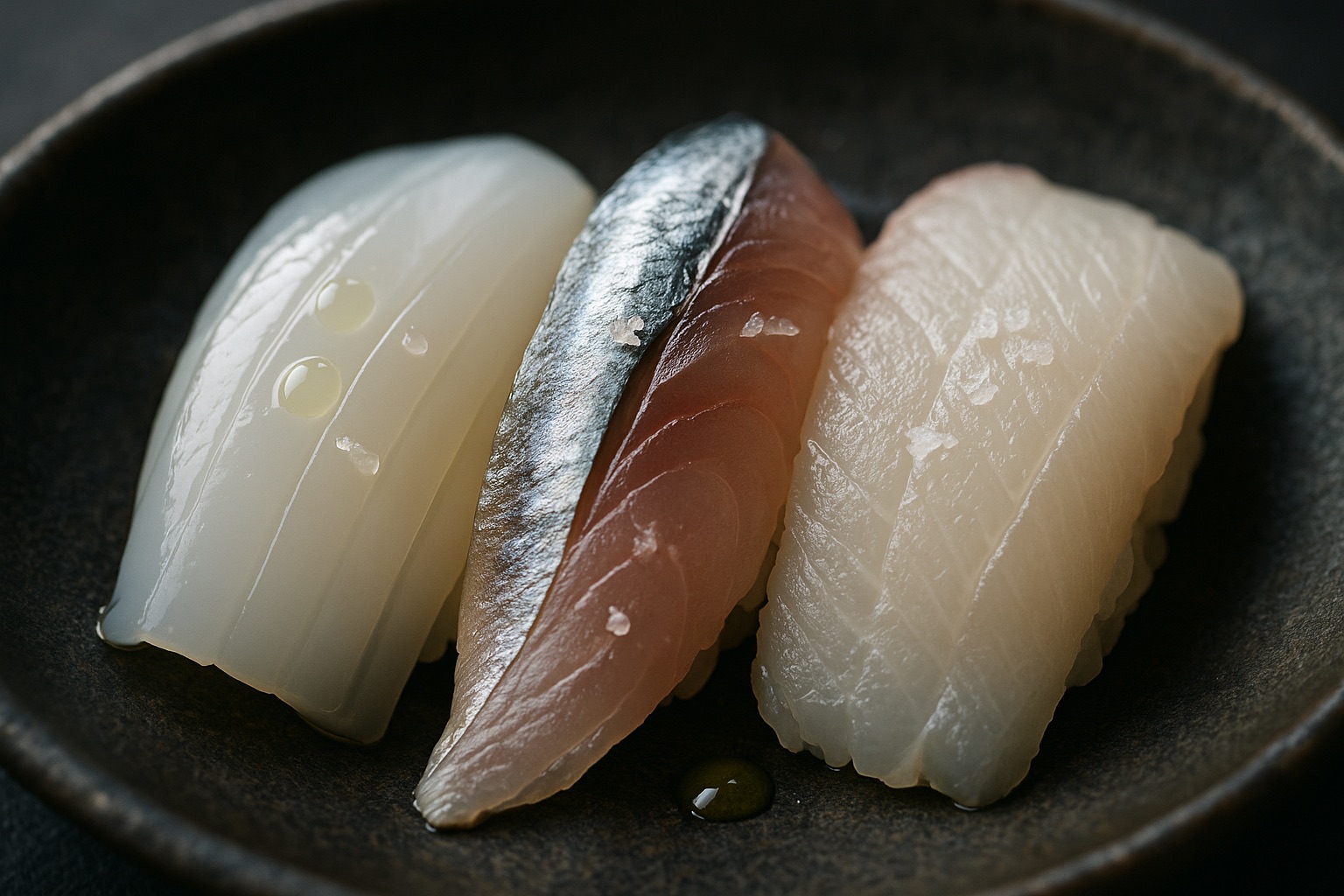
What Kyushu-mae means practically: you will likely eat without soy sauce at the top counters. You will taste squid so fresh it is almost translucent. You will understand why a plain piece of aji (horse mackerel) with a single drop of kabosu can be more interesting than a complex Tokyo preparation.
Why Fukuoka's Fish Is Different — The Geography
Three Seas, Three Characters
🌊 Genkai Sea (玄界灘) — Northwest
Where the Tsushima Current meets cold Pacific upwelling. Strong tides, high salinity, cold-water species. This is where the great Fukuoka fish come from: aji (horse mackerel), hirame (flounder),tai (sea bream), ika (squid). Intense flavour, firm texture.
🌊 Ariake Sea (有明海) — South
The strangest body of water in Japan. A semi-enclosed bay with a tidal range of up to 6 meters — the largest in the country. This extreme environment produces species found almost nowhere else: mutsugoro(mudskipper), taregani (rock crab), and legendary nori seaweed. Ariake fish have a unique sweetness from the sheltered, highly productive waters.
🌊 Suo-nada (周防灘) — East
The calm inner sea between Fukuoka and Yamaguchi. Sheltered, warm, producing outstanding fugu(pufferfish), anago (conger eel), and kuruma-ebi (Japanese tiger prawn). Less dramatic than the Genkai but extraordinary for specific ingredients.
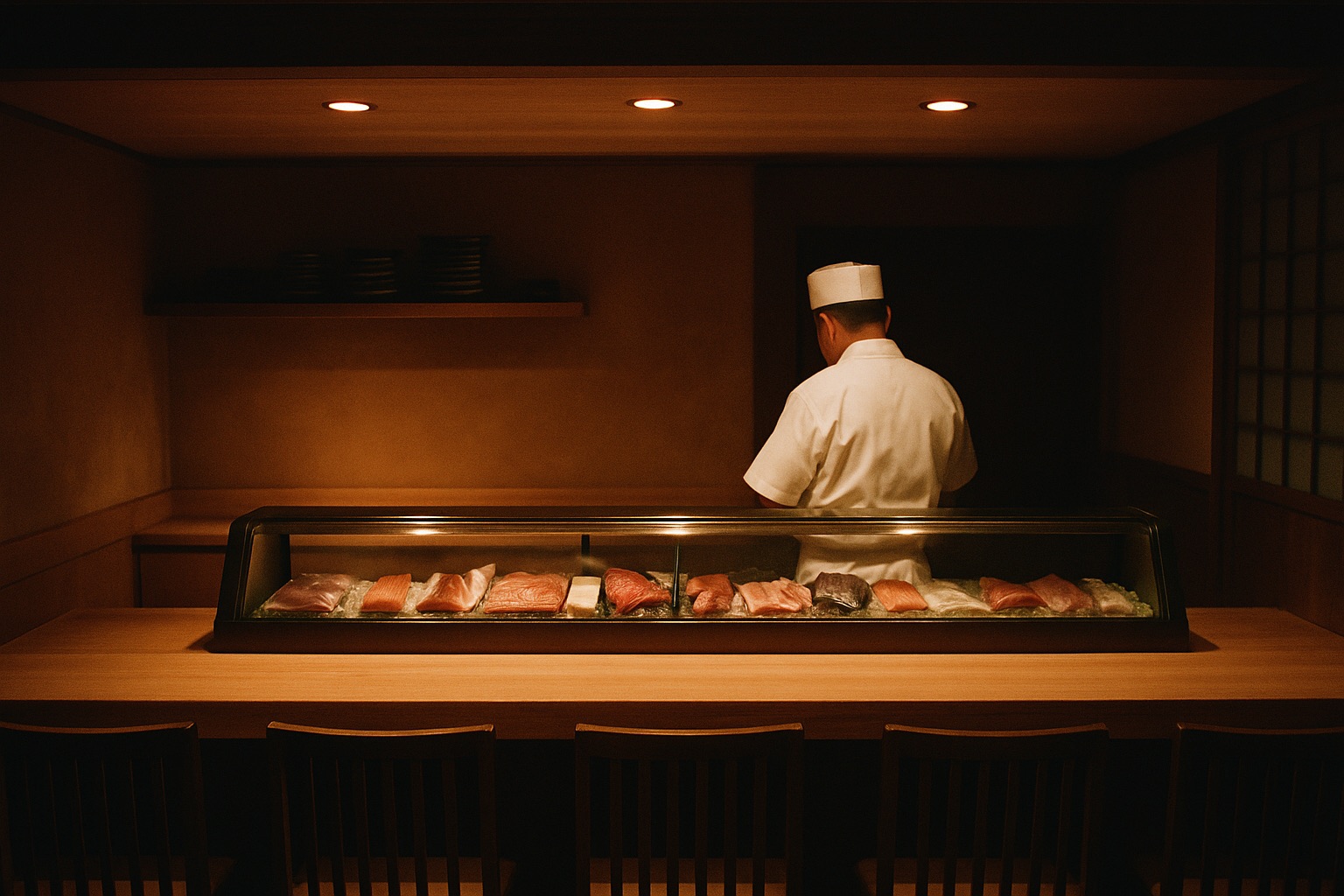
What this geography creates is something Tokyo simply cannot replicate: fish on the counter within hours of leaving the water, sourced from three ecologically distinct seas. The history of Fukuoka as a trading city — the port closest to Korea and China for 2,000 years — also means the city has always had access to the best of the sea. Sushi culture here is not new. The expectation that fish should be extraordinarily fresh is not a marketing claim. It is simply the standard.
This also explains why Fukuoka sushi is cheaper than Tokyo's equivalent. A Tokyo chef sourcing Genkai Sea aji pays for transport, time, and intermediaries. A Fukuoka chef pays for a 30-minute drive to the dock. The ingredient cost is substantially lower. The landlord cost is substantially lower. The result: a counter that would cost ¥60,000–80,000 in Tokyo costs ¥35,000–50,000 in Fukuoka, with fish of equal or better quality.
The specific species to watch for at Fukuoka counters: summer ika (squid, transparent and sweet in a way that summer Tokyo squid rarely matches), shirako (cod milt, prized in winter), Genkai-mono aji in spring, and tai in cherry blossom season. These are not menu items. They are events.
✦ AI-generated illustration — not a photograph of the actual site
Tenzushi Kyomachi — The House That Built Kyushu-mae
天寿し 京町店 · Kokura, Kitakyushu · ¥35,000 · ⭐ Michelin 1 star
⚠️ Location note — please read this first
Tenzushi Kyomachi is in Kokura, Kitakyushu— not in Fukuoka City. Many English guides incorrectly list it as a "Fukuoka restaurant." It is not. Kokura is 15 minutes from Hakata Station by shinkansen, or about an hour by local train. The distinction matters for planning. But it absolutely does not diminish the case for going.
Founded in 1939 — now 87 years old — Tenzushi Kyomachi is the restaurant that codified what Kyushu-mae means. Chef Isao Amano's philosophy is not complicated to describe, but it takes decades to execute: use only fish from Kyushu waters, serve it the same day it was caught, and let the ingredient speak with the smallest possible intervention.
There is no soy sauce on the table. Instead: a small wedge of Oita kabosu, flaky sea salt, and occasionally a dusting of funmatsu-shoyu(powdered soy sauce) applied directly to the fish by the chef. This powdered soy technique is unique to Tenzushi — a way of adding soy flavour without introducing moisture that would soften the fish's texture.
There is also no alcohol. Not because the chef disapproves of drinking, but because he believes sushi is best experienced when the palate isn't dulled by sake. The only drink served is tea. This is, to put it mildly, an unusual decision in a country where sushi and sake are culturally inseparable. It is also a statement of extraordinary conviction about what the meal is supposed to be.
The omakase is 16 pieces. At ¥35,000, it earns a Michelin star that it has held since 2019. The fish changes with the season — there is no fixed menu, and each visit is different.
Booking & Access
Address: 3-11-9 Kyomachi, Kokurakita Ward, Kitakyushu City
Getting there: JR Kokura Station, 5 min walk. From Hakata: 15 min shinkansen (~¥2,500) or 1 hr local train.
Hours: Wed–Sun · 12:00 / 14:00 / 17:30 / 19:30 seatings · Closed Mon–Tue
Booking: Phone (Japanese only) or online reservation. Book 3–6 weeks in advance.
English: △ — limited at the counter, but online booking is manageable
Why make the trip to Kokura? Because this is the restaurant that answered a question most Japanese food culture never thought to ask: what if sushi was defined by the sea it came from, not the technique of the chef who prepared it? The answer is 16 pieces of the cleanest, most honestly presented fish you will eat in Japan. That is worth 15 minutes on a train.
Sushi Sakai — The Most Accessible Michelin Counter in Fukuoka
鮨さかい · Tenjin, Fukuoka City · ¥44,000+ · ⭐ Michelin 1 star · Tabelog Gold
Chef Sakai trained for seven years at Umiin Tokyo — one of the capital's most respected Edomae establishments — before returning to Fukuoka to open his own counter in 2013. He earned a Michelin star the following year. He has held it since, while also collecting multiple Tabelog Gold awards and appearing regularly in Japan's Top 10 restaurant rankings.
The style at Sushi Sakai is not purely Kyushu-mae. It's an intelligent conversation between Edomae technique and Kyushu ingredients: the disciplined Tokyo training applied to fish that arrived this morning from the Genkai Sea. The result has a depth that pure freshness-first Kyushu-mae sometimes lacks, combined with a regional character that Tokyo sushi cannot replicate.
The signature technique is the preparation of squid. Chef Sakai cuts the squid into ultra-fine threads — far thinner than standard sashimi-style cuts — which increases the surface area dramatically and allows the natural sweetness to become the dominant sensation. It's the kind of detail that you notice immediately and can't unsee afterwards.
The Booking Reality
This is what separates Sushi Sakai from comparable Michelin counters in Tokyo: you can book it. A Tokyo counter at this level typically requires a Japanese introduction (縁故) and a wait of six months to a year. Sushi Sakai takes reservations through Tablecheck, which has an English interface, accepts international credit cards, and is straightforward to use.
Book 4–8 weeks in advance for a weekend seat. Weeknight seats are often available on shorter notice. This remains one of the best value opportunities in Japanese fine dining: a counter that would cost ¥60,000+ in Tokyo, bookable online, in English, at ¥44,000.
Booking & Access
Location: Watanabedori, Chuo Ward (near Tenjin) · Subway Watanabedori Station
Booking: Tablecheck.com — English interface available
Price: ¥44,000 omakase · Sake pairing available
English: ○ — the restaurant is experienced with international guests
Sushi Gyoten — Best for English Speakers
鮨ぎょうてん · Chuo Ward, Fukuoka City · ¥50,000+ · Asia's 50 Best tier
Chef Kenji at Sushi Gyoten speaks fluent English. In the world of Japanese fine dining omakase — where the counter experience is built around a deeply personal, often wordless relationship between chef and diner — this is rarer than a Michelin star. Most Michelin-level sushi chefs in Japan speak no English, and the counter conversation (which can significantly enrich the experience) is simply lost to foreign guests.
At Gyoten, the chef explains each piece as it is prepared — the fish, the season, the technique, the region it came from. For anyone eating serious Japanese sushi for the first time, this changes the experience entirely.
The food is excellent on its own terms. Gyoten uses a red vinegar (akazu) shari that gives the rice a distinctive amber colour and a deeper, more complex flavour than white vinegar rice. The tuna preparation is exceptional — several different cuts, different preparation methods, served as a progression. And the restaurant serves unusual ingredients that more conservative counters avoid: konowata (sea cucumber entrails, one of the three great Japanese delicacies), live shako (mantis shrimp), and seasonal shirako.
The dashiserved between courses has been described by international food writers as "liquid gold" — a broth of such clarity and depth that it functions almost as a palate-reset meditation between pieces.
Booking & Access
Location: Chuo Ward, Fukuoka City (exact address provided on booking confirmation)
Booking: Direct enquiry via email — English is fine
Price: ¥50,000+ omakase · Lead time: 6–10 weeks for weekend seats
English: ◎ — chef is fully fluent, counter conversation in English is the norm
✦ AI-generated illustration — not a photograph of the actual site
Other Counters Worth Knowing
These three counters sit in the ¥18,000–25,000 range — below the top tier but well above casual sushi. Each has a distinct personality worth knowing before you book.
Sushi Nishimura
鮨 仁 · Hakata Ward, Fukuoka City
¥25,000+
Edomae × Kyushu hybrid
Sushi Sakai fans who want the same DNA at a lower price point
Sushi Gosuian
鮨 語酔庵 · Maizuru back alley, Fukuoka City
¥20,000+
Kyushu-mae (minimal)
Travelers who want a hidden-gem atmosphere and a lower price
Sushi Kijima
鮨 木島 · Fukuoka City
¥18,000+
Hakata × Kappo fusion
Anyone who wants sushi with a kaiseki sensibility
About Sushi Nishimura specifically
Chef Nishimura trained at Sushi Sakai, which means the DNA of that counter — Edomae technique applied to Kyushu ingredients — runs through every piece here. At ¥25,000, it's a reasonable way to experience a similar philosophy at a more accessible price. Japan's restaurant ranking publication selected it as one of the country's Top 100 restaurants in 2025. It was not there the year before. That kind of ascent means something.
Practical Guide — How to Book, What to Expect, What to Spend
What is omakase?
Omakase(おまかせ) means "I'll leave it to you." When you book an omakase counter, there is no menu — the chef decides what you eat based on what arrived from the sea that morning. The meal proceeds as a sequence, usually 10–20 pieces, served one or two at a time directly from the chef's hand to the counter in front of you. You eat each piece immediately after it's set down — the rice is body temperature, the fish is cold, and the combination degrades within a minute. Waiting to take a photo before eating is a real question. Most chefs are patient about a quick photo. Letting the piece sit for two minutes while you post it is not appreciated.
Asking questions is genuinely welcomed. What fish is this? Where is it from? Why did you prepare it this way? This is the conversation the chef wants to have. Most omakase chefs at this level are enthusiastic about their ingredients and happy to explain. At English-speaking counters like Gyoten this is effortless. At others, pointing and gesturing work better than you expect.
How to book
The three platforms used most widely for English-language omakase booking in Japan:
- TablecheckEnglish interface, real-time availability, international card payment. Used by Sushi Sakai and many others. Best option for most travellers.
- TableallConcierge-style booking service. Good for counters that don't take direct foreign bookings. Small service fee applies.
- OMAKASEJapan-focused platform, English available. Useful for smaller independent counters.
Budget guide
| Budget | Counter | Notes |
|---|---|---|
| ¥50,000+ | Sushi Gyoten | Best for English speakers; chef explains every piece |
| ¥44,000 | Sushi Sakai | Most prestigious; online booking available |
| ¥35,000 | Tenzushi Kyomachi | History; Kokura (15 min by shinkansen) |
| ¥25,000 | Sushi Nishimura | Rising counter; Sakai-trained chef |
| ¥20,000 | Sushi Gosuian | Hidden-gem atmosphere; back alley in Maizuru |
| ¥18,000 | Sushi Kijima | Sushi + kaiseki elements; good entry point |
Tenzushi vs Sushi Sakai — Which One Should You Choose?
This is the question most visitors end up asking. Both are Michelin-starred. Both are exceptional. They are also very different evenings. Here is the direct comparison:
| Comparison | Tenzushi Kyomachi | Sushi Sakai |
|---|---|---|
| Style | Pure Kyushu-mae (founder) | Edomae × Kyushu |
| Location | Kokura (15 min shinkansen) | Tenjin, city centre |
| Price | ¥35,000 | ¥44,000+ |
| Alcohol | None — tea only | Sake & beer available |
| English | △ limited | ○ comfortable |
| Booking | Phone / online (3–6 weeks) | Tablecheck (4–8 weeks) |
| What it is | Sushi as philosophy | Sushi as fine dining |
Choose Tenzushi if:
- You want to understand where Kyushu-mae came from
- You don't drink alcohol at dinner
- The idea of no soy sauce sounds interesting, not alarming
- You're willing to travel to Kokura
Choose Sushi Sakai if:
- You want to stay in Fukuoka City
- You want sake with your meal
- You prefer booking in English via a familiar platform
- You want the highest-rated counter in the city
A Note on Fukuoka Sushi vs Tokyo Sushi
This is not a question of which is better. That framing misses the point.
Tokyo's three-star sushi counters — Saito, Sushi Yoshitake, Sawada — represent the absolute peak of Edomae technique. The aging, the marinating, the specific preparation of each fish, the decades of refinement: this is extraordinary craft, and there is nothing in Fukuoka that produces exactly the same experience. If you want to understand Edomae at its most extreme, you have to go to Tokyo.
But those Tokyo counters cost ¥60,000–80,000. They require reservations made through connections (Japanese introductions) that most foreign visitors don't have. And they serve fish that may have come from Kyushu anyway — transported to Tokyo for the prestige of being presented by a Tokyo chef.
Fukuoka offers something different: sushi defined by place rather than by technique. The fish is from here. The philosophy was built here. The chef at Tenzushi has been refining the same 16-piece omakase for decades — not because he hasn't thought of something different, but because this is what the Genkai Sea produces and this is how he believes it should be served.
My honest recommendation: if you are visiting Japan for the first time and have to choose between spending ¥70,000 on a Tokyo Michelin three-star or ¥35,000 on Tenzushi followed by ¥35,000 on Sushi Sakai — eat in Fukuoka. You will come away understanding Japanese sushi as a tradition with regional roots and competing philosophies, rather than as a single aesthetic that Tokyo defines. That understanding is more valuable than a single very expensive meal.
The Honest Summary
Fukuoka is Japan's second sushi city — not because Tokyo is first in every sense, but because this is the city that produces a genuinely different tradition with a genuinely different philosophy. Kyushu-mae is not a lesser version of Edomae. It is the sea talking directly, with as little interruption as possible.
For most English-speaking visitors, the most practical path is: book Sushi Sakai on Tablecheck, and if you can manage the trip to Kokura, eat at Tenzushi too. You will leave with a much fuller picture of what Japanese sushi actually is.
All Counters at a Glance
| Counter | Style | Price | English | Best for |
|---|---|---|---|---|
| Tenzushi Kyomachi | Kyushu-mae (founder) | ¥35,000 | △ | Anyone who wants to understand the origin of Kyushu-mae sushi |
| Sushi Sakai | Edomae × Kyushu | ¥44,000+ | ○ | Serious diners who want Michelin-level sushi with online booking |
| Sushi Gyoten | Creative Kyushu-mae | ¥50,000+ | ◎ | English speakers who want the full omakase experience without a language barrier |
| Sushi Nishimura | Edomae × Kyushu hybrid | ¥25,000+ | △ | Sushi Sakai fans who want the same DNA at a lower price point |
| Sushi Gosuian | Kyushu-mae (minimal) | ¥20,000+ | △ | Travelers who want a hidden-gem atmosphere and a lower price |
| Sushi Kijima | Hakata × Kappo fusion | ¥18,000+ | △ | Anyone who wants sushi with a kaiseki sensibility |
Written by
A Local in Oita, Japan
A Japanese local born and raised in Oita, Kyushu. Sharing the Japan that guidebooks miss — from someone who actually lives here.
About this site →More from Japan Local Travel
JR Kyushu Rail Pass: Is It Worth It? A Local's Honest Guide
A local breaks down the JR Kyushu Rail Pass — the 3, 5, and 7-day options, what's covered, real price math for popular routes, how to buy and use it, and the honest answer to whether it's worth it for your trip.
Best Time to Visit Kyushu: A Month-by-Month Season Guide
When should you visit Kyushu? A local walks you through the seasons month by month — cherry blossoms, the rainy season, summer heat, golden autumn, and mild onsen winters — so you pick the right time for your trip.
Driving in Kyushu: Renting a Car & the Best Road Trips
Should you rent a car in Kyushu? A local explains the license you need, what driving here is really like, costs and tolls, where a car beats the train — and the island's most beautiful road trips.