Beppu Onsen GuideThe Honest Version from Someone Who Lives 15 Minutes Away
Written by a local in Oita · June 2026 · 20 min read
I live in Oita City. Beppu is 15 minutes away by train. I've been there more times than I can count — not as a tourist, but as someone who goes for a cheap soak in a neighborhood bathhouse on a Tuesday afternoon.
✦ AI-generated illustration — not a photograph of the actual site
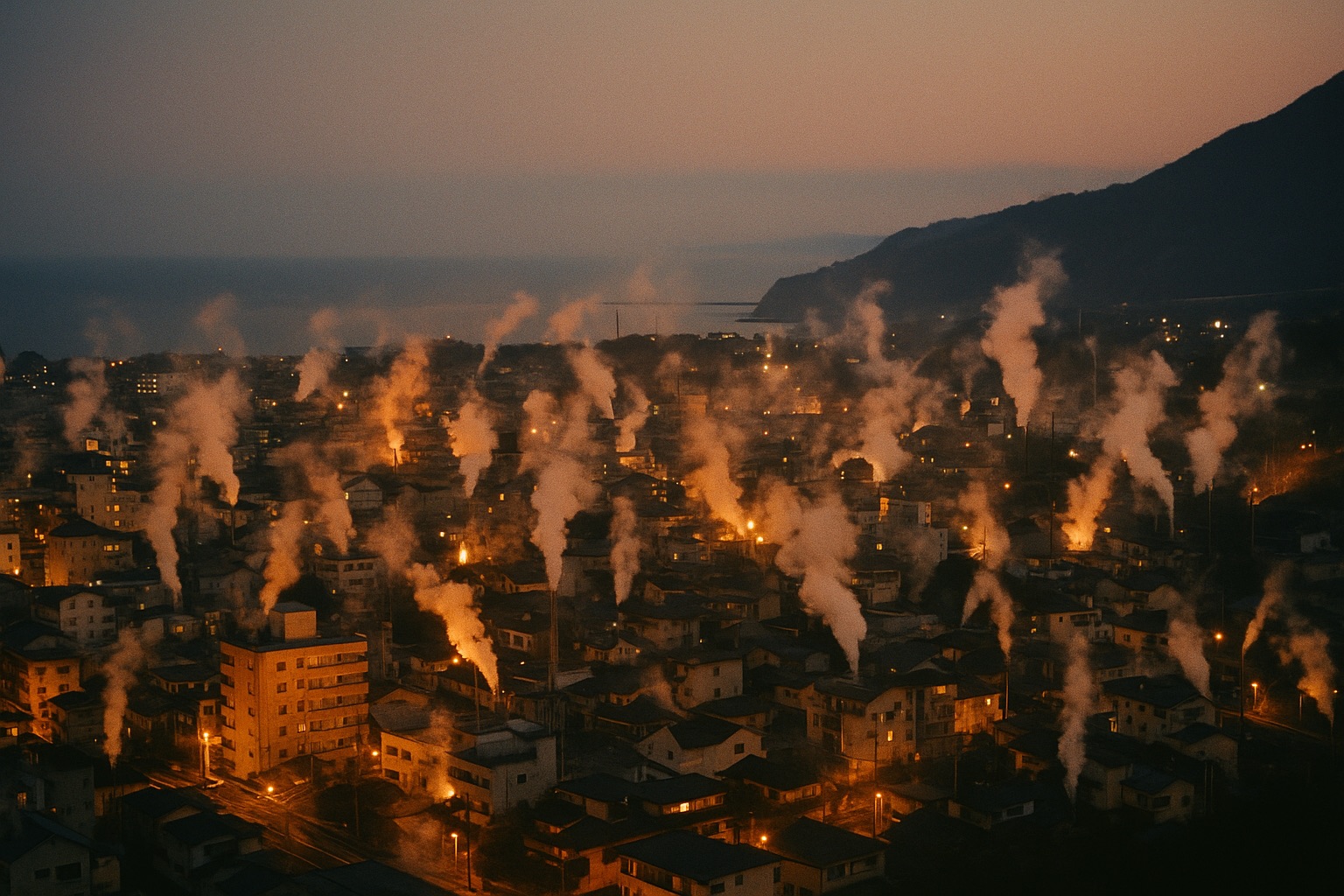
That perspective changes how I see Beppu. Not as a theme park of hot springs, but as a city where the earth is still actively trying to cook everything — where steam rises from street grates, sidewalk cracks, and hillside pipes with the casual indifference of a city that has been doing this for centuries.
This guide is the version I'd give a close friend: which two hells are worth seeing and which five you can skip, where the ¥110 bathhouses are and why they're better than the famous ones, how to handle the tattoo question honestly, and what to eat while the steam is still rising.
First time at a Japanese onsen? Read our guide to using a public onsen before you go.
In this article
- 1Why Beppu Is Different — The Geology Behind the Steam
- 2The Beppu Hatto — Eight Districts, Eight Personalities
- 3The Hells of Beppu — What to See and What to Skip
- 4The Best Onsen in Beppu — By Type and Budget
- 5The Tattoo Question — The Honest Answer
- 6Jigoku Mushi — Eating in Beppu
- 7Getting to Beppu
- 8How to Plan Your Beppu Day
- 9Practical Tips from Someone Who Goes Regularly
Why Beppu Is Different — The Geology Behind the Steam
Beppu has more than 2,800 hot spring sources and the highest volume of geothermal water output of any city in Japan — and by most measures, any city in the world outside of Yellowstone. That number requires context to understand properly.
Most onsen towns have a handful of sources. Beppu has 2,800. They are not organized in one location — they are distributed across the entire city, emerging from wherever the geology allows: sidewalks, hillsides, drainage channels, the gardens of private houses. When you arrive at Beppu Station and walk outside, you will see steam rising from multiple directions before you've gone 100 meters. This is not a spa town that happens to have hot springs. It is a city that was built on top of a geothermal system that it has never been able to contain.
The source: the Aso volcanic system. The calderas and magma chambers of Aso, located to the west of Beppu, heat the groundwater that percolates through the fault lines beneath the city. Beppu Bay sits at the convergence point of several of these faults, which is why the emergence is so concentrated here. The geology isn't going anywhere — Aso is still active, and so is Beppu's water.
The Beppu Hatto (別府八湯)
Because the geothermal sources emerge at different points across the terrain, Beppu's hot spring culture has naturally divided into eight distinct district clusters — the “Beppu Hatto” (Eight Hot Springs). Each district has its own water chemistry, temperature, character, and community of regular users. Most visitors know only two or three. Understanding all eight changes how you approach the city.
The Beppu Hatto — Eight Districts, Eight Personalities
Beppu Onsen (別府温泉)
The central district surrounding JR Beppu Station. This is where most visitors arrive and where the majority of hotels and ryokan are clustered. Convenient but the most tourist-facing of the eight districts.
Takegawara Onsenis here — the 1879 wooden bathhouse that is Beppu's most recognizable building. Ordinary bath ¥100, sand bath ¥1,500. The building alone is worth the visit even if you don't bathe.
Kannawa (鉄輪)
The most atmospheric district in Beppu, and in many ways the heart of what makes the city unusual. Steam rises from street vents throughout the neighborhood, from the hillsides, from between buildings. The smell of sulfur is constant. Locals walk through it as if this is a perfectly normal way to live, which for them it is.
Kannawa has more than 1,000 years of continuous hot spring use. The famous “hells” (jigoku) are concentrated here. So is the Jigoku Mushi Kobo — the geothermal steam kitchen where you cook your own food. This is the district to base yourself in for a full day of Beppu.
Myoban (明礬) — The Local Secret
Myoban is where the serious onsen visitors go. The district specializes in sulfur springs — strong, skin-softening water with a distinctive smell that locals consider a sign of quality. The distinctive feature of Myoban is the yunohana koya: small thatched huts where the sulfur from the steam crystallizes naturally on the roof and walls over time. These crystals (yunohana) are collected and sold as premium bath additives.
Hyotan Onsen — Japan's only Michelin three-star hot spring — is in this district. So are several small community baths at ¥200–400 that serve the neighborhood. My honest recommendation: walk through the yunohana koya area, visit one of the community baths, then go to Hyotan if your budget allows. That sequence is worth more than any amount of time in the Beppu Onsen central district.
Horita (堀田) — The Real Local Bath
About 15 minutes from Beppu Station by bus, Horita sees almost no foreign tourists. The district has several municipal baths at ¥200–300 serving the local population — the same retirees and shift workers who have been coming every morning for decades. If your goal is to experience what Beppu's hot spring culture looks like from the inside rather than from a tourism perspective, Horita is where to go.
Kankaiji (観海寺) — The View District
The elevated area overlooking Beppu Bay to the east. Large hotels and ryokan with outdoor baths facing the water are clustered here. If “luxury ryokan with a panoramic sea view” is your priority, Kankaiji is where to stay. The onsen quality is good; the view is exceptional.
⑥ Shibaseki (柴石)
Known for steam baths (mushi-yu) — a form of geothermal sauna where you lie on a stone shelf in a steam chamber. Almost no tourists. Used by locals for chronic pain and stress recovery.
⑦ Hamawaki (浜脇)
South of the central district, Hamawaki has traces of Beppu's old entertainment culture. Multiple inexpensive municipal baths. Quieter than the center, more neighborhood in character.
⑧ Kamegawa (亀川)
Eastern Beppu near JR Kamegawa Station. Community baths close to the sea — some have ocean views from the bath window. Primarily residential, deeply local in character.
The Hells of Beppu — What to See and What to Skip
The honest local take on the most-visited attraction in Beppu
The jigoku (地獄, “hells”) of Beppu are the city's most famous attraction. They are boiling hot spring pools too dangerous and too volcanically active to bathe in, which have been turned into viewing experiences. They are worth seeing. What guidebooks don't tell you is that two or three of them contain virtually all the visual interest — the rest are variations on a theme.
✦ AI-generated illustration — not a photograph of the actual site
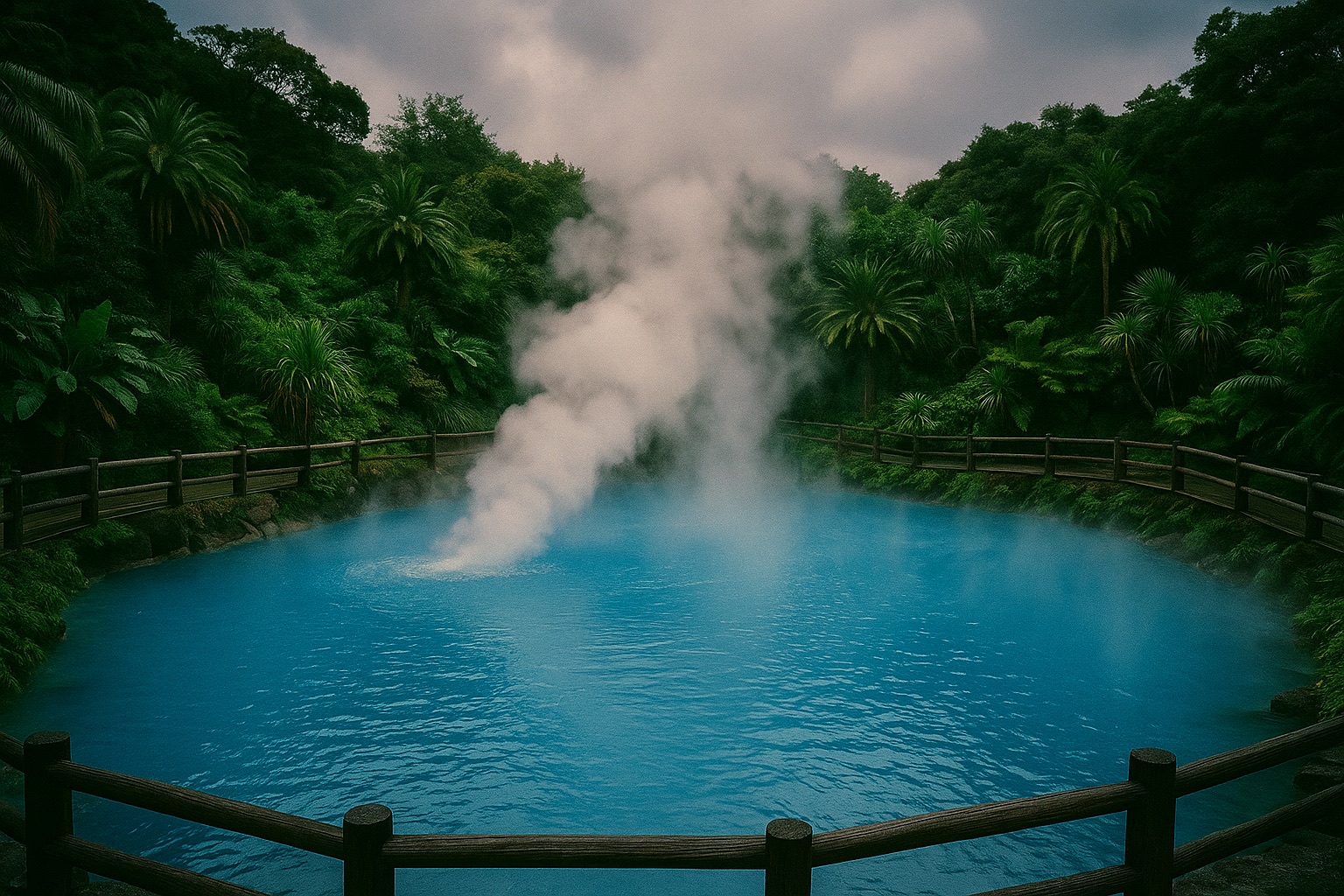
Umi Jigoku (海地獄) — Sea Hell
A vast boiling pool of supernatural cobalt blue — the color comes from dissolved iron sulfate. Surrounded by a landscaped garden with tropical plants fed by the heat. This is Beppu's defining image, and it earns the status. Visit this one.
Entry: ¥450 / Hot spring eggs and steamed sweet potato sold at the stall inside
Chinoike Jigoku (血の池地獄) — Blood Pond Hell
Deep red from dissolved iron oxide — a vivid, disturbing color that looks impossible until you're standing in front of it. The contrast to Umi Jigoku (blue) makes visiting both the natural pairing. These two together cover what you actually need from the hells experience.
Entry: ¥450 / Located about 10 minutes by bus from Umi Jigoku
The Ticket Decision — What Locals Actually Think
The 7-hell combined ticket costs ¥2,400 and is frequently described as “good value.” Do the math: if you only visit the two worth seeing, you pay ¥900 total for individual tickets — saving ¥1,500 and two to three hours.
- →Buy individual tickets (¥450/hell) if you're visiting 1–4 hells. Total: ¥900 for the two recommended.
- →Buy the combined pass (¥2,400) only if you genuinely want to spend a full day systematically visiting all seven. Some people do — it's a legitimate approach. Most regret it.
The ones you can skip (and why)
- •Tatsumaki Jigoku (Tornado Hell): A geyser that erupts every 30–40 minutes. Unless your timing is perfect, you wait. Not worth scheduling around.
- •Shiraike, Yama, Oniyama, Kamado: Each has a character, but individually they don't add significant new information after you've seen blue and red pools. Fine if you have the pass already; not worth buying for.
The Best Onsen in Beppu — By Type and Budget
✦ AI-generated illustration — not a photograph of the actual site
Municipal & Low-Cost Baths (¥100–300) — The Local Choice
竹瓦温泉 Takegawara Onsen
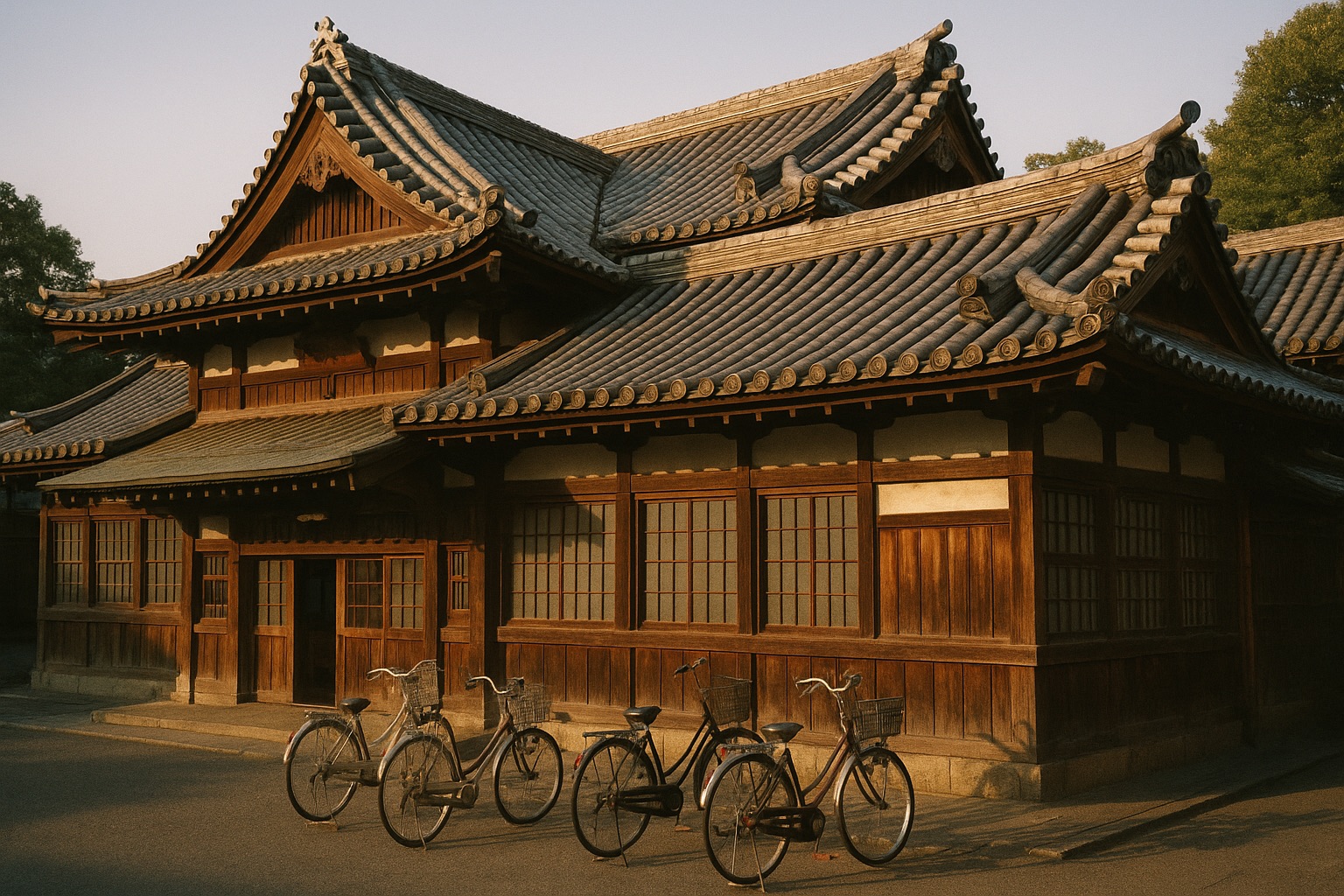
The original bathhouse, built in 1879. The current building dates from the Taisho era — heavy timber architecture with distinctive curved roof tiles that appears in every photograph of Beppu. Inside: a simple, clean bath in a wooden interior that feels unchanged for a century.
The sand bath (sunanyu) is the other offering — you lie in a wooden trough while an attendant buries you in warm black sand heated by the geothermal water below. It is not glamorous. It is genuinely good.
Ordinary bath
¥100
Sand bath
¥1,500
Hours
6:30–22:30
Closed
3rd Wed/month
Best time: 6:30–8:00am (fewest visitors, freshest water). Sand bath: walk-in only, queue early when busy.
堀田温泉 Horita Onsen
15 minutes from Beppu Station by bus. The district has multiple small municipal baths at ¥200–300. Foreign tourists: essentially zero. Local regulars: constant. If you want to understand what Beppu's hot spring culture means to the people who live here — not as tourism but as daily life — Horita is the answer.
Entry: ¥200–300 / No English / Bring your own towel and toiletries
明礬地区 Myoban Community Baths
The community baths in Myoban district use the district's signature sulfur spring water — one of the strongest and most skin-beneficial of Beppu's water types. Walk through the yunohana koya (sulfur crystal huts) first, then find a community bath to soak in. The skin-softening effect of the Myoban water is noticeably different from the central district baths.
Entry: ¥200–400 / Sulfur smell will stay on clothing — wear something you don't mind
Mid-Range Facilities (¥500–1,500)
ひょうたん温泉 Hyotan Onsen
Michelin ★★★Japan's only Michelin three-star hot spring facility. The Michelin designation applies to the facility as a whole: multiple outdoor baths, indoor baths, a waterfall bath, sand bath, family private baths, a steam sauna, and a restaurant that serves geothermal-cooked food. It earns the rating through comprehensiveness and consistent quality rather than exclusivity — the entry price is ¥780.
Adult entry
¥780
Hours
9:00–1:00am
English
Available
Tattoo
Contact first
Restaurant
Yes
Parking
Free
鉄輪むし湯 Kannawa Mushi-yu (Steam Bath)
A form of bathing that has been practiced in Kannawa since the 13th century: you enter a low stone chamber, lie on a bed of sekisho (a medicinal herb), and breathe hot geothermal steam for 10 minutes. It is genuinely unlike anything else. The chamber entrance is barely large enough to crawl through; the interior is dark and intensely humid. Highly recommended.
Entry: ¥700 / Duration: 10 minutes / Hours: 6:30–20:00 (closed Thu) / Located in the heart of Kannawa district
Special Experiences (¥1,400–)
別府温泉保養ランド Beppu Onsen Hoyoland (Mud Bath)
Japan's most famous mud bath. The experience: you enter an outdoor pool of naturally occurring hot spring mud and submerge yourself to the shoulders. The mud is warm, opaque, and strangely comfortable. The therapeutic reputation is well-established among regular visitors. This is, to my knowledge, the only naturally occurring public mud bath of this scale in Japan.
Entry: ¥1,400 / Outdoor mud pool + conventional indoor baths / Bring old swimwear or rent towel sets
SHONIN PARK (Opened 2025)
Opened in summer 2025 on the Beppu Bay waterfront. A mixed-use facility combining hot spring baths, terrace dining, accommodation, and retail in a contemporary architectural setting. Positioned as Beppu's first “new generation” onsen facility — the aesthetic is modern rather than traditional, targeting a younger Japanese and international audience.
Check current pricing and hours — as of mid-2026 the facility is still in its opening phase. Tattoo policy: more permissive than traditional facilities.
The Tattoo Question — The Honest Answer
The standard answer — “tattoos are banned in Japanese onsen” — is an oversimplification that isn't accurate as a blanket statement, particularly in Beppu, which has the highest concentration of foreign visitors among Kyushu's onsen cities and has made specific institutional steps to address this.
Category 1: No tattoos (strict)
Large hotel public baths and some older municipal facilities. The traditional prohibition is enforced, usually with signage at the entrance. Do not enter these if visibly tattooed.
Category 2: Tolerated (grey zone)
Many smaller community baths, particularly in regional districts, apply the rule inconsistently for foreign visitors. This is a legal grey zone — the facility has the right to refuse entry but may not exercise it. Do not rely on this category. It creates awkward situations for everyone.
Category 3: Tattoo-friendly (confirmed)
In 2025, the Beppu Tourism Association published a tattoo-friendly facility map identifying specific baths that accept tattooed visitors. This exists. It is findable. Use it. SHONIN PARK is among the more permissive newer facilities. Kashikiri-buro (貸切風呂 — private rental baths) are available at many ryokan and mid-range facilities for ¥1,000–3,000 per hour and are the simplest solution for anyone wanting a private soak.
Practical approach for tattooed visitors
- 1.Check the Beppu Tourism Association's tattoo-friendly map before visiting (search “Beppu tattoo friendly onsen map 2025”).
- 2.Book a kashikiri-buro (private bath) at your accommodation. This requires zero negotiation and guarantees a private soak.
- 3.Contact Hyotan Onsen in advance — they have been known to accommodate tattooed visitors in specific situations.
Jigoku Mushi — Eating in Beppu
✦ AI-generated illustration — not a photograph of the actual site
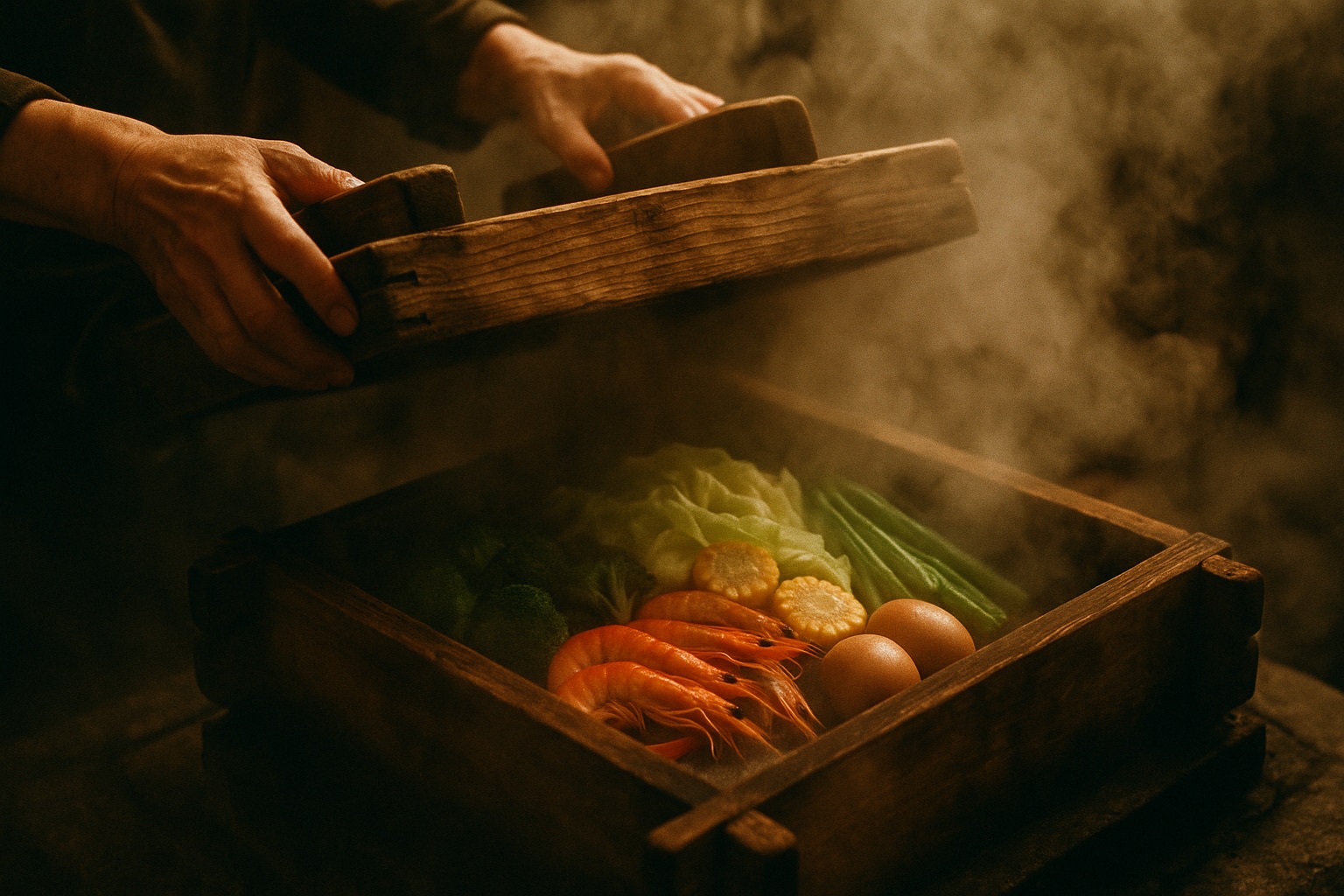
Beppu has a food culture that exists nowhere else in Japan: jigoku mushi (地獄蒸し) — cooking with geothermal steam. The same water that fills the baths and creates the hells also rises as steam through cooking chambers, and Beppu has built an entire culinary tradition around the fact that its earth functions as a natural pressure cooker.
地獄蒸し工房 鉄輪 — Jigoku Mushi Kobo Kannawa
The most famous jigoku mushi facility — a public cooking workshop where you select ingredients from the market stall (vegetables, shrimp, chicken, eggs, pork buns, even pudding) and cook them yourself in a dedicated steam pot fed by the geothermal vents below. The steam temperature is consistent, the timing is straightforward, and the results are better than you expect: the steam-cooking concentrates natural flavors without adding fat or liquid.
Facility entry
¥540
Ingredients
¥500–1,000
Hours
10:00–21:00
Closed
3rd Wed/month
English
Available
Location
Kannawa district
This is the single most distinctively Beppu experience available to visitors. Prioritize it.
別府冷麺 — Beppu Cold Noodles
One of Japan's Three Great Cold Noodles — alongside Morioka in Iwate and Hakodate in Hokkaido. Beppu cold noodles use a thick, chewy noodle (more elastic than Korean naengmyeon) in a spiced broth, served cold. The dish originated from Korean cuisine brought by post-war migrants and has been part of Beppu's food culture for decades. It remains largely unknown to visitors who focus on the onsen.
Best places: Rokusei (六盛) and Toyoken (東洋軒) — both are local institutions with decades of history. Neither is on the tourist circuit. Both require you to seek them out.
温泉プリン・温泉たまご — Hot Spring Pudding & Eggs
Geothermal-steamed pudding (¥250–400) is sold at multiple points around the hells and at souvenir shops throughout Beppu. The texture is slightly firmer than a conventional steamed custard, with a cleaner dairy flavor. Hot spring eggs (onsen tamago — cooked slowly in lower-temperature spring water to achieve a custard-like yolk) are sold at the hells themselves. Both are worth eating once; the pudding makes a reasonable souvenir.
Getting to Beppu
| From | Method | Time | Cost |
|---|---|---|---|
| Hakata (Fukuoka) | Sonic limited express | ~2 hrs | ¥6,500+ |
| Hakata | Shinkansen to Kokura → Sonic | ~1.5 hrs | ¥4,000+ (JR Pass valid) |
| Hakata | Highway bus | ~2 hrs 40 min | ¥3,250 |
| Osaka | Ferry (Sunflower) | Overnight (arr. 6am) | ¥8,800+ |
| Oita City | JR Nippo Line | ~20 min | ¥350 |
The Hidden Option: Osaka–Beppu by Ferry
The Sunflower Ferry from Osaka Nanko Port arrives in Beppu at approximately 6am the next morning. The detail that makes this interesting: the ferry has an onsen on board. You bathe while crossing the Seto Inland Sea at night, sleep, and arrive in Japan's hot spring capital at dawn — at which point you can walk directly to Takegawara Onsen for the 6:30am opening. This is an unusual way to arrive anywhere. It is worth considering.
For a complete breakdown of getting from Fukuoka to Beppu: see our Fukuoka to Beppu transport guide.
How to Plan Your Beppu Day
Half-Day (5–6 hours)
Full Day (8–10 hours)
1 Night, 2 Days — The Right Way to Do Beppu
Day 1
→ Afternoon arrival, check in
→ Evening: Myoban district walk + community bath
→ Night: Beppu cold noodles + Kannawa bar
→ Ryokan indoor/outdoor bath before bed
Day 2
→ 6:30am: Takegawara Onsen (empty, fresh water)
→ Breakfast: hot spring eggs + convenience store
→ Two hells + Jigoku Mushi Kobo lunch
→ Hyotan Onsen (Michelin ★★★)
→ Depart with hot spring pudding souvenir
Practical Tips from Someone Who Goes Regularly
🌅 Early morning is best
6:30–9:00am: fewest visitors, freshest water replenished overnight. The atmosphere at Takegawara at 6:45am is something genuinely different from the midday version.
🧺 Small towel only
The standard onsen rule: bring a small hand towel (tenugui) — you fold it to wash with and can place it on your head while soaking. Large bath towels are not taken into the water area.
💴 Cash is essential
Municipal baths are cash-only universally. Some community baths don't accept anything else. Carry ¥3,000–5,000 in coins and small bills specifically for this.
🧴 Bring toiletries to cheap baths
¥100–300 municipal baths often do not provide soap or shampoo. The mid-range facilities (Hyotan, etc.) do. Check before you go.
💧 Hydrate after every bath
Hot spring bathing is dehydrating, particularly in sulfur springs. Stop at any convenience store for water or sports drink after each soak.
👕 Dress for sulfur
The Myoban and Kannawa districts leave a sulfur smell on clothing. Wear something you don't mind — or plan to wash that evening. Synthetic fabrics hold the smell more than cotton.
📅 Hell timing on weekends
Umi Jigoku and Chinoike open at 8:00am. Arrive at or just before opening on weekends — by 10am the major hells have queues. An hour at opening is significantly better than 90 minutes at midday.
🤿 Private baths for groups or tattoos
Kashikiri-buro (private bath rooms) at ¥1,000–3,000/hour accommodate 2–3 people, guarantee privacy, and sidestep the tattoo question entirely. Book at your accommodation the morning of your visit.
“Beppu is Japan's most honest hot spring city. The luxury spa and the ¥110 municipal bath are filled from the same ground, by the same geological forces. Whichever you choose, you're soaking in water that has been rising through the earth since before the building above it existed. That is the same in a ¥15,000 ryokan and in a neighborhood bath where the old man next to you has been coming every morning for forty years. The water doesn't know the difference.”
Plan Your Beppu Visit
Written by
A Local in Oita, Japan
A Japanese local born and raised in Oita, Kyushu. Sharing the Japan that guidebooks miss — from someone who actually lives here.
About this site →Related Articles
JR Kyushu Rail Pass: Is It Worth It? A Local's Honest Guide
A local breaks down the JR Kyushu Rail Pass — the 3, 5, and 7-day options, what's covered, real price math for popular routes, how to buy and use it, and the honest answer to whether it's worth it for your trip.
Best Time to Visit Kyushu: A Month-by-Month Season Guide
When should you visit Kyushu? A local walks you through the seasons month by month — cherry blossoms, the rainy season, summer heat, golden autumn, and mild onsen winters — so you pick the right time for your trip.
Driving in Kyushu: Renting a Car & the Best Road Trips
Should you rent a car in Kyushu? A local explains the license you need, what driving here is really like, costs and tolls, where a car beats the train — and the island's most beautiful road trips.