Solo Travel in KyushuWhy Japan's Best Island Is Even Better Alone
Written by a local in Oita · June 2026 · 18 min read
Every Japan solo travel guide tells you the same things: Japan is safe. The trains are on time. People are helpful. All true. And all completely useless as a reason to choose Kyushu over Tokyo or Kyoto.
✦ AI-generated illustration — not a photograph of the actual site
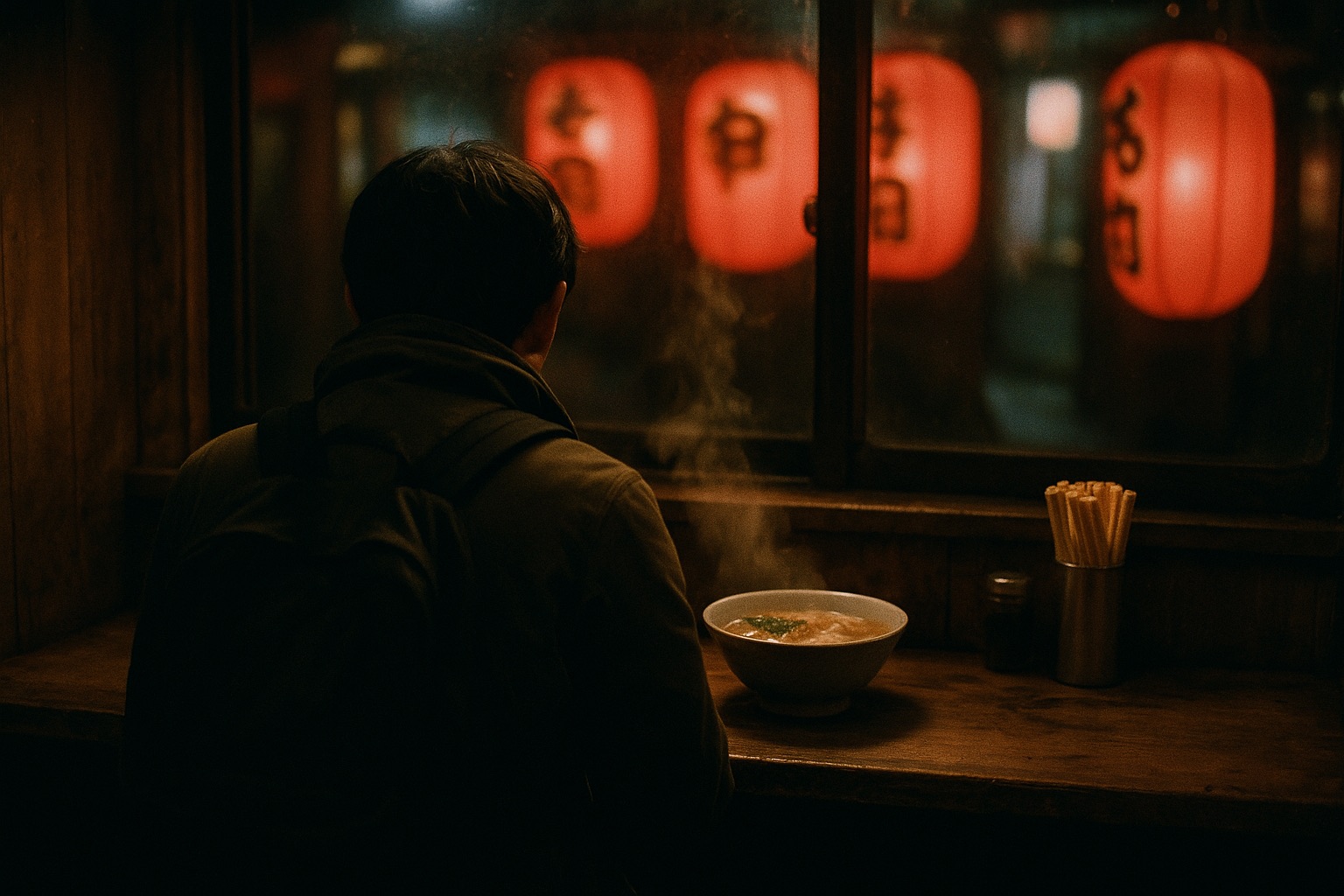
Here's the actual reason to choose Kyushu: traveling alone here doesn't just feel safe — it feels intentional. The food culture was built for it. The onsen culture was built for it. The unhurried pace of the cities was built for it.
This guide is written by someone who lives here. Not as a statistical summary of why Japan ranks well on safety indices, but as a practical account of what solo travel in Kyushu actually looks and feels like — the early morning fish markets, the counter seats where you end up talking to a taxi driver, the outdoor baths you have entirely to yourself at dawn. That is what this guide is about.
In this article
- 1Why Kyushu Is Better for Solo Travel Than Tokyo or Kyoto
- 2Safety in Kyushu — The Honest Version
- 3The Solo Traveler's Kyushu — Day by Day
- 4Eating Alone in Kyushu — The Solo Diner's Paradise
- 5Accommodation for Solo Travelers
- 6Getting Around Kyushu Solo
- 7The Best Solo Experiences — Things Groups Can't Do
- 8Practical Info — Budget, SIM, Insurance
Why Kyushu Is Better for Solo Travel Than Tokyo or Kyoto
The Crowds Problem
Solo travel has one consistent enemy: crowds. In Tokyo's Senso-ji or Kyoto's Fushimi Inari, you're not exploring — you're flowing with a current of other tourists. The path is determined for you. There's no room for the spontaneous detour, no chance encounter with something nobody else stopped to notice.
In Kyushu, the equivalent experiences — Kurokawa Onsen, Takachiho Gorge, the castle towns of Hita and Usuki — are genuinely quieter. You can actually stop. A solo traveler's greatest advantage is the ability to change plans in real time; Kyushu gives you the space to use it.
The Paradox of Less English
English is less widely spoken in Kyushu's regional cities — Oita, Miyazaki, Saga — than in Tokyo. Most guidebooks present this as a disadvantage. I'd argue the opposite, at least for solo travelers.
In tourist-facing Tokyo, your interactions are often conducted through a practiced service script. In a Beppu market or a Nagasaki shotengai, your attempt to communicate — a phone screen held up, a gesture, a laughed-at mistake — becomes a genuine exchange. The absence of a smooth English interface forces a realness that most visitors to Japan never get. Solo travelers have lower friction than groups for these encounters: one person curious and attentive is more approachable than five.
The Counter-Seat Food Culture
Kyushu's food culture is fundamentally a counter culture. The original Hakata ramen shops — the ones built for dock workers, truck drivers, and night-shift laborers — were designed around a single long counter. One person, one bowl, five minutes. No table pressure, no minimum spend, no social equation to solve.
Yatai (open-air stalls) operate the same way: one seat becomes available, you take it. The person next to you may be a construction worker, an office employee having their second dinner, or a tourist from Osaka. None of this requires a group to manage. Solo travelers can move through Fukuoka's food landscape faster, cheaper, and more freely than anyone traveling with others.
The Onsen Is Meant for One
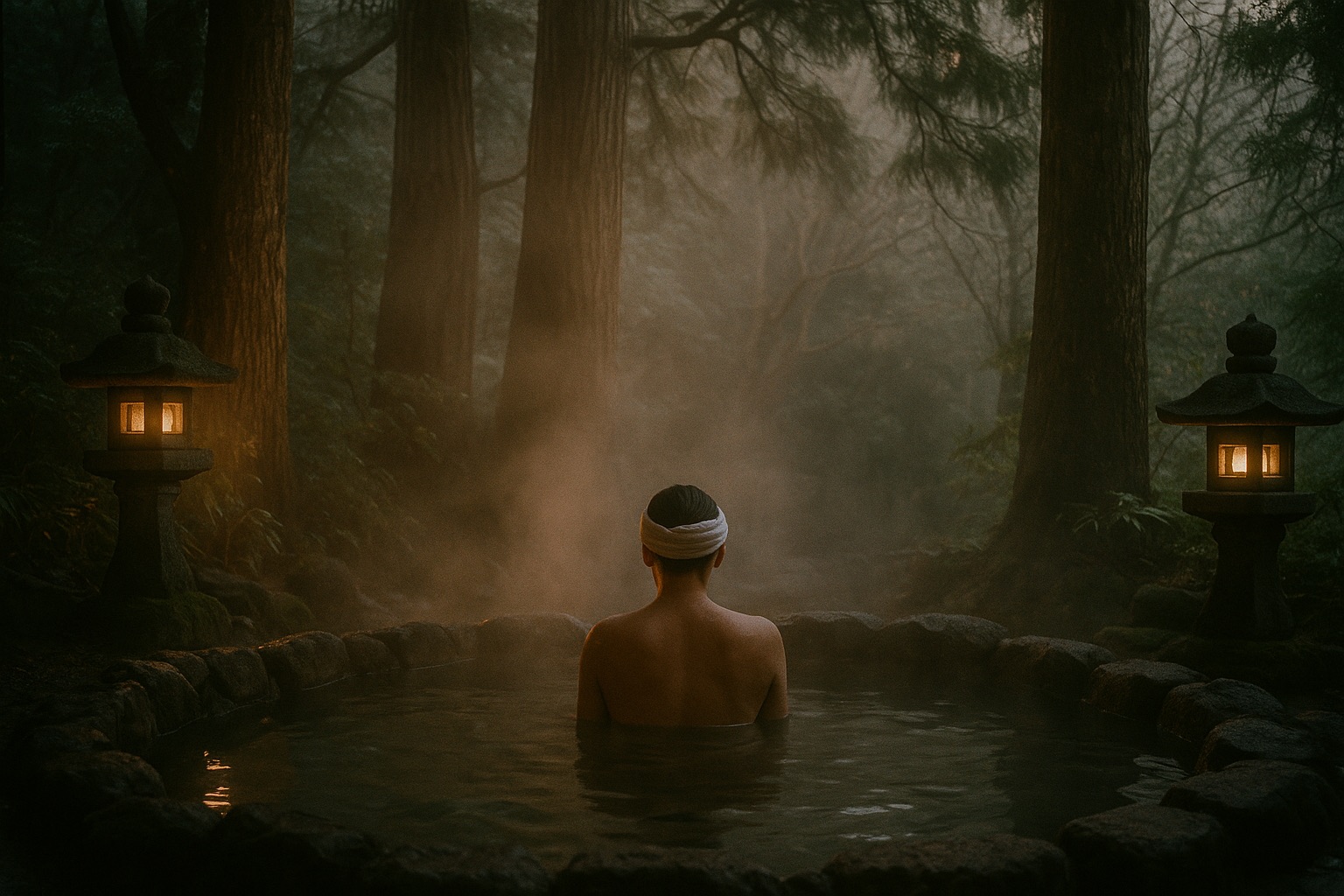
Japanese onsen culture is, at its core, a solo activity. You enter the water alone with your thoughts. The social dynamic of a group — who goes in first, who's ready to leave — doesn't exist. In a morning outdoor bath with no one else present, which is entirely possible in Kyushu's smaller onsen towns, you can sit in near-silence for as long as you want. Steam, the sound of water, the shape of the cedar trees in early light. That is the actual thing. Groups very rarely get it.
Safety in Kyushu — The Honest Version
Not statistics — what it actually feels like to be here alone
Japan ranked among the world's safest countries in the Global Peace Index 2025 (score: 1.440). That's accurate. But numbers don't convey what that safety actually means on the ground, which is this: in Kyushu, there is almost no moment where you need to be alert in the way that solo travel in many other destinations requires. You don't scan the street. You don't hold your bag differently. You walk into a convenience store at 3am without thinking about it.
Structural Safety — Why It Works
- •Convenience stores are everywhere. Every neighborhood in Kyushu has at least one 24-hour combini. They function as rest points, landmarks, and emergency resources. You are never far from one.
- •Kōban (police boxes) are positioned throughout commercial areas. They are staffed and approachable. If you are lost or uncomfortable, they are the right place to go.
- •Taxis are metered and honest. There is no negotiation, no detour for a higher fare. Hail one, ride to your destination, pay what the meter says.
For Solo Female Travelers — A Local Perspective
The numbers that say Japan is safe for women are consistent with lived experience here. A few specifics worth knowing:
- •Women-only train carriages exist on most major lines during rush hours. They are clearly marked (pink signs) and staff will direct you if you're unsure.
- •Walking alone at night in Fukuoka's Tenjin and Nakasu areas — even at midnight — is not unusual and does not attract attention.
- •Onsen facilities have separate baths for women and men. The women's side is private, well-maintained, and safe.
- •The izakaya dynamic: a solo woman eating or drinking at a counter is not uncommon and will not generate the kind of unwanted attention it might elsewhere. Japanese social culture strongly disfavors approaching strangers uninvited.
The Honest Caveats
- •English signage is limited in regional cities. Download Google Translate's offline Japanese language pack before you arrive — the camera translation function is genuinely transformative.
- •Typhoon season (August–September) can close trains, buses, and ferries for 12–48 hours at a time. Build flexibility into plans made during this window.
- •Many restaurants and shops are cash-only, particularly markets, public baths, and yatai. Keep ¥10,000–20,000 in cash accessible at all times.
The Solo Traveler's Kyushu — Day by Day
A 5-day route optimized for one person
Fukuoka — The City That Was Built for Solo Eating
Arrive, settle, eat three times
Dazaifu & Karatsu — History at Your Own Pace
Ancient shrine at dawn, coastal castle by noon
Nagasaki — History You Need to Sit With
The city where going alone is the right choice
Kurokawa Onsen — The Nothing Day
The best solo travel day on this list
Beppu — The Onsen Capital, Properly
Local baths, not tourist baths
For a longer trip, see our full 7-day Kyushu itinerary.
✦ AI-generated illustration — not a photograph of the actual site
Eating Alone in Kyushu — The Solo Diner's Paradise
Why the counter-seat culture makes Kyushu the best solo food destination in Japan
The idea of eating alone as an awkward or sad experience is a cultural assumption, not a universal truth. In Kyushu, it's simply what a large portion of people do at lunch and late at night. The counter seat — one person facing a chef or a wall, a bowl in front of them — is not a consolation prize for the solo diner. It's the intended configuration.
🍜 Counter Ramen — The Foundation
Hakata ramen was designed for one person. The original stalls were built around a single counter for dock workers eating a fast meal at 2am. That DNA remains in every serious ramen shop in Fukuoka today.
Ganso Nagahamaya (元祖長浜屋)
¥500 · 24 hours · counter only · no English needed — point at the poster. The most purely local ramen experience in Fukuoka. The taxi drivers and market workers eating at 3am next to you are not performing authenticity for anyone. See our full Fukuoka ramen guide.
Hakata Ramen ShinShin (博多らーめんShinShin)
¥850 · English-friendly · good first shop for visitors who want a slightly more guided experience before going full local.
Ordering tip: “barikata” (barely firm noodles) is how locals do it. Say it to the counter and you will probably get a nod.
🏮 Yatai — The Best Solo Seat in Japan
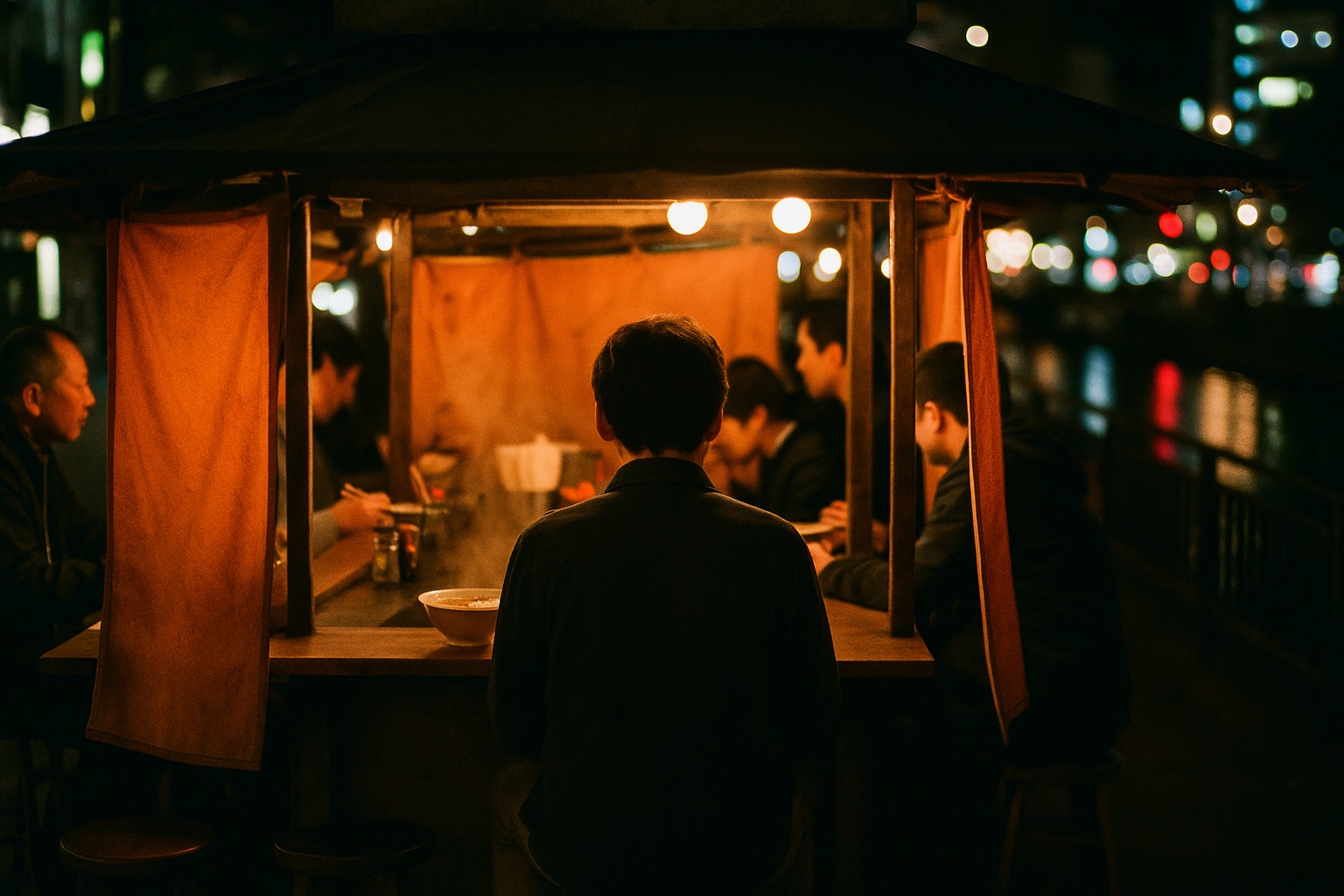
Fukuoka's yatai (open-air food stalls) are not tourist infrastructure. They are the city's actual late-night eating culture, compressed into canvas-walled counters on the banks of the Naka River. There are roughly 130 of them.
For a solo traveler, they are almost the ideal dining environment: you sit down at whatever single seat is available, order yakitori and a drink, and are immediately surrounded by people having the same meal at the same counter. Whether you talk to anyone is entirely up to you. Nobody is watching. Often, the person next to you is also alone.
How to find one and what to order
- • Walk along the Naka River (Nakagawa) between Tenjin and Nakasu from around 6pm
- • Look for canvas walls, lantern light, and a stool with a gap — sit down
- • Standard order: shochu highball + yakitori assortment + ramen to finish
- • Budget: ¥2,000–3,500 per person, drinks included
🍣 Sushi Counter — Better Alone Than in a Group
A sushi counter is one of the few dining experiences that is genuinely superior when you're alone. You sit directly in front of the chef. You eat at your own pace. The chef can speak to you individually — explain the fish, ask what you're enjoying, suggest the next piece. In a group of four, that conversation becomes impossible; the chef is feeding an order, not having an experience with you.
See our Fukuoka sushi guide for specific counter recommendations that accept single reservations.
🍲 Motsunabe — One Important Note
Motsunabe (offal hot pot) is Fukuoka's other great dish. Most shops have counter seating and no problem serving one person. The caveat: many require a minimum order of two portions (ichi-nin-mae). Call ahead or check the shop's website if you want to be sure. Rakutenchi has counter seats and is comfortable for solo diners. See our counter-seat motsunabe options.
✦ AI-generated illustration — not a photograph of the actual site
Accommodation for Solo Travelers in Kyushu
Capsule Hotels
Private sleeping pod, shared lounge and facilities. Good balance of quiet and social. Newer designs (THE MILLENNIALS Fukuoka, Book and Bed Tokyo Fukuoka) are considerably more comfortable than the old-style capsules.
Price: ¥3,000–5,000/night
Guesthouses & Hostels
Good options in Nagasaki, Kumamoto, and Beppu specifically. The shared kitchen model means you will encounter other solo travelers naturally. Dorm beds available, private rooms often bookable for ¥5,000–8,000.
Dorm: ¥2,500–4,000 / Private: ¥5,000–8,000
Business Hotels
Toyoko Inn and Comfort Hotels are the reliable choice. Single rooms are designed for one person and are not a downgrade — they're the intended product. Always clean, consistent, and without the single-occupancy surcharge common in other countries.
Single: ¥6,000–10,000/night
Ryokan Solo Plans
Increasingly, onsen ryokan — including some in Kurokawa — offer single-person plans. These were rare a decade ago; they are much more common now. A ryokan night alone, with a full kaiseki dinner and private bath access, is one of the better Kyushu experiences for a solo traveler willing to spend.
¥15,000–30,000/night (2 meals included)
Getting Around Kyushu Solo — Practical Tips
🚅 Rail Passes — The Solo Advantage
One of the genuine advantages of solo travel in Japan is that a rail pass costs you exactly one pass. No per-head calculations, no group coordination.
| Pass | Coverage | Price | Best for |
|---|---|---|---|
| Northern Kyushu 3-Day | Fukuoka, Saga, Nagasaki, Oita | ¥10,000 | This itinerary |
| All Kyushu 5-Day | All 7 prefectures | ¥15,000 | Kumamoto + Kagoshima added |
📱 Apps Worth Having Before You Land
Google Maps (offline)
Download the Japan map cache before you fly. Works without data.
Google Translate (camera)
Point your camera at any menu, sign, or poster — live translation. Essential.
Hyperdia
Train schedules and connections. More detailed than Google for rural routes.
Tablecheck / Tableall
Restaurant reservations in English. Use to book sushi counters that accept solo reservations.
💴 Cash — More Important Here Than Most of Japan
Kyushu's markets, yatai, public baths, and many small restaurants operate on cash only. This is more true in Kyushu than in Tokyo, where contactless payment has wider penetration.
- →Seven Bank ATMs (inside 7-Eleven stores) accept international cards. Withdraw in one go — limit is approximately ¥50,000 per transaction.
- →Keep ¥10,000–20,000 in notes accessible. Not in a bag that takes 30 seconds to dig into — somewhere reachable.
The Best Solo Experiences in Kyushu — Things Groups Can't Do
The actual reason solo travel is superior here
Early Morning at Karato Market, Shimonoseki (Weekend)
The wholesale section opens before dawn for professional buyers. Arrive before 9:30am when “Ikiiki Bakanai” (the retail section) opens and you'll find yourself walking the aisles with fishermen and restaurant buyers selecting their stock for the week. A solo traveler can move at whatever speed they want — stop to watch a transaction, ask questions (gestures work), taste what's offered. A group of five people is a disruption in that environment; one person is just another customer. See our Karato Market guide.
6am at Kurokawa — The Empty Outdoor Bath
Set an alarm. The early morning outdoor baths at Kurokawa (6–7am) are often empty or hold one other person. Steam rising in the cold air. Cedar trees. The sound of water and birds. No schedule, no one waiting for you to be finished. This is the experience the photographers try to manufacture — except here it actually exists, and you get to it by waking up early and being by yourself. Our Kurokawa onsen guide covers which baths are most likely to be empty at dawn.
Reigando Cave, Kumamoto — Thirty Minutes Alone
In 1643, the swordsman Miyamoto Musashi retreated to a cave on Mt. Iwato in Kumamoto and spent the remaining two years of his life writing The Book of Five Rings. The cave — Reigando (霊巌洞) — is accessible and free. Tourist traffic is light. Sit inside for ten minutes with no agenda and no group obligations and you can understand, at least approximately, why he chose this particular place. There is a quality of silence here that is not staged. It's part of our Kyushu castles and historical sites series.
Midnight at Ganso Nagahamaya
¥500 tonkotsu ramen at 1am. Counter seats. The man next to you might be a fisherman, a taxi driver between fares, or an office worker missing the last train. Nobody is performing Fukuoka for you. This is the actual city, at the hour when it's most itself. No group logistics required — you just walk in, sit down, and eat. See our full Fukuoka ramen guide.
Beppu's ¥110–300 City Baths
Beppu has close to 100 public baths. Many cost between ¥110 and ¥300 and serve the neighborhood — the same retirees and fishing-shift workers come every morning. Showing up alone with a towel is exactly the right way to use them. Showing up in a group of six foreigners is conspicuous in a way that changes the atmosphere. Solo travelers fit into neighborhood baths in a way groups cannot. Read how to use them in our guide to using a public onsen.
Practical Info — Budget, SIM, Insurance
Daily Budget Guide
| Category | Budget | Mid-range | Comfort |
|---|---|---|---|
| Accommodation | ¥3,000 (guesthouse dorm) | ¥8,000 (business hotel) | ¥20,000 (ryokan) |
| Food | ¥2,000 (combini + ramen) | ¥4,000 | ¥8,000 |
| Transport | ¥1,000 | ¥2,000 | ¥4,000 |
| Activities | ¥500 | ¥2,000 | ¥5,000 |
| Total/day | ¥6,500+ | ¥16,000+ | ¥37,000+ |
📶 SIM Card
Purchase an eSIM or prepaid SIM at the airport arrivals hall. IIJmio and Docomo-based plans have the best coverage in Kyushu's mountain and rural areas.
Unlimited data plans from ¥3,000 for 15 days. eSIM can be activated before you land.
🏥 Travel Insurance
Solo travel means solo medical management. If you fall ill or get injured, there is no travel companion to navigate the system for you. Check whether your credit card includes travel insurance — and read what it actually covers before you go.
Japan's hospitals are excellent. The language barrier is the only complication — most hospitals in major cities have some English-speaking staff.
“When you travel alone, every decision is yours. The next train, the detour into that alley, the extra hour in the bath. Kyushu is the place where that freedom has the most to work with — the food culture, the onsen, the pace, the unhurried nature of the cities. Come alone. You'll use more of it.”
Plan Your Kyushu Trip
Written by
A Local in Oita, Japan
A Japanese local born and raised in Oita, Kyushu. Sharing the Japan that guidebooks miss — from someone who actually lives here.
About this site →Related Articles
JR Kyushu Rail Pass: Is It Worth It? A Local's Honest Guide
A local breaks down the JR Kyushu Rail Pass — the 3, 5, and 7-day options, what's covered, real price math for popular routes, how to buy and use it, and the honest answer to whether it's worth it for your trip.
Best Time to Visit Kyushu: A Month-by-Month Season Guide
When should you visit Kyushu? A local walks you through the seasons month by month — cherry blossoms, the rainy season, summer heat, golden autumn, and mild onsen winters — so you pick the right time for your trip.
Driving in Kyushu: Renting a Car & the Best Road Trips
Should you rent a car in Kyushu? A local explains the license you need, what driving here is really like, costs and tolls, where a car beats the train — and the island's most beautiful road trips.