Why Fukuoka Has Better Food Than Almost Anywhere in Japan
In 57 CE, the Han Emperor Guangwu gave a solid gold seal to an envoy from a Japanese kingdom called Na, located in what is now Fukuoka. The seal was discovered in 1784 on Shikanoshima Island, just outside the city, and it is now one of Japan's National Treasures. The inscription reads: "King of Na, Han Vassal." It is the oldest physical evidence of diplomatic contact between Japan and the Asian continent.
I begin with the gold seal because most food guides skip the part that explains everything. Fukuoka's food culture is extraordinary because Fukuoka has been a port for two thousand years. Before Tokyo existed, before Osaka was a city of significance, Hakata Bay was already one of the most active trading harbours in East Asia. Chinese silk, Korean ceramics, continental Buddhist texts — all of it came through here.
In the 13th century, Hakata merchants trading with Song Dynasty China brought back not just goods but techniques. Historians believe the earliest forms of udon and soba noodle making in Japan arrived through Fukuoka's ports, carried by monks who had studied in China and returned through Hakata. The Shōfuku-ji temple — still standing in Hakata today — was founded by the monk Eisai in 1195 upon returning from China, and he also brought tea cultivation to Japan through the same port.
There is a phrase that historians use to describe Hakata's cultural character: hakata wa soto kara kita mono wo jibun no mono ni shite shimau— "Hakata takes things from outside and makes them its own." This is not laziness or appropriation. It is a 2,000-year-old habit of metabolising foreign ideas into something that feels native.
That habit explains every major Fukuoka dish. Hakata ramen: not originally from Fukuoka, but perfected and evangelised from here. Mentaiko: a Korean fermented food brought back by a man who missed the taste of his Busan childhood. Mizutaki hot pot: invented by a man who learned European consommé in Hong Kong. Every great Fukuoka food has a story of absorption and reinvention.
"There is no other city in Japan where the street food and the Michelin three-star restaurants occupy the same neighbourhood. In Fukuoka, a ¥1,000 yatai ramen and a ¥30,000 omakase sushi counter are two minutes apart on foot. That coexistence is not an accident — it is a reflection of what this city has always been."
For more on Fukuoka's history, including the extraordinary story of the female warlord who commanded armies at 12 and the castle that may have inspired Star Wars, see our guide to Fukuoka's castles and warlords.
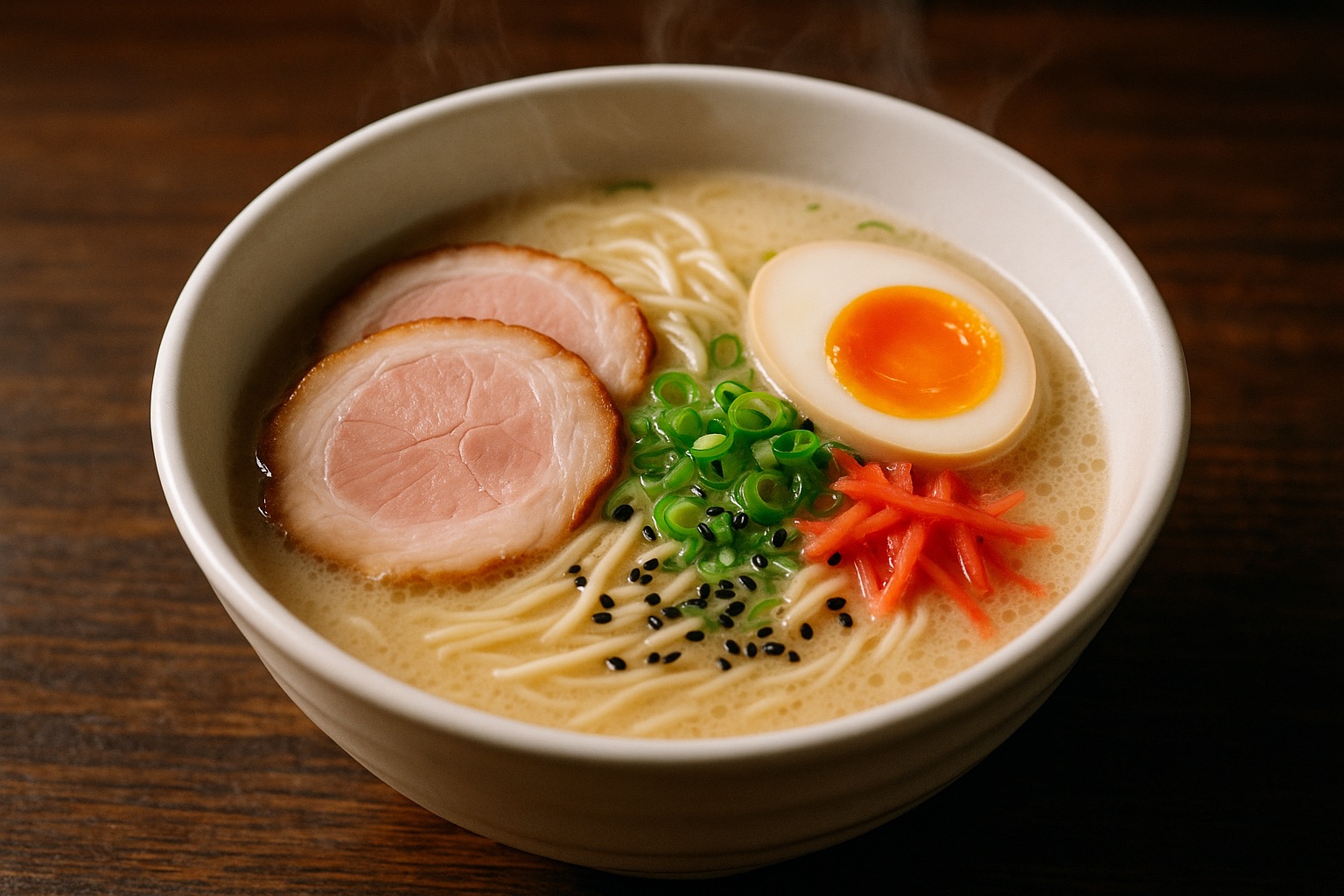
Hakata Ramen — The Accidental Invention That Conquered Japan
✦ AI-generated illustration
Here is something most people don't know: Hakata ramen was not invented in Fukuoka. It was invented in Kurume — a smaller city about 40 kilometres to the south — around 1937. The story goes that a cook named Miyamoto Tokio left his pork bone broth on the heat too long and returned to find it had turned milky white and intensely flavoured. Rather than throw it away, he served it. Customers were fascinated. The thick, opaque, deeply savoury broth — tonkotsu — was something nobody had tasted before.
The style spread northward to Fukuoka after World War II, carried by vendors who set up yatai street stalls in the postwar chaos. In Fukuoka, it underwent further evolution: the broth stayed rich, but the noodles became thinner and straighter — designed to hold less broth so you could eat faster. The bowl got smaller. And then two uniquely Fukuoka innovations appeared that no other ramen city has ever replicated.
The first is the kaedamasystem (替え玉 — "replacement ball"). When you finish your noodles but still have broth left, you order a second serving of noodles for ¥100–200. They arrive as a small compressed sphere that you drop directly into your remaining broth. This exists because Fukuoka ramen evolved in yatai stalls where customers needed to eat quickly — the kaedama system means you never have to choose between wasting broth and ordering a second full bowl.
The second is noodle firmness specification. In most ramen shops you accept the noodles as they come. In Hakata ramen, you specify: futsuu (normal), katame (firm), barikata (very firm), or konaotoshi (powder drop — barely boiled at all, raw flour still on the noodles). Most locals order barikata. First-timers should try katame to start.
How to eat Hakata ramen (the local way)
- Specify your noodle firmness when you order. Locals say barikata (バリカタ).
- On the counter you'll find garlic press, sesame seeds, pickled ginger, and spicy paste. Add them yourself — but carefully. The garlic especially transforms the bowl.
- Use red pickled ginger (beni shoga) sparingly. It's powerful.
- When your noodles are gone, say kaedama hitotsu (替え玉一つ) for a refill.
- There is usually a small timer or button at counters — some shops set the kaedama noodle time by your pace.
One honest note on the famous chains: Ichiran and Ippudo are both Fukuoka-born and both excellent. You will not eat badly at either. But they are not where locals go when they want ramen. Ichiran's individual booths are a clever concept for solo diners, but the ramen is calibrated for a national audience. For the real thing, go to a small counter shop in Nakasu, Tenjin, or the Nagahama area — where ramen culture started. Ask your hotel for their local favourite. That answer will be honest.
The full history and neighbourhood guide to Hakata ramen deserves its own article, which we're writing separately. For now: come hungry, order barikata, and don't skip the kaedama.
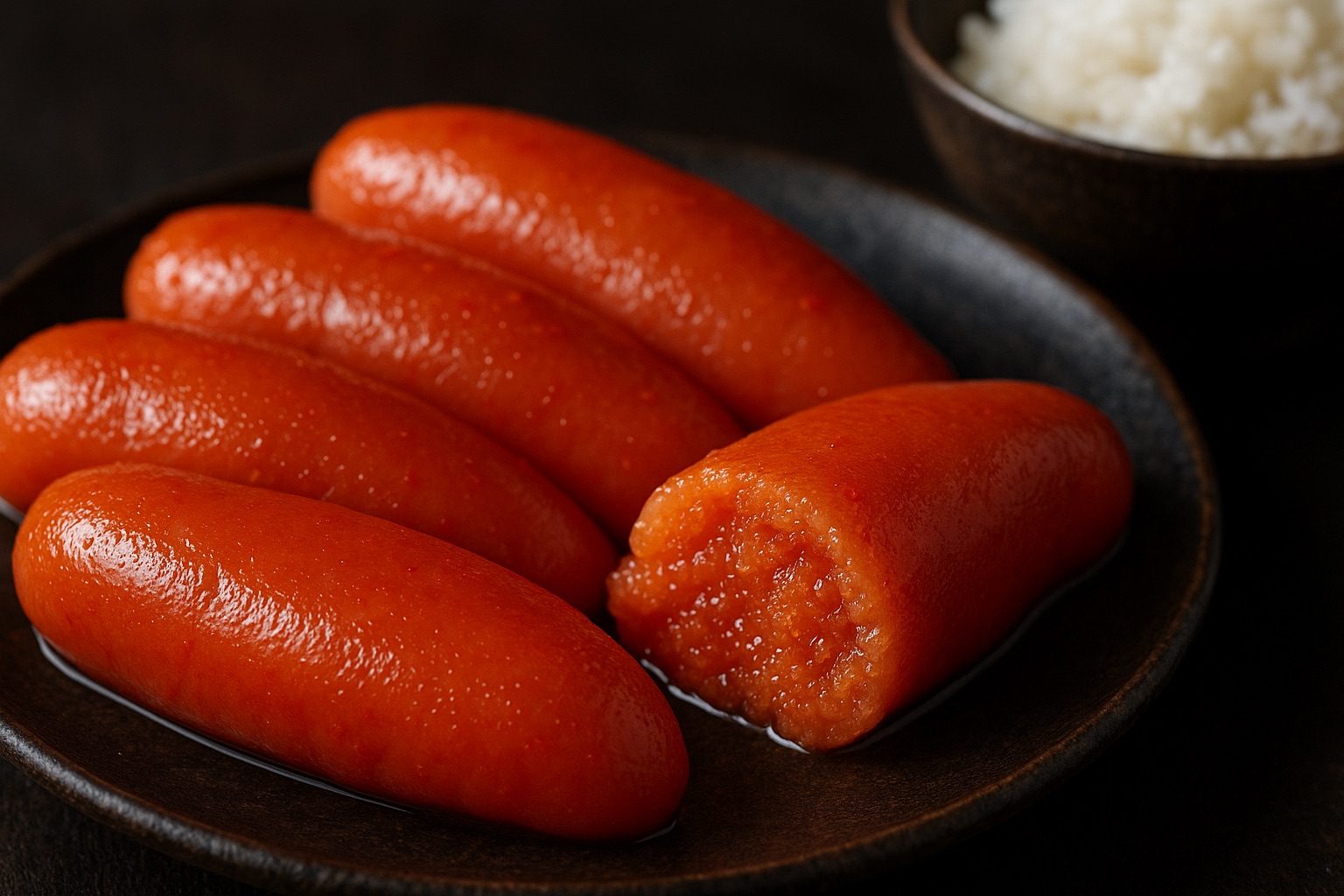
Mentaiko — The Korean Immigrant's Gift to Japanese Food
✦ AI-generated illustration
In 1949, a man named Kawahara Toshio opened a small shop called Fukuya in Hakata. He had grown up in Busan, Korea — then under Japanese colonial rule — and had eaten myeongran jeot(명란젓), a fermented spicy cod roe, all his life. After the war he returned to Japan and couldn't find it anywhere. So he spent years trying to recreate it from memory.
The result — which he eventually perfected after many experiments — was what we now call mentaiko (明太子). The name comes from the Korean word for pollock: myeongtae. It is, in its origins, a Korean immigrant food that became Japan's most beloved condiment.
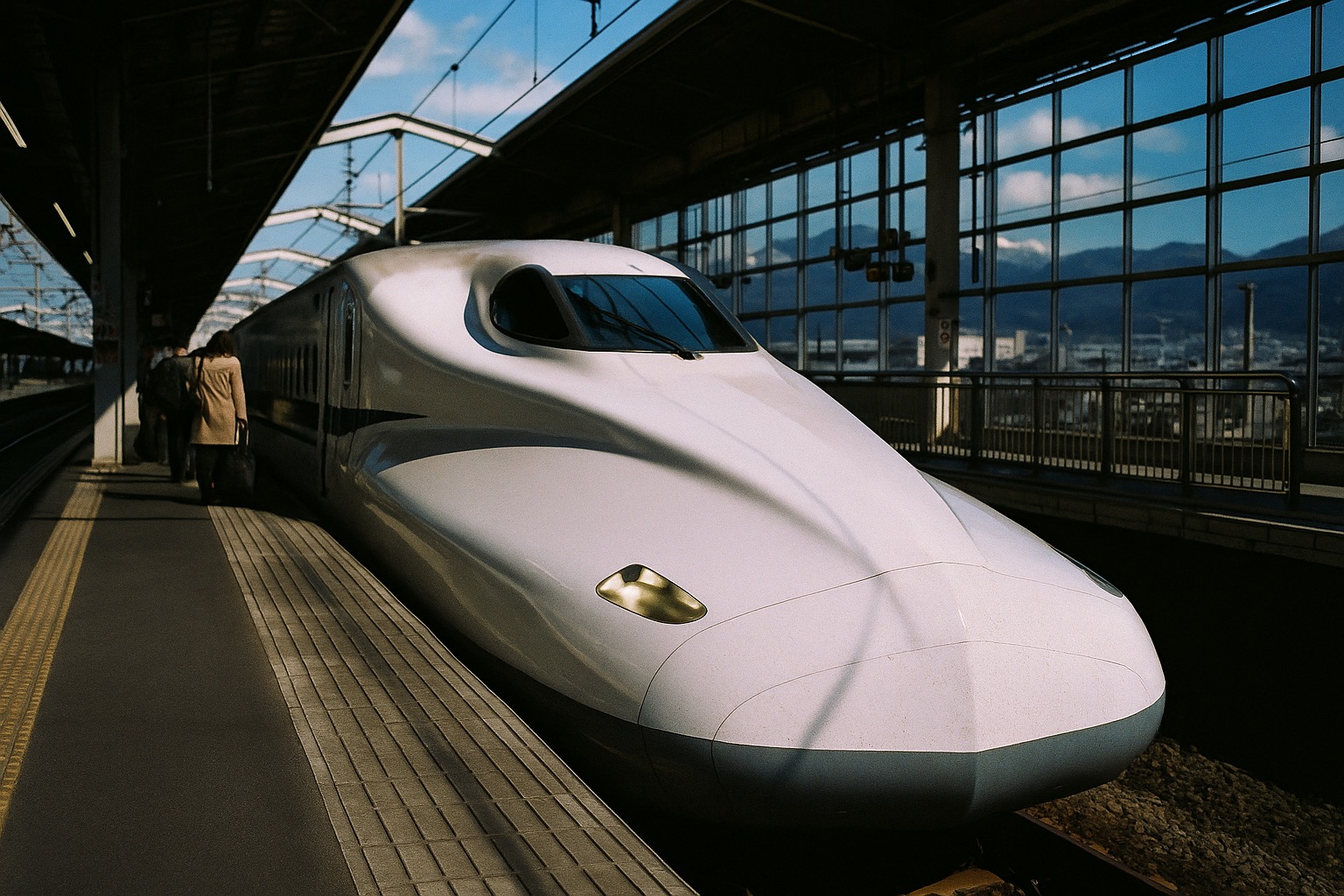
For two decades it remained a regional Fukuoka specialty — something locals ate and tourists brought home from the airport. Then in 1975, the Shinkansen Hakata Station opened. Suddenly, Fukuoka was connected to Tokyo by bullet train. Mentaiko became the ultimate Fukuoka souvenir — compact, highly flavoured, unmistakable. Within a decade it was in supermarkets across Japan. Today it's in pasta sauces, on pizza, folded into baguettes, and available at every konbini. Kawahara Toshio changed Japanese food. He is not as famous as he deserves to be.
Mentaiko vs tarako — what's the difference?
Both are salted cod roe. Tarako (たらこ) is plain salted — pink, mild, slightly sweet. Mentaiko (明太子) is marinated in spicy chilli paste — deeper orange-red in colour, complex, with heat that builds slowly. The Fukuoka version is typically more intensely seasoned than the versions you find elsewhere in Japan.
In Fukuoka, you can buy fresh mentaiko (生めんたいこ) that lasts only a few days — more intense and softer than the vacuum-packed souvenir versions. This is what locals eat. If you're buying to take home, get the properly preserved kind. If you're eating now, ask for nama (生 — fresh).
The five best ways to eat mentaiko, from most traditional to most unexpected:
- On plain white rice. Hot, fresh rice with a whole lobe of mentaiko on top. That's it. This is the default.
- In an onigiri rice ball. The combination of chewy rice and spicy roe in a triangle of nori is one of the perfect foods.
- Mentaiko pasta (明太子パスタ). This exists because of Fukuoka. The combination of Italian pasta technique and Korean-Japanese condiment is one of the great accidental fusions.
- On a French baguette. Several Fukuoka bakeries sell mentaiko-butter baguette as a specialty. The combination of fermented saltiness and crisp bread is excellent.
- Grilled (炙りめんたいこ). Lightly torched, it becomes warmer, slightly caramelised, and deeper in flavour. Order this at izakayas.
For souvenirs: Fukuya (the original shop founded by Kawahara Toshio) still operates in Fukuoka and at Hakata Station. Their product is considered the standard by which others are judged. The station shop is convenient; the original shop, if you have time, is worth the visit for the history alone.
Yatai — Fukuoka's Street Food Stalls and the Culture Behind Them
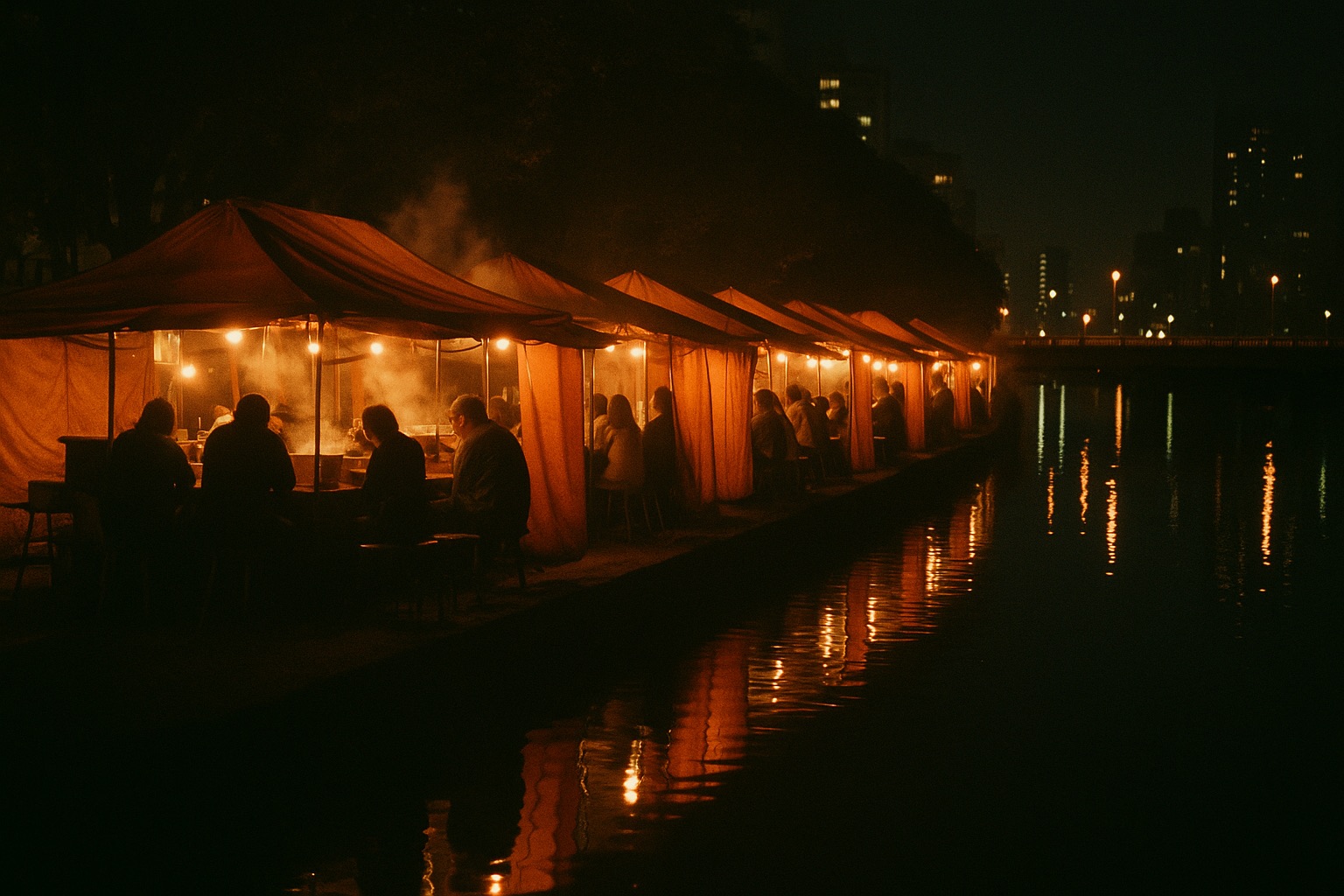
The yatai (屋台) — mobile street food stalls — are Fukuoka's most photographed feature and, for many visitors, the defining memory of a visit. But most people who sit at them don't know the uncomfortable history underneath.
After World War II, Japan was devastated. The black market and street stalls were how millions of people survived. The yatai were part of that underground economy — they were tolerated by postwar necessity, not celebrated as heritage. When Japan recovered and formal food regulation returned, the authorities tried to eliminate them. GHQ-era restrictions, health code crackdowns, and neighbourhood opposition steadily reduced their numbers from a peak of around 400 stalls down to approximately 100 today.
What saved them — and what makes Fukuoka's yatai culture genuinely unique in the world — is that the city eventually decided to preserve rather than eliminate. The permits are now issued by lottery, are strictly limited in number, and are fully heritable (a stall owner can pass their permit to a family member). No new permits have been issued for decades. This means the roughly 100 existing yatai are a closed, protected ecosystem — effectively the only officially recognised street stall culture of this kind anywhere in the world. You cannot start a new yatai in Fukuoka. The licences do not go on sale.
The stalls set up in the evening — usually after 18:00, with the best hours between 21:00 and midnight — in three main areas: along the Naka River (Nakagawa) near Nakasu, in the Tenjin area a few blocks from the main shopping district, and along the Nishitetsu Fukuoka (Tenjin) Station. Most seat only 6 to 10 people under an orange canvas roof. You share a counter with strangers. Most stalls have English menus now, though the owners' English varies.
Yatai rules and etiquette
- Shared seating is normal. You will sit next to strangers. This is expected and often leads to conversation.
- Don't be loud. Yatai counters are intimate. Big groups work less well than pairs or solos.
- Order something to drink first. Beer or shochu, usually. Ordering only food without a drink is slightly unusual.
- Cash is standard, though some stalls now accept IC cards. Bring ¥2,000–3,000 per person for a full meal and drinks.
- "Yatai crawl" (ハシゴ): Having one drink and a dish at two or three stalls in sequence is completely normal and recommended.
What to order: ramen (of course), yakitori (grilled chicken skewers), oden (simmered fish cakes and vegetables — Fukuoka's version uses a lighter dashi than Tokyo or Osaka), yaki ramen (fried ramen — unusual and distinctly Fukuoka), and if you see mentaiko gohan (mentaiko rice), order it. Many stalls serve all of the above in a menu of 20–30 items.
One practical note: the famous yatai along the Naka River near Nakasu get very busy on weekends and attract tourists. The Tenjin yatai zone, a few blocks west, tends to be calmer and more local. Both are good. If you want the most photogenic spot, Nakasu. If you want the best conversation, Tenjin.
The Hot Pots of Fukuoka — Motsunabe and Mizutaki
Fukuoka has two signature hot pot dishes, and they could not be more different from each other: one is a refined consommé-based chicken dish with aristocratic pretensions, and the other is a rugged offal pot with its roots in postwar poverty. Both are essential.
Mizutaki (水炊き) — the one with a Western secret
In 1905, a Nagasaki-born man named Hayashida Heizaburo was working in Hong Kong for a British trading family. He watched British cooks make consommé — a technique of slowly simmering bones to extract a clear, intensely flavoured stock, then combining it with meat. He was also watching Chinese cooks who simmered whole chickens slowly in water, a technique completely different from Japanese cooking at the time.
When he returned to Fukuoka and opened a restaurant, he combined both: whole chicken pieces simmered slowly in water until the broth turned rich and golden, served in a communal pot at the table with vegetables, tofu, and ponzu sauce. He called it mizutaki— "water simmering" — and marketed it as "Hakata-style simmered pot." It became one of Fukuoka's most celebrated dishes.
The proper way to eat mizutaki: drink the broth first, plain, in a small cup. This is not optional — the chef has spent time making that broth, and skipping it is missing the point. Then eat the chicken. Then the vegetables and tofu. Finally, cook rice or noodles in the remaining broth (called shime— the "finish") and eat that last. It is a complete meal with a beginning, middle, and end.
Motsunabe (もつ鍋) — from the coal mines to Michelin
The origin of motsunabe is as far from aristocratic refinement as it is possible to get. After World War II, Fukuoka Prefecture had a significant coal mining industry in the Chikuho region. Korean workers who had come to Japan during the colonial period stayed after the war and worked the mines. Offal — the organs, intestines, and tripe discarded by butchers as worthless — was what they could afford. They cooked it in aluminium pots with soy sauce, garlic, and leeks over charcoal. It was called horumon (ホルモン), a word with disputed origins — either from the German Hormonor from the Osaka dialect word meaning "throw-away parts."
For decades it remained poor people's food, rarely served in proper restaurants. Then, in the early 1990s, it exploded nationally — first in Fukuoka, then across Japan — in what food historians describe as one of the most dramatic B-class food rehabilitations in modern Japanese history. Motsunabe became fashionable. Then it became respectable. Today several Fukuoka motsunabe restaurants appear in the Michelin Guide.
The dish as served today: beef tripe and intestines simmered in a rich soy sauce or miso broth with enormous quantities of Chinese cabbage, garlic chives (nira), and garlic. The offal becomes tender and rich, the broth absorbs all the flavour. Finish with champon noodles cooked in the remaining broth. It is one of the most deeply satisfying things you can eat in winter — but in Fukuoka they serve it year-round, and the summer version is also excellent.
Budget: ¥2,000–3,500 per person at a good motsunabe restaurant. Mizutaki is pricier: ¥4,000–8,000 per person at a traditional restaurant. Both are worth the money.
Beyond the Famous Dishes — What Locals Actually Eat
Fukuoka food guides tend to cover ramen, mentaiko, yatai, and hot pots and call it done. Here is what they miss — the things that locals actually eat regularly.
Goboten udon (ごぼう天うどん)
Fukuoka udon is nothing like Tokyo udon. Where Tokyo udon has firm, bouncy noodles and a strong dark soy broth, Fukuoka udon has soft noodles — almost falling apart — and a light, golden dashi that you can drink like tea. The signature topping is goboten: a tempura fritter made from burdock root (gobo), which becomes crisp on the outside and gives the broth a earthy, slightly sweet depth as it softens. It costs about ¥600 at a regular udon shop. It is extraordinary. Most tourists never try it because they came for ramen.
Tetsunabe gyoza (鉄鍋餃子)
Fukuoka's version of gyoza dumplings are cooked differently from the pan-fried style common elsewhere. They are placed in a cast-iron pot, steamed, then turned out as a unified crispy-bottomed circle. The filling tends to be lighter and more ginger-forward than other regions. Eat them with the local dipping sauce (usually ponzu-based rather than soy-vinegar) immediately — they lose their texture quickly.
Genkai Sea fish (玄界灘の魚)
The Genkai Sea off Fukuoka's coast is one of the most productive fishing grounds in Japan. If you visit a local supermarket — even a standard chain — the fish counter will be better than most specialist fishmongers in Tokyo. Sea bream, squid, mackerel, and the local specialty kanpachi(amberjack) are all exceptional fresh. The city's fish quality is one reason Fukuoka has so many excellent sushi restaurants.
Hakata Torimon (博多通りもん)
If you buy one souvenir from Fukuoka, make it Hakata Torimon — a white bean paste confection with butter and milk that has the texture of a high-quality Western-style cake but is distinctly Japanese in design. It has won the Zenkoku Wagashi Competition multiple times. It is inexpensive, universally liked, and far superior to the generic souvenir sweets you find in every other Japanese city. Available throughout Hakata Station and in most souvenir shops.
Fukuoka's Fine Dining Scene — What You Don't Expect
Here is something that surprises almost every visitor: Fukuoka is one of the best fine dining cities in Asia.
In the 2025 Asia's 50 Best Restaurants list, GOH (ゴー) — a Fukuoka restaurant serving contemporary Japanese cuisine with Korean influences — was ranked No.36. It is the only Fukuoka restaurant on the list. Chef Zaiyu Hasegawa's tasting menu reflects the city's history: Japanese technique, Korean flavour memory, and the Genkai Sea's ingredients.
The Michelin Guide Fukuoka & Saga currently awards three stars to two sushi restaurants: Sushi Gyoten (鮨 行天) and Sushi Sakai (鮨 さかい). Both are omakase-only, reservation-only, and serve the Genkai Sea's fish at the peak of their quality. The quality of Fukuoka sushi is directly tied to those fishing grounds — the fish is often caught and served within 24 hours. In Tokyo, the same fish might travel 1,200 kilometres before reaching the counter.
What makes this remarkable is the context: within a 10-minute walk of Fukuoka's Michelin three-star counters, you can sit at a yatai and eat a bowl of ramen for ¥900. The coexistence is not tension — it is the city's fundamental character. Nobody in Fukuoka thinks there is anything contradictory about eating at a Michelin restaurant for dinner and a yatai for a late-night bowl afterwards. Both are taken equally seriously.
For most visitors, the Michelin restaurants require advance reservation (sometimes months ahead) and significant budget. But knowing they exist changes how you understand the rest of what you eat here. Fukuoka is not a "cheap food city." It is a city where the full spectrum of Japanese cooking happens to coexist at every price point.
Practical Guide — When to Eat, Where to Go, What to Spend
By time of day
| Time | What to eat | Where |
|---|---|---|
| Morning (7–10) | Breakfast set at a local café, onigiri from 7-Eleven, or goboten udon at an early-opening udon shop | Hakata Station basement; any konbini; udon shops open from 7am |
| Lunch (11–14) | Teishoku (set meal): rice, miso soup, fish or meat, side dish. ¥800–1,200. Best value eating in Japan. | Any restaurant with a lunch sign (ランチ). Tenjin neighbourhood has many. |
| Afternoon (14–18) | Coffee and Hakata Torimon or any wagashi sweet; check the depachika (department store basement food halls) | Tenjin department stores (Mitsukoshi, Daimaru); local coffee shops |
| Evening (18–21) | Izakaya with yakitori and mentaiko dishes, or a proper sit-down restaurant for motsunabe or mizutaki | Nakasu and Tenjin izakaya districts |
| Late night (21–02) | Yatai ramen; this is when yatai are at their best and most atmospheric | Naka River (Nakasu) and Tenjin yatai zones |
Budget guide
- Yatai ramen: ¥800–1,200 per bowl
- Goboten udon: ¥500–700
- Izakaya dinner (drinks + food): ¥2,500–4,000 per person
- Motsunabe dinner: ¥2,000–3,500 per person
- Mizutaki dinner: ¥4,000–8,000 per person
- Mentaiko souvenir (Fukuya, travel size): ¥600–1,200
- Hakata Torimon (6-piece box): ¥750–1,000
Getting there from Oita or Beppu
Fukuoka is accessible from Beppu and Oita by Limited Express Sonic (about 2 hours) or highway bus. For a food day trip from Beppu, the highway bus is often more comfortable and cheaper. See our full guide on getting between Fukuoka and Beppu for all options and current prices.
A Local's Honest Recommendations
I've eaten in Fukuoka many times. Here are honest opinions, not promotional ones.
🍜 Ramen
Ichiran is not bad. Ippudo is good. But if you want to understand why Fukuoka locals care about ramen, find a small counter shop in Nagahama or Tenjin — ideally one with 6 seats and hand-written prices. Ask your hotel reception for their actual local favourite, not the tourist recommendation. That answer is usually the real one.
🏮 Yatai
For atmosphere: the Naka River yatai near Nakasu are the most photogenic and most tourist-facing — still fun, still good food, but you will be eating next to other foreigners. For a more local feel: the Tenjin yatai cluster, particularly on weeknights. Both are worth doing. Don't go before 21:00 — the stalls aren't fully set up and the atmosphere isn't there yet.
🐟 Mentaiko
Fukuya is the original and the best for mentaiko. The Hakata Station branch is convenient; if you have time, the main Higashi Ward shop has more variety including fresh (nama) mentaiko that you cannot take home but should eat while you're here. For cheap and good: any major supermarket in the city will have local brands that outperform anything available in Tokyo.
🎁 Souvenirs
In this order: (1) Hakata Torimon — universally liked, excellent quality, compact; (2) mentaiko — pack carefully, it travels well if sealed; (3) Hiyoko — a small chick-shaped sweet that is Fukuoka's other signature confection, less interesting than Torimon but beloved by Japanese recipients. All are available at Hakata Station.
Fukuoka is worth visiting for food alone. It is more compact and less expensive than Tokyo or Osaka, its public transport is simple, and the density of excellent eating — from a ¥600 udon shop at lunch to a three-star sushi counter in the evening — is unmatched in Japan. The yatai close around 2am. You will not run out of things to eat.
Coming from Kyushu? Read our guide on getting from Fukuoka to Beppu to plan the rest of your Kyushu trip. And for Fukuoka's history, see the Castles & Warlords of Kyushu series.