Fukuoka Yatai GuideHow to Eat at Japan's Last Street Food Stalls
Written by a local in Oita · June 2026 · 16 min read
Every major city in Japan used to have street food stalls like these. Tokyo had them. Osaka had them. Kyoto had them. One by one, they disappeared — pushed out by zoning laws, urban development, and a postwar government that associated them with black markets and disorder.
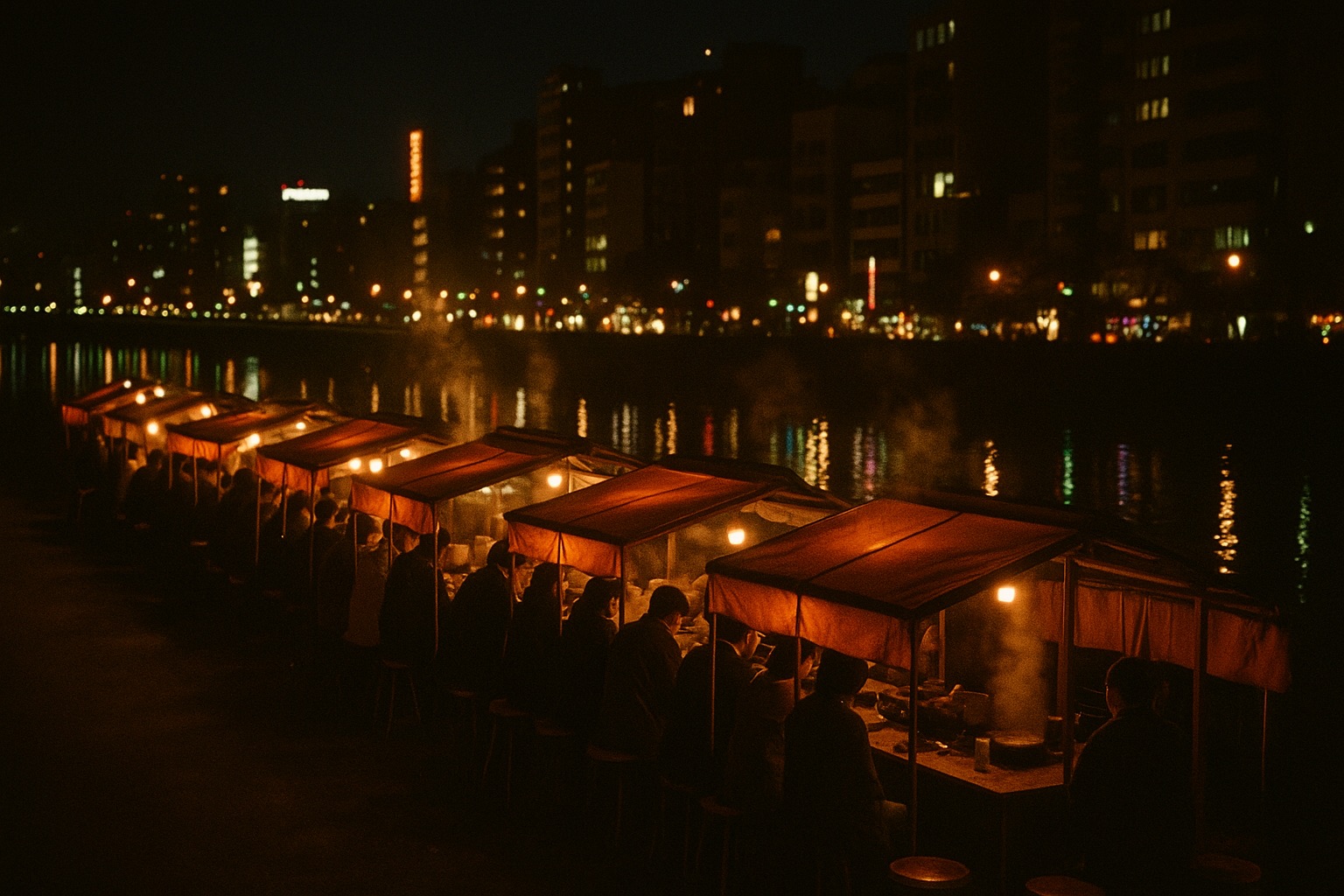
✦ AI-generated illustration — not a photograph of the actual site
Fukuoka kept them. As of 2026, roughly 100 licensed yatai operate across three districts every night — and Fukuoka is the only city in Japan where this tradition survives at this scale.
This guide explains why they matter, how they work, and exactly how to spend a perfect yatai night.
In this article
The History — Why Fukuoka Still Has Yatai
The yatai of Fukuoka did not begin as a charming culinary tradition. They began as a survival mechanism.
In 1945, with Japan's cities in ruin and food distribution systems collapsed, makeshift food stalls appeared throughout the country. Men and women who had lost their livelihoods to the war cooked whatever they could on open fires and sold it on the street. In Tokyo, Osaka, and Kyoto, these stalls numbered in the thousands. They existed in a legal grey zone — not quite sanctioned, not quite criminal — and they fed people who might otherwise have gone hungry.
The occupation-era GHQ and then the postwar Japanese government viewed them with suspicion. Street stalls were associated with black markets, unsanitary conditions, and the disorder of immediate postwar life. Through the 1950s and 1960s, city after city eliminated them — through zoning, sanitation regulations, and the general drive toward urban modernization. Tokyo's stalls disappeared. Osaka's disappeared. Kyoto's disappeared.
Fukuoka's survived. The reasons are debated — some credit the culture of the city, some the geography (the Nakasu river district provided a natural gathering point), some the specific politics of the local administration. What is documented is that Fukuoka chose to manage rather than eliminate. The result, over decades, was the evolution from informal street stalls to the formalized, licensed, GPS-tracked system that exists today.
How the System Works Today
- 📍Each licensed stall is assigned a specific GPS-marked location. Every morning, the stall must be moved from that location; every evening, it returns. This is a condition of the license — the city maintains control over placement.
- 📜Licenses are not freely issued. They are effectively inherited — passed within families or sold at very high prices when an operator retires. New licenses are essentially unavailable. The number of stalls has declined from a peak of approximately 400 to the current roughly 100 as operators retire without successors.
- 🔒The regulatory requirements are strict: health inspections, limited seating capacity (typically 8–12 seats per stall), operating hours, waste management. This is not casual street food — it is regulated food service in an unusual format.
What this means for visitors: every yatai you sit at has been run by someone — often a family — who has committed seriously to operating within a demanding system. That context is part of what makes the experience different from ordinary street food tourism.
The Three Districts — Honest Assessment
| District | Character | Best for | Price |
|---|---|---|---|
| 🌉 Nakasu | River views · tourist-friendly · most famous | Photos · first-timers who want atmosphere | Slightly higher |
| 🏙️ Tenjin | Local feel · English-friendly · most varied | Best overall experience · solo travelers | Standard |
| 🐟 Nagahama | Ramen-focused · all locals · most authentic | Ramen purists · seeing the real thing | Cheapest |
🌉 Nakasu (中洲) — Most Famous, Most Photographed
The Nakasu district, on the island formed by the Naka River and its canal, is where the famous yatai photographs come from: a row of orange-lanterned stalls reflected in dark water, the city glowing behind them. The image is real and genuinely beautiful. The experience is also the most tourist-heavy of the three districts.
Nakasu has the highest concentration of stalls — more than 20 operate in the central zone — and the highest ratio of foreign visitors. Menus are more likely to have photos or simple English. Prices run slightly higher than the other districts. Arrive before 7pm if you want a seat without waiting.
Honest take
Go here for the photographs and the atmosphere. The stalls are good, but you're not getting the most authentic yatai experience — you're getting the most visually spectacular one. That's a legitimate reason to choose it.
🏙️ Tenjin (天神) — Best for Locals, Best for First-Timers
The Tenjin district occupies the area near the department stores and office buildings west of the city center. The clientele is primarily Fukuoka's office workers — people stopping for dinner and a drink on the way home. The atmosphere is less performative than Nakasu and more genuinely social.
This is also where the most interesting individual stalls are concentrated: Mamichan (foreign-visitor-friendly, English menu), Chez Remy (French cuisine in a yatai), Genkai (70+ years of history), and Kokin-chan (yaki ramen). Tenjin is where the specific recommendations in this guide are clustered.
Honest take
If you can only go to one district, go to Tenjin. It balances genuine local atmosphere with the most accessible stalls for first-time visitors. The best balance between what yatai actually is and what a visitor can access.
🐟 Nagahama (長浜) — For Ramen Purists Only
The Nagahama district near the fish market is the original home of Hakata ramen. The stalls here are almost exclusively ramen-focused — the same tradition that produced Ganso Nagahamaya (the ¥500 ramen shop that operates 24 hours nearby). Foreign visitors are rare. The regulars are fish market workers, taxi drivers, and people who come specifically for cheap, late-night tonkotsu.
Honest take
Go here for the ¥ finish of a yatai evening — after you've eaten in Tenjin or Nakasu, take a taxi to Nagahama for a late-night bowl of pure tonkotsu at a stall where nobody will be taking photos. That contrast is worth experiencing.
What to Eat — The Yatai Menu Explained
EssentialThe Standards
博多ラーメン Hakata Ramen
¥700–1,000The benchmark. Thin straight noodles in a cloudy white tonkotsu (pork bone) broth, finished with green onions and thin-sliced pork. Yatai ramen tends toward a lighter version than dedicated ramen shops — the broth is often less intense, the noodles cooked slightly softer. Don't come to a yatai expecting the same concentration as Ichiran or Shin-Shin. Come for the experience of eating it at 10pm at a counter with eight seats.
Order kaedama (替え玉 — a refill of noodles into the remaining broth) when you finish your first round. ¥100–150 extra.
焼き鳥 Yakitori
¥150–300/skewerCharcoal-grilled chicken skewers. The standard order: negima (chicken and green onion alternated on the skewer) and tsukune (minced chicken meatball). Both arrive with a choice of salt (shio) or tare (sweet soy glaze). Order two or three of each — they are a drinking food, not a meal.
おでん Oden
¥100–300/pieceA selection of items — daikon radish, soft-boiled egg, konnyaku, fish cake, tofu — slow-simmered in a light dashi broth. Point at what you want in the pot; the cook will fish it out and plate it. This is cold-weather food at its most elemental. Eating oden at a yatai counter in December, with steam rising around you, is one of the things Fukuoka does that nowhere else quite replicates.
餃子 Gyoza
¥400–600/plateFukuoka's gyoza are thin-skinned and packed with garlic chive and pork, pan-fried until the bottom is crisp. They arrive with vinegar-soy dipping sauce and a small dish of garlic paste — use it. A plate of six serves as a side dish, not a main.
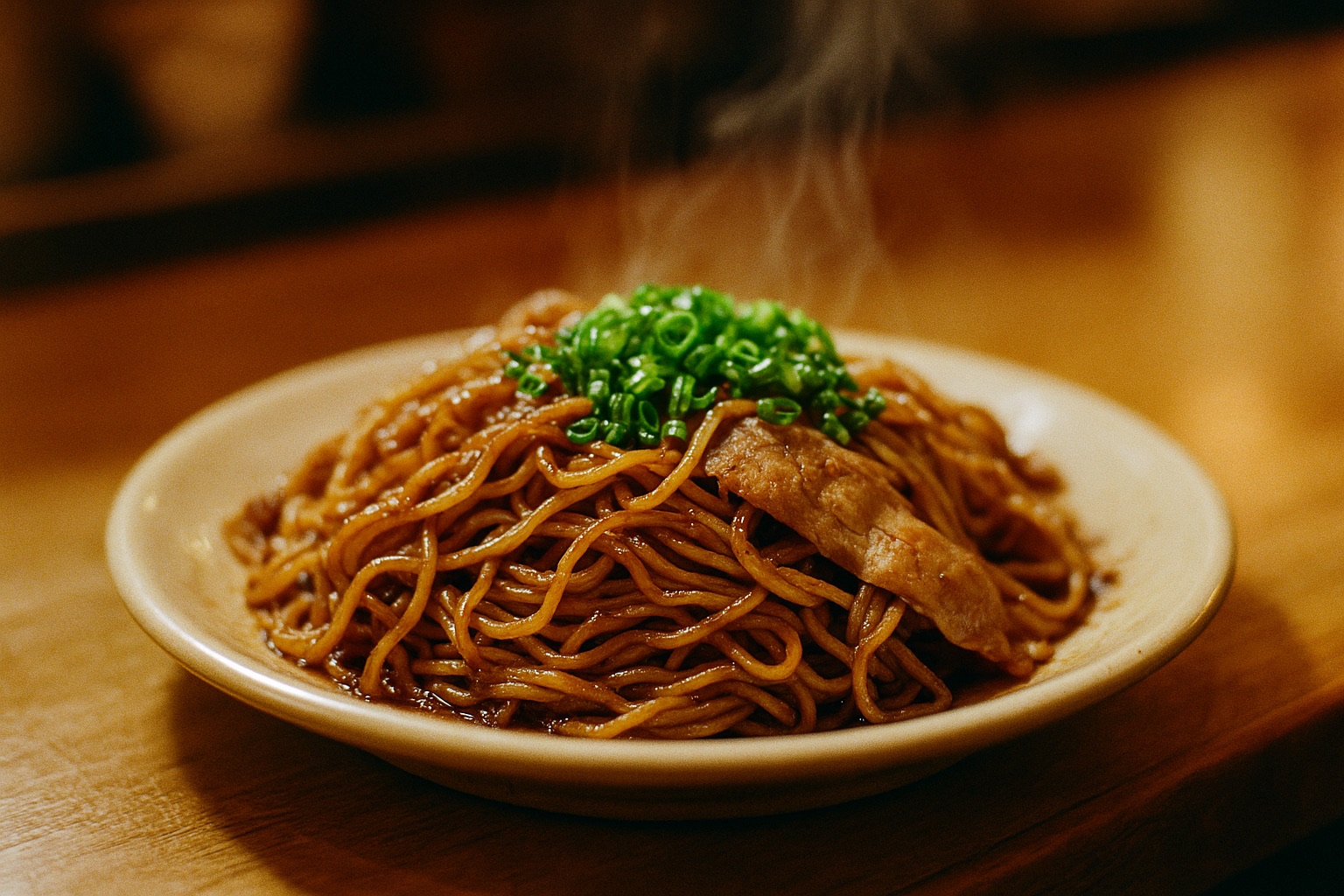
✦ AI-generated illustration — not a photograph of the actual site
Fukuoka-onlyThings You Can Only Get Here
焼きラーメン Yaki Ramen — The One Thing to Order
¥800–1,200Yaki ramen does not exist outside of Fukuoka's yatai. The dish: ramen noodles stir-fried in a wok with a tonkotsu-flavored sauce rather than submerged in broth. The result is closer to a Chinese chow mein than to conventional ramen — the noodles are slightly charred from the wok, the sauce is rich and umami-concentrated, the green onions and thin pork add brightness and texture. It is not a lesser version of ramen; it is a different dish entirely.
The stall that defined the form is Kokin-chan (小金ちゃん)in the Tenjin district. It frequently has a queue even at midnight. Order it first if that's where you're going — it can sell out.
めんたいこ料理 Mentaiko Dishes
¥500–800Spicy marinated pollock roe — Fukuoka's most famous product — appears in yatai menus as tamagoyaki (rolled egg omelet) with mentaiko filling, as a butter-sautéed preparation, or with small rice dishes. Any form is worth trying; the tamagoyaki version is the most approachable for first-timers.
フグ料理 Fugu Dishes
¥1,000–2,000Pufferfish — Japan's famously dangerous delicacy — is available at select Tenjin-area stalls. The licensed handling removes the toxic organs; what remains is mild, slightly gelatinous white flesh. The primary reason to order it at a yatai is the experience of eating fugu at an outdoor counter for ¥1,500 rather than at a formal restaurant for ¥15,000. The flavor is subtle; the story is better.
Drinks
生ビール Draft beer
¥500–700
The default. Arrives cold and immediately.
焼酎 Shochu
¥400–600
Diluted with water (mizuwari) or hot water (oyuwari). The standard drink at a yatai — cleaner than beer for a multi-stall evening.
ハイボール Highball
¥500–700
Whisky and soda, served with ice. A lighter option if you're planning three stalls.
The Yatai Etiquette — What You Actually Need to Know
Most yatai etiquette guides run to ten rules. Here are the five that actually matter.
Find an empty seat and sit down
There are no reservations and no waiting lists. If you see an open stool, sit down. The cook will come to you. If all seats are full — which is common from 8pm onward on weekends — either wait nearby or move to the next stall. Multi-seat groups may need to split across adjacent stalls during peak hours.
Order by pointing at photos or saying the word
Many yatai have no English menu. The words "ramen," "yakitori," and "oden" are recognizable as-is by almost every stall cook. For anything more specific, pointing at a menu photo or neighbor's dish communicates the intent. A smile and a gesture work in places where English doesn't.
Don't overeat at one stall
The yatai format is designed for mobility. One stall, two or three dishes and a drink — that is the correct portion. If you order a full meal at the first stall, you won't be able to do the crawl. The best yatai evenings are ones where you move.
Eat, pay, leave when you're done
Long occupation of a counter seat — particularly when the stall is full or has people waiting — is not the done thing. Eat your food, finish your drink, pay, say "gochisousama deshita" (thank you for the meal), and stand up. The stall is not a bar to linger in; it is a counter to eat at.
Bring cash
Almost no yatai accepts cards or IC payments. The economics of the business — tight margins, small transactions, old infrastructure — don't support card terminals. Carry ¥5,000–10,000 in notes and coins for a full evening. A ¥1,000 note per stall is a reasonable baseline.
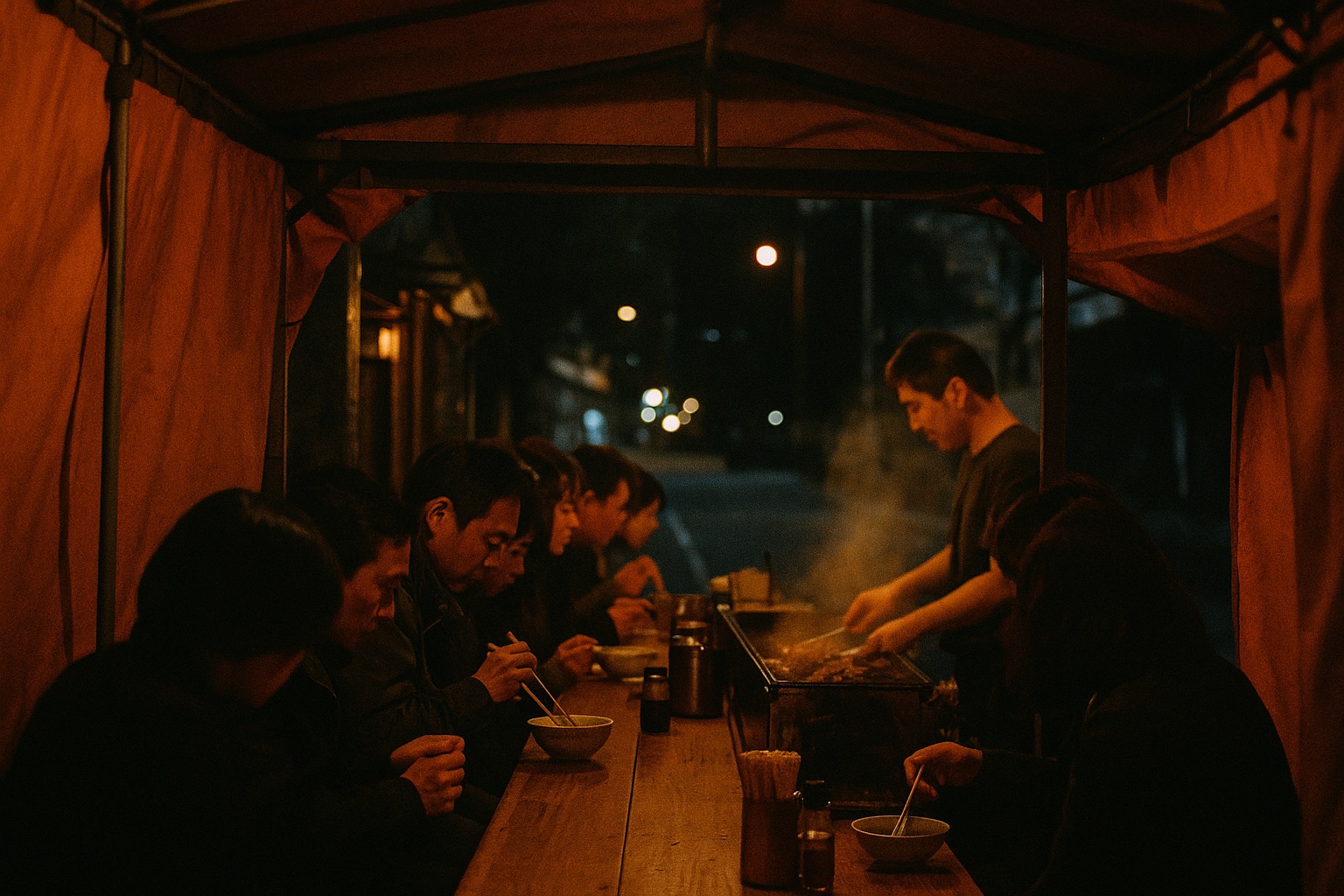
✦ AI-generated illustration — not a photograph of the actual site
Recommended Stalls — The Ones Worth Seeking Out
Most yatai guides give you only a district — not a specific stall. These four are worth finding by name.
ままちゃん Mamichan — Tenjin District
Mamichan is the most consistently recommended stall for first-time foreign visitors. The owner — referred to as “Mamichan” — is known for the warmth and ease with which she manages the mixed Japanese and international clientele. The menu has English notation. Popular dishes include the roasted pork ramen (a slightly richer variant than standard Hakata-style) and the mapo tofu.
If you're new to yatai and nervous about the process — sitting down at an eight-seat counter where you don't speak the language — Mamichan is the right starting point. The operation is relaxed and the language barrier is manageable.
シェ・レミー Chez Remy — Tenjin District
There is no other yatai like Chez Remy. The owner, Remy, is a French chef who operates a French cuisine yatai — escargot, fresh fish cooked in French technique, hot wine — from a Fukuoka street stall. He speaks English and French in addition to Japanese, and the conversation at the counter is as much part of the experience as the food.
The wait is real. Chez Remy is well-known enough that queues of 45 minutes or more are common, particularly on weekends. Arrive early (before 7pm) or late (after 10pm) to minimize the wait.
玄海 Genkai — Tenjin District
One of Fukuoka's oldest surviving yatai — more than 70 years of continuous operation, the second oldest in the city. Genkai is known for its seafood tempura — fresh fish and shellfish battered and fried to order at the counter. The historical context matters here: you are sitting at a stall that has been in the same spot, under the same name, since the postwar era. The food is good; the continuity is extraordinary.
小金ちゃん Kokin-chan — Tenjin District
The definitive yaki ramen stall. Kokin-chan's stir-fried ramen has been featured in Japanese food media consistently and appears in virtually every English-language recommendation of Fukuoka yatai on Reddit and travel forums. The queue is real — even at midnight. Order the yaki ramen; nothing else matters. If there are people waiting, eat efficiently and give up your seat.
The Perfect Yatai Night — A Three-Stall Strategy
Under ¥5,000. Planned like someone who's done it before.
First-Timer Route (English-Friendly)
Mamichan — Tenjin
Yakitori × 2 + ramen + beer · ~¥2,000
Order in English · get comfortable with the format
Nakasu riverside stall
Oden × 2–3 pieces + shochu · ~¥1,500
Taxi 5 min from Tenjin · walk the river before you sit down
Nagahama or Nakasu ramen finish
Hakata ramen · ~¥800
The traditional close to any yatai evening
Local-Style Route (Authenticity-First)
Tenjin area local stall
Mentaiko tamago + yakitori + beer · ~¥1,500
Sit wherever there's space · no agenda
Kokin-chan (小金ちゃん)
Yaki ramen · ~¥1,000
This is the point — the thing you can only eat here
Nagahama late-night stall
Tonkotsu ramen · ~¥700
The midnight crowd at Nagahama is its own experience
The Strategic Principle
The goal is not to eat a lot. It's to eat a little in several places — each with its own atmosphere, its own counter, its own conversation. Two dishes and a drink per stall. Walk or taxi between them. The budget for the whole evening should be under ¥5,000. If you're spending more, you're ordering too much at each stop.
Practical Tips
🕕 Hours
Roughly 18:00–2:00am. Stalls close earlier on slow nights. The 9pm–midnight window is the sweet spot — busy enough for atmosphere, past the worst early-evening queues.
🌧️ Rain & wind
Light rain: stalls have canvas roofs and stay open. Heavy rain or strong wind (typhoon conditions): many close. Check the forecast if planning around a specific stall.
🍂 Best season
Autumn (Oct–Nov) and winter (Dec–Feb) are ideal. Hot food and steam in cold air is the combination the experience is designed for. Summer works but is hot — choose a stall with good airflow.
🧍 Solo dining
Yatai are genuinely solo-friendly. A single stool at the end of the counter is available most nights. The format — strangers sharing a narrow counter — tends to produce conversation. See our guide on solo travel in Kyushu.
👔 Clothing
Charcoal smoke and cooking smells attach to fabric. Wear something you don't mind washing immediately or don't mind smelling of yakitori. Synthetic fabrics hold the smell more than cotton or denim.
🗣️ Language
The words "ramen," "yakitori," "beer (biiru)," and "check please (o-kaikei)" will get you through most stalls. A pointed finger and a smile close the remaining gap.
💴 Budget per stall
¥1,500–2,500 covers two dishes and one drink at most stalls. Budget ¥4,000–5,000 for a full three-stall evening including transit between districts.
📵 Phones
Taking photos is fine — most stalls don't mind. Audio or video recording of conversations (or other customers) is not appropriate. Keep it brief and unobtrusive.
“Yatai are evidence that Fukuoka is different from Japan's other cities. Someone decided to keep them. The culture, the regulations, the families that have run the same stall for three generations — all of it exists because somebody chose that it would. Every evening, when the lights come on over the Naka River, that choice is visible. It is a small miracle. Worth seeing.”
More Fukuoka Food Guides
Written by
A Local in Oita, Japan
A Japanese local born and raised in Oita, Kyushu. Sharing the Japan that guidebooks miss — from someone who actually lives here.
About this site →Related Articles

JR Kyushu Rail Pass: Is It Worth It? A Local's Honest Guide
A local breaks down the JR Kyushu Rail Pass — the 3, 5, and 7-day options, what's covered, real price math for popular routes, how to buy and use it, and the honest answer to whether it's worth it for your trip.
Best Time to Visit Kyushu: A Month-by-Month Season Guide
When should you visit Kyushu? A local walks you through the seasons month by month — cherry blossoms, the rainy season, summer heat, golden autumn, and mild onsen winters — so you pick the right time for your trip.
Driving in Kyushu: Renting a Car & the Best Road Trips
Should you rent a car in Kyushu? A local explains the license you need, what driving here is really like, costs and tolls, where a car beats the train — and the island's most beautiful road trips.