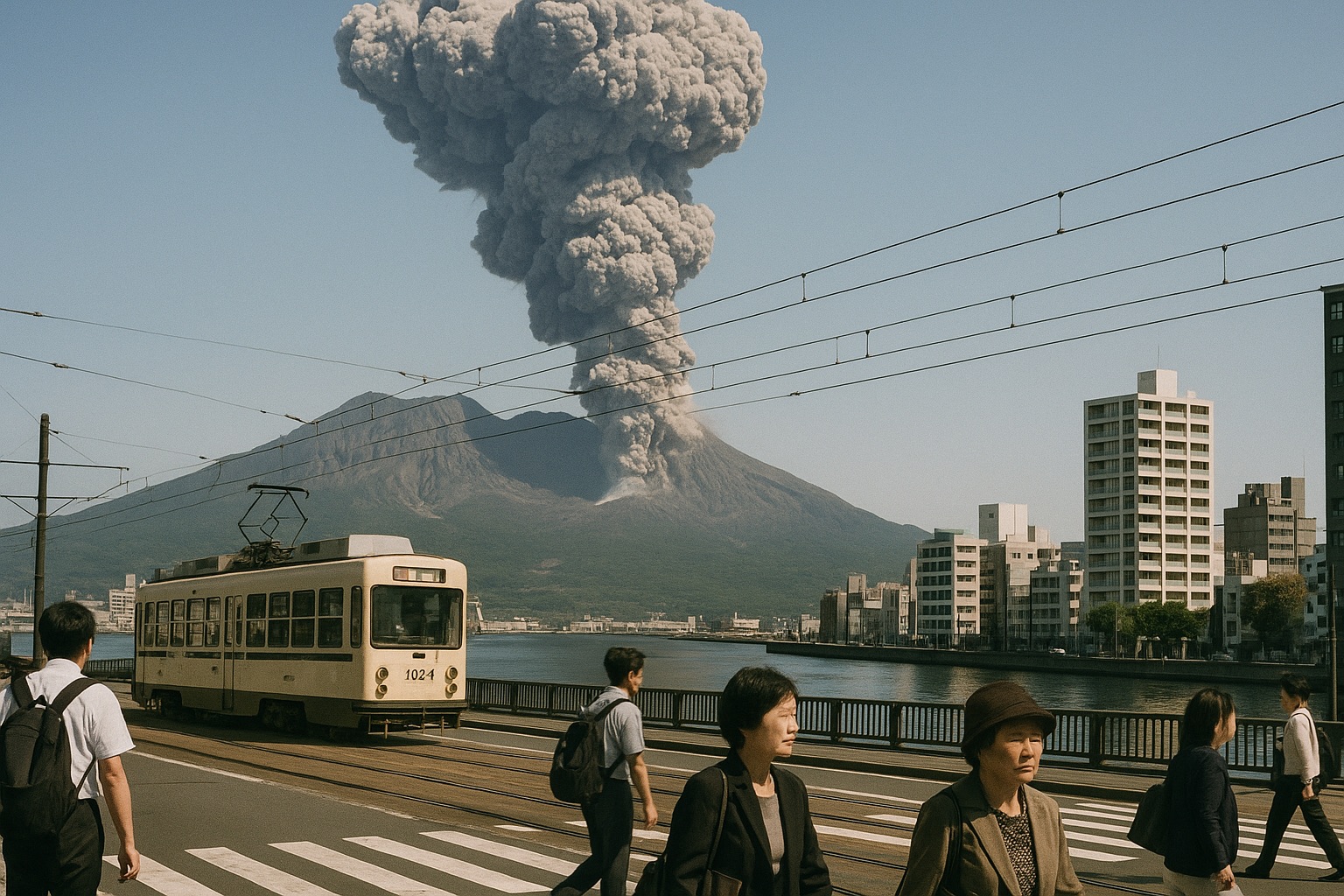
In Kagoshima, the weather forecast includes an extra line: which way the ash is blowing.Across the bay, four kilometers from downtown, Sakurajima — one of the most active volcanoes on Earth — rumbles and puffs almost daily, sometimes hundreds of eruptions in a single year. The city's response, perfected over a century: umbrellas, designated ash bags, car covers, and complete equanimity.
If you grew up visiting American national parks — Yellowstone's geysers, Hawai'i's lava fields — Sakurajima belongs on your Japan list. It is raw geology with a city in the foreground, and almost no international tourists in between.
A City That Lives with Its Volcano
Sakurajima means "cherry blossom island" — and it was an island until 1914, when its largest modern eruption poured out enough lava to bridge the strait to the Osumi Peninsula. The name stuck even after the geography changed.
Roughly 4,000 people still live on the volcano itself — farming the famous giant Sakurajima daikon radishes and tiny Sakurajima mandarins in the mineral-rich soil — while Kagoshima city (population ~600,000) spreads along the opposite shore. Children on the volcano walk to school in hard hats during active periods. Gas stations sell windshield ash brushes. Yellow municipal bags labeled kohai (ash collection) line the curbs after a big plume.
This is what makes the visit special. Plenty of places let you look at a volcano. Almost nowhere lets you watch a modern city and an erupting volcano coexist, calmly, as they have for generations.
Is It Safe to Visit? (The Honest Answer)
Yes, with the obvious caveat that it's an active volcano and conditions rule everything. The summit craters have been off-limits for decades — visitors stay in the inhabited and viewing zones kilometers away, the same areas where thousands of residents live. Japan's volcanic monitoring is among the best in the world, with alert levels published in English, and access rules adjust automatically when activity rises.
What you'll actually experience on most days: a quiet green mountain occasionally clearing its throat with a gray plume that drifts off in the wind. Eruptions here are typically short ash bursts — dramatic to see, photographed from a safe distance, gone in minutes. If you witness one, you'll join the locals in barely breaking stride.
The Ferry — 15 Minutes, ¥200, the Best View in Kyushu
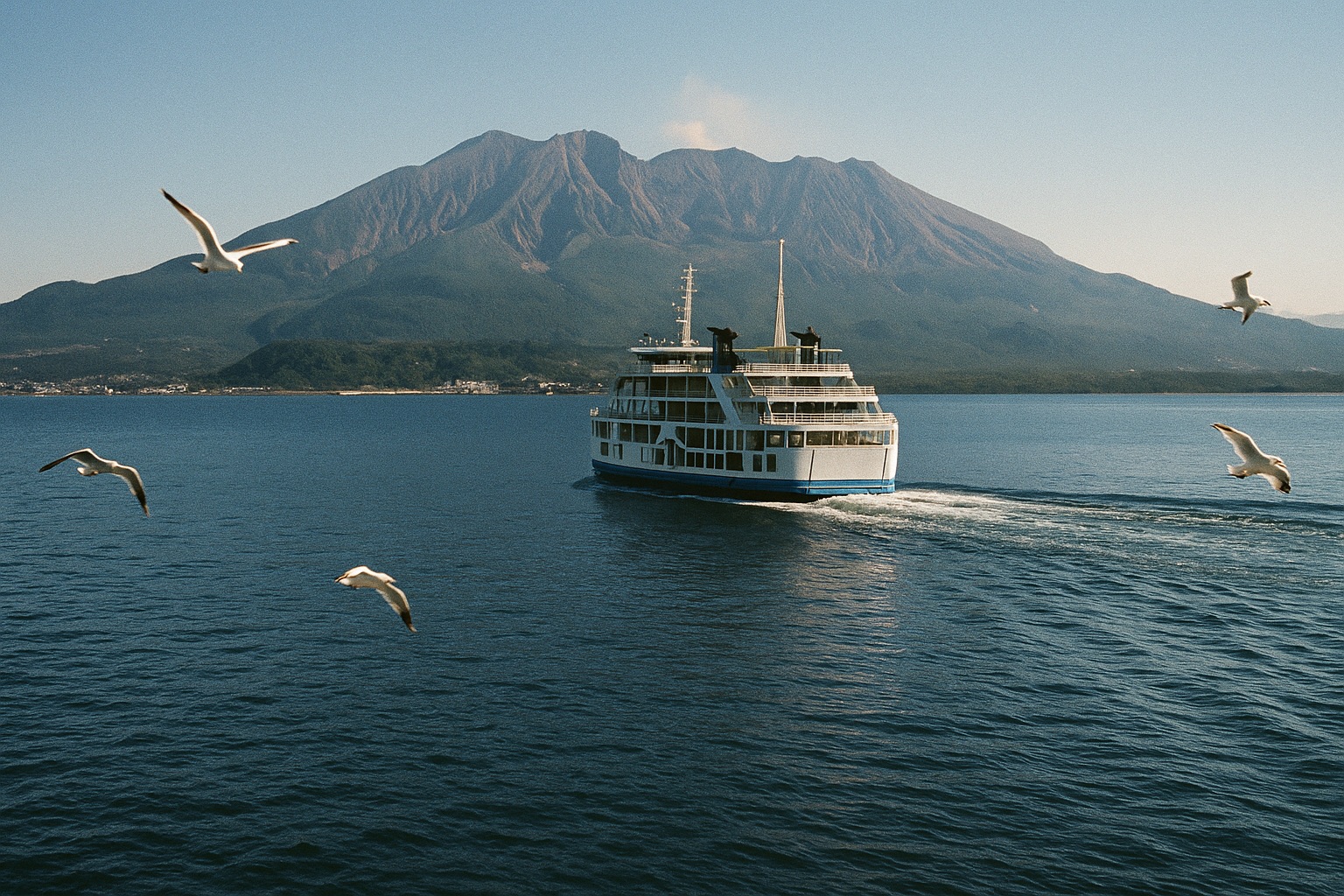
✦ AI-generated illustration — not a photograph of the actual site
Fifteen minutes across Kinko Bay — one of Japan's great cheap boat rides
The Sakurajima Ferry runs from downtown Kagoshima to the volcano in about 15 minutes for ¥200(children ¥100) — no reservation, drive-on or walk-on, departures every 15–20 minutes through the day. The crossing itself is an attraction: the cone growing in the windshield, Kinko Bay's dolphins if you're lucky, and the ferry's famous standing udon counter, where the local move is finishing a bowl in the time it takes to cross.
📌 2026 update most guides haven't caught
The ferry's famous 24-hour operation ended in late 2025. Service now runs roughly 4:00 a.m. to 11:30 p.m. Still absurdly frequent and cheap — but don't plan a 2 a.m. crossing based on an old blog post. Check the official timetable for current hours.
What to See on the Volcano
🌋 Yunohira Observatory — As Close as You Can Get
At 373 meters, this is the highest point open to the public, staring straight into the upper slopes. On clear days the crater rim fills your field of vision; when the mountain exhales, you feel the rumble in your chest. Drive or take the island bus.
🪨 Lava Trails & the Nagisa Park Footbath
Walking paths cross the rugged 1914 lava fields near the ferry terminal — black rock colonized by pines, signs marking what was buried beneath. Finish at the Nagisa Park ashiyu, a roughly 100-meter free footbath fed by volcanic hot springs, where you soak your feet while watching the smoking summit. Onsen culture and live geology in one frame. (More Kyushu bathing: our Beppu guide.)
🥬 The Giant Daikon & Tiny Mandarin
Volcanic soil grows extremes: Sakurajima daikon are the world's heaviest radishes (record specimens over 30kg), while Sakurajima komikan are among the world's smallest mandarins. Both appear in island restaurants and roadside stands in season — the daikon often as buttery-soft simmered rounds.
The Buried Torii — 1914 Frozen in Place
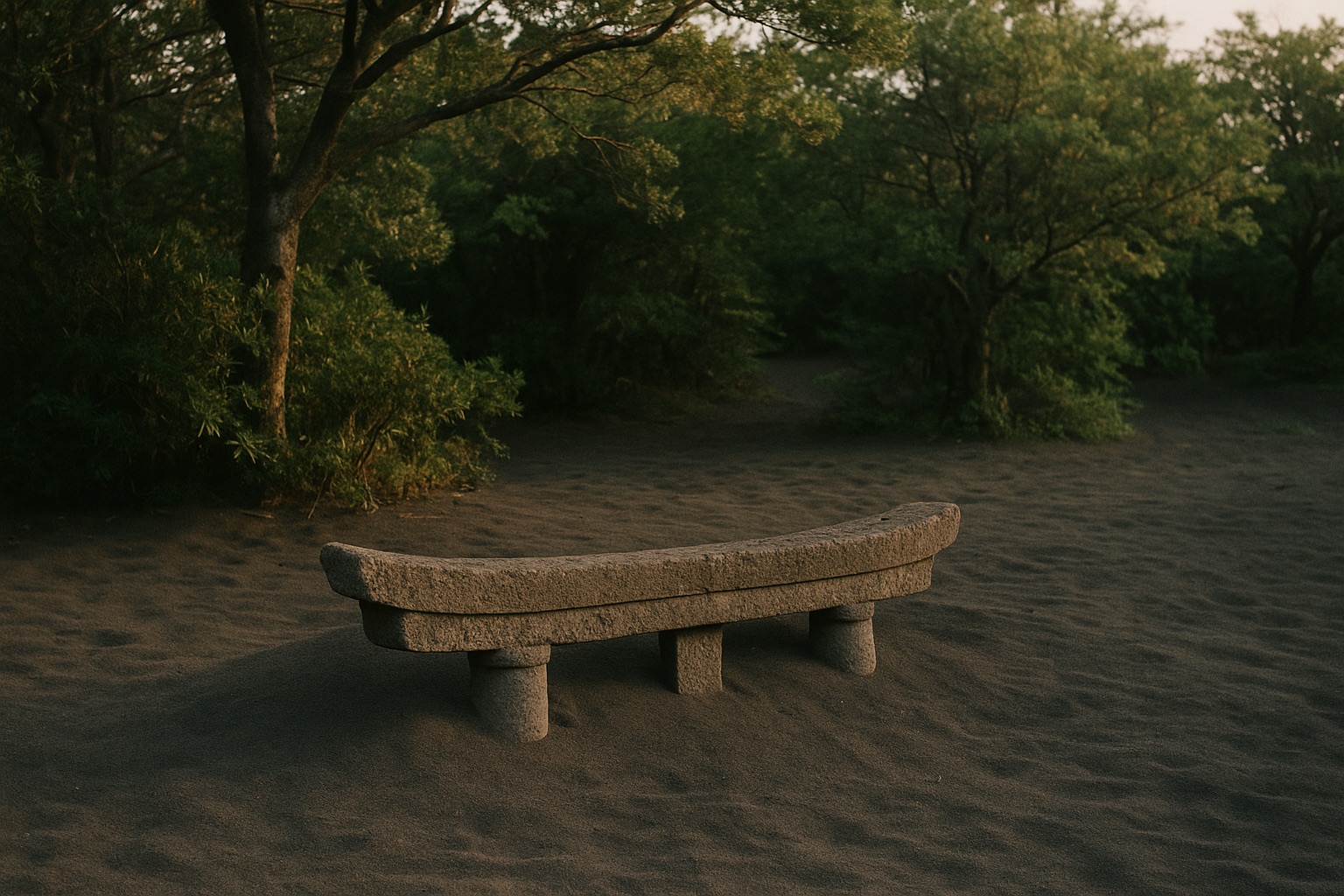
✦ AI-generated illustration — not a photograph of the actual site
Kurokami's buried torii — three meters of shrine gate under your feet
On the volcano's east side stands Sakurajima's most haunting sight: the Kurokami buried torii. Before 1914 this stone shrine gate stood three meters tall. The eruption buried the village in pumice and ash in a single day — and when survivors returned, the village headman ordered the protruding crossbeam left exactly as it was, as a warning to future generations.
A century later you stand at ground level that used to be the sky, looking down at the top of a gate people once walked beneath. It takes five minutes to see and stays with you for years. This is the Pompeii impulse — but living, current, with the same mountain steaming on the horizon.
Logistics — Getting There & Around
- 🚄To Kagoshima: Kyushu Shinkansen from Hakata (Fukuoka) to Kagoshima-Chuo in about 1 hour 20 minutes. From Tokyo, fly — Kagoshima airport has frequent connections.
- ⛴️To the volcano: tram or bus to the ferry terminal, then the 15-minute crossing. Going car-free? The Sakurajima Island View loop bus hits the main observatories; a one-day pass covers ferry + bus.
- 🚗With a car: drive on the ferry and circle the volcano (about an hour around) to reach Kurokami's buried torii and the quieter east side — recommended if it fits your trip.
- ⏱️Time needed: a half day covers ferry + footbath + one observatory. A full day adds the island loop, lunch, and the buried torii. Sunset from the Kagoshima side, with the cone silhouetted over the bay, is the closing shot.
Combining Sakurajima with the Rest of Kyushu
Kagoshima anchors the southern end of any Kyushu route. The natural pairings:
- •Ibusuki (50 min south): volcanic sand baths and the Eevee manhole trail — the perfect same-region day. (Details in our Pokémon in Kyushu guide.)
- •Kagoshima city itself: kurobuta pork, Saigo Takamori's last-stand sites, and the Shimazu clan's gardens at Sengan-en with the volcano as borrowed scenery. (History: our Kagoshima castles & the last samurai guide.)
- •The full island: Sakurajima slots into days 5–6 of our 7-day Kyushu itinerary, or the southern leg of the route in Is Kyushu Worth Visiting?
🌋
Some places you photograph. Sakurajima, you feel — in your chest when it rumbles, in the grit on your windshield, in the calm of a city that decided long ago to live with its mountain.
¥200 and fifteen minutes across the bay. The most underpriced front-row seat in Japan.
Continue Exploring Southern Kyushu