Every Japanese city tells you something about Japan. Nagasaki tells you something about the world— Portuguese missionaries and hidden Christians, two centuries when this one harbor was Japan's only window to the West, Chinese merchants who reinvented the city's food, and the morning of August 9, 1945.
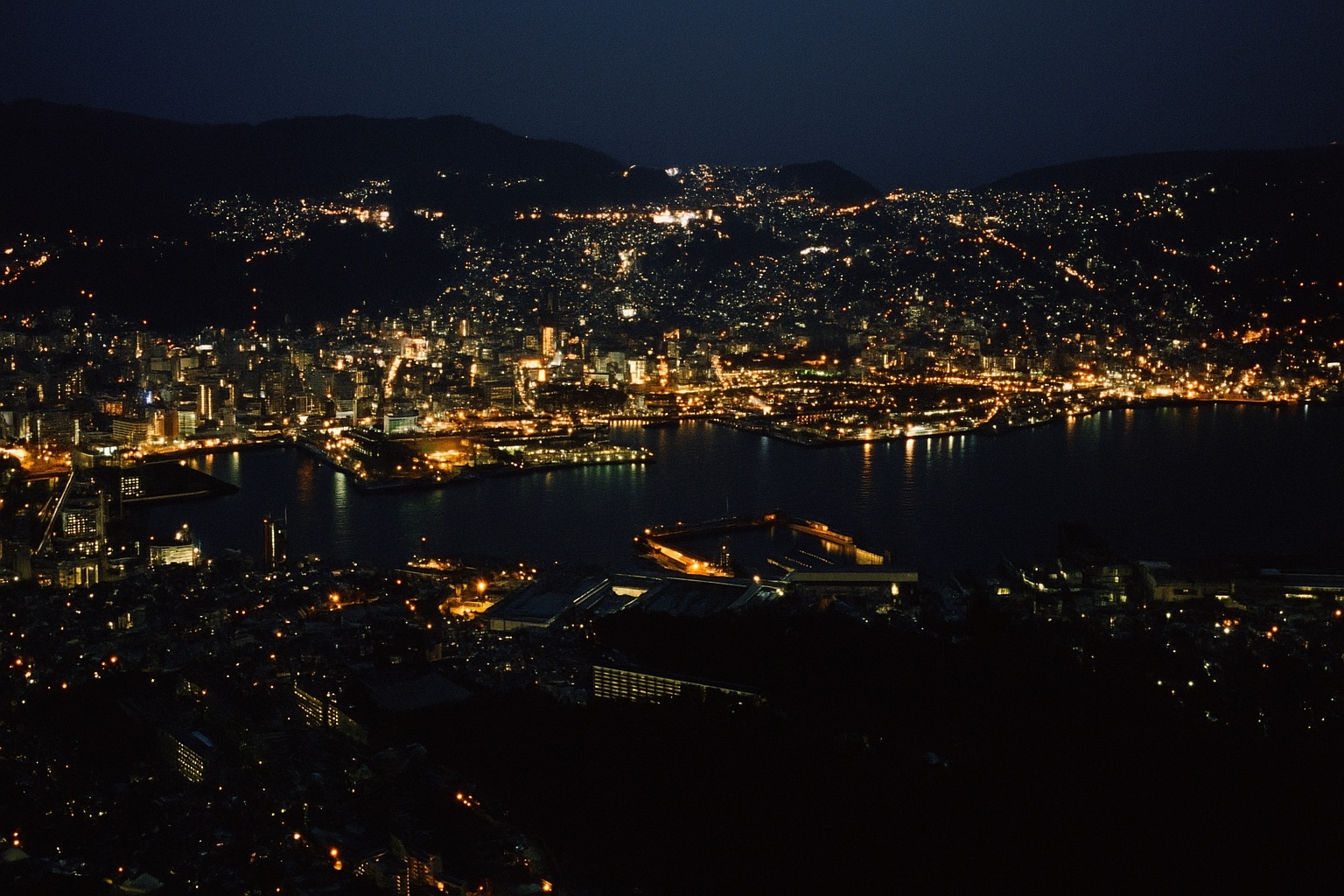
It's also — and visitors are never prepared for this — one of Japan's most beautiful and delicious cities: an amphitheater of hills around a harbor, trams rattling through, and a night view officially ranked among the best on Earth. Here's how to visit it well.
Why Nagasaki Is Unlike Anywhere in Japan
When Japan sealed itself off from the world in the 1630s, it left one keyhole open: Nagasaki. For over 200 years, everything foreign — Dutch science, Chinese cuisine, Western medicine, telescopes, chocolate, badminton — entered Japan through this single port. The city absorbed it all and built an identity no other Japanese city shares: church spires above temple roofs, a Chinatown older than Yokohama's, festivals with dragon dances, and a cuisine that cheerfully ignores the borders the rest of the country kept.
That cosmopolitan history is also why the city's tragedy lands so specifically: the atomic bomb fell on Japan's most internationally connected, most Christian city. Understanding both layers is what makes a Nagasaki visit more than sightseeing. (The deeper history — rebellions, hidden Christians, the last castle — is in our Nagasaki history guide.)
Visiting the Atomic Bomb Sites — A Guide for American Visitors
Many American travelers tell us the same two things: they feel they shouldgo, and they're quietly anxious about how it will feel to be there. Both instincts deserve a direct answer.
Go. The Nagasaki Atomic Bomb Museum and the adjacent Peace Park are not accusatory spaces — they are mourning spaces, built around a single conviction: never again, for anyone. American visitors are received with the same warmth as anyone else; the museum's framing is human, not national. You will see artifacts that are very hard to look at — a melted rosary from Urakami Cathedral, a clock stopped at 11:02 — and you will see schoolchildren folding paper cranes beside you.
- •Allow 2–3 hours for museum + hypocenter park + Peace Park, connected by a short walk. Mornings are quietest.
- •Urakami Cathedral, rebuilt near the hypocenter, completes the story — the bomb detonated above the largest Christian community in Japan.
- •Etiquette: normal museum behavior is all that's asked. Photography rules are posted. Tears are common and entirely unremarkable.
Visitors consistently describe these hours as among the most important of their entire Japan trip. The city itself models the response: Nagasaki rebuilt itself outward, into a place insistently full of life — which is why the rest of this guide exists.
Dejima & the International Layers
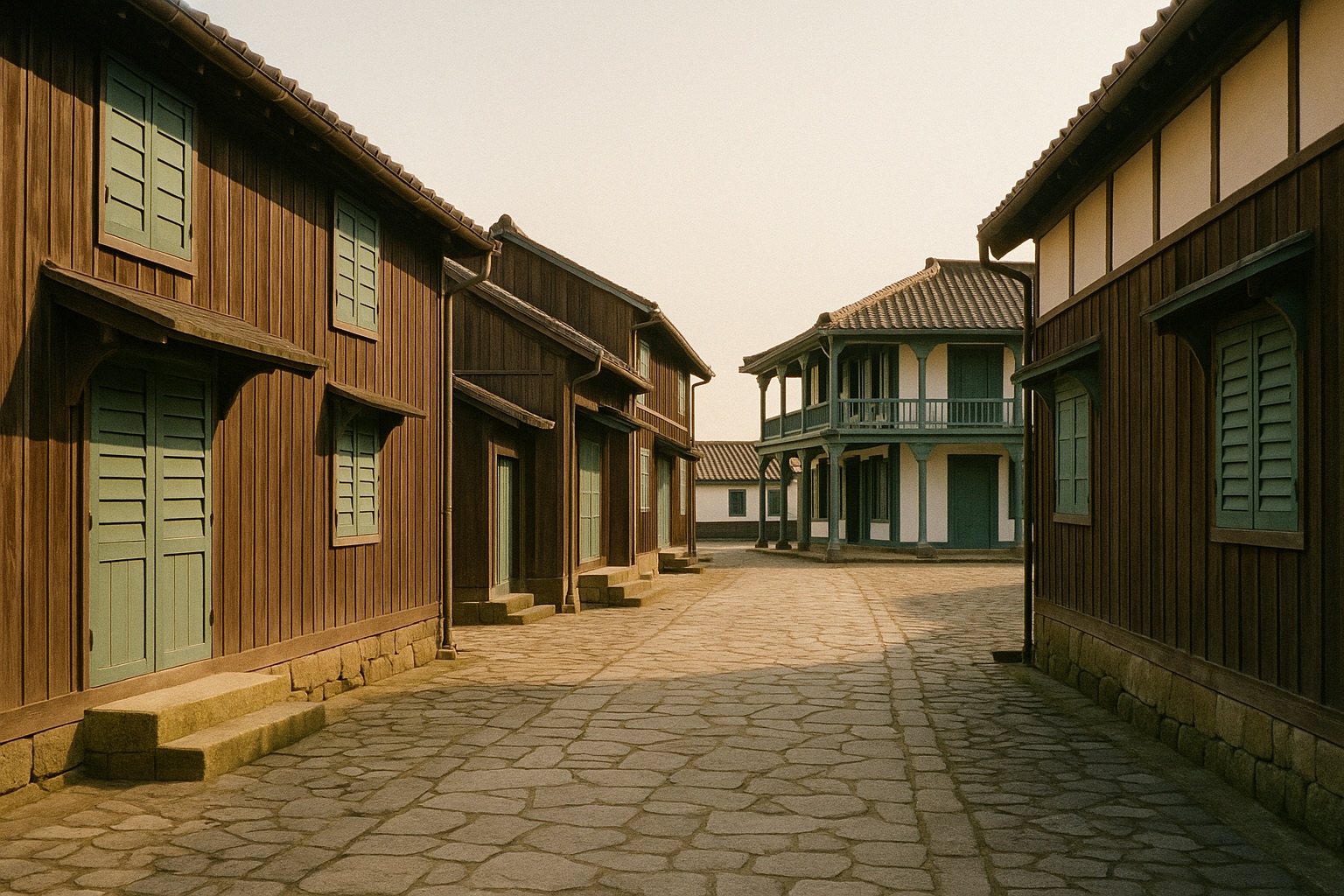
✦ AI-generated illustration — not a photograph of the actual site
Dejima — the fan-shaped island where Japan and the West traded for two centuries
🇳🇱 Dejima
The reconstructed fan-shaped island where Dutch traders lived under guard for 200 years — the single point of East-West contact during Japan's isolation. Walk the chief factor's rooms, the warehouses, the kitchens where Japan first met coffee and beer. Compact, vivid, and the key that unlocks everything else in the city.
🏮 Shinchi Chinatown & Temples
Japan's oldest Chinatown, anchor of the Chinese community that shaped Nagasaki's food (next section). Nearby, the Chinese-built Sofukuji temple's vermilion gates are a piece of Ming China standing in Japan.
⛪ Oura Cathedral & Glover Garden
Japan's oldest standing church — where hidden Christians revealed themselves after 250 years of secrecy, an event that stunned the Catholic world — beside the hillside villas of Victorian-era merchants, with harbor views that explain why they built here.
What to Eat — Champon, Sara Udon & Castella
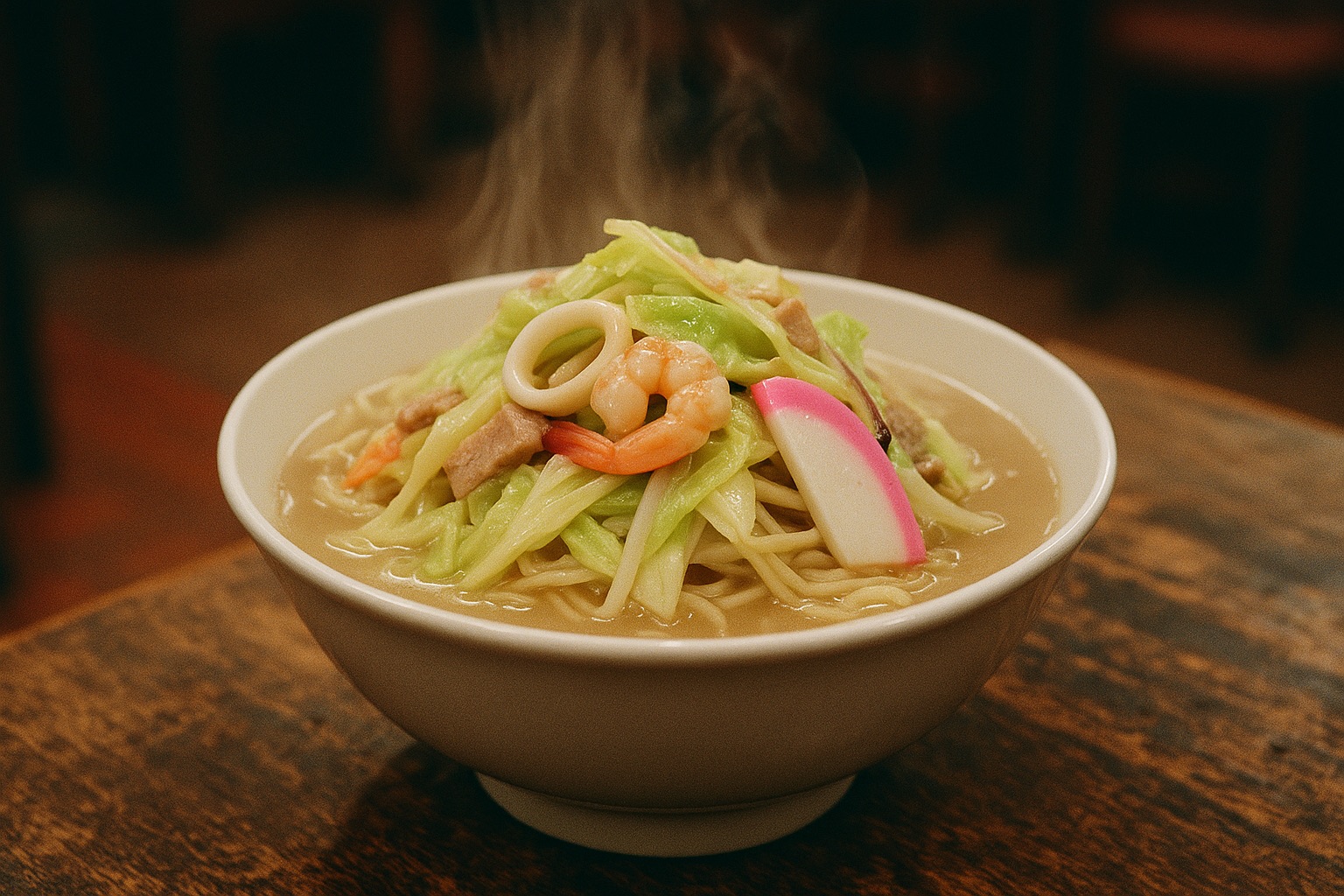
✦ AI-generated illustration — not a photograph of the actual site
Champon — invented to feed Chinese students cheaply, perfected for everyone
- 🍜Champon — thick noodles boiled in a creamy pork-seafood broth (not added after), heaped with stir-fried cabbage, squid, shrimp, and pork. Invented around 1899 by a Chinese restaurateur to feed students cheaply. Order it in Chinatown at the source.
- 🍝Sara udon — champon's crispy sibling: the same toppings in thick sauce over crunchy fried noodles. Locals argue about which is superior; order both and join the argument.
- 🍰Castella — the Portuguese-descended honey sponge cake that became Nagasaki's signature gift. The famous old shops sell beautifully boxed loaves; the "edge cuts" (mimi) sold cheaply at some bakeries are the local''s secret.
- 🍖Toruko rice & wagyu — the gloriously unhinged "Turkish rice" (pork cutlet + spaghetti + pilaf on one plate, nothing Turkish about it) for lunch; top-class Nagasaki wagyu for a splurge dinner.
Mount Inasa — The $10-Million Night View
Because Nagasaki climbs its hills, the city at night becomes a bowl of light around black water — a view repeatedly ranked among the world's top three city nightscapes alongside Hong Kong and Monaco. The Mount Inasa ropeway lifts you 333 meters to the observatory in five minutes; sunset-into-dusk is the move, watching the amphitheater ignite.
Practical: the ropeway runs into the evening; free shuttle buses serve major hotels on busy nights; bring a layer — the summit is breezy even in summer. On a clear night this is, simply, the best free-ish (~¥1,250 round trip) spectacle in Kyushu.
Gunkanjima — The Battleship Island
Nine miles offshore sits Hashima — "Gunkanjima," the Battleship Island — once the most densely populated place on Earth, a coal-mining fortress city of concrete towers on a rock the size of a few city blocks. Abandoned in 1974 when the mine closed, it has decayed into the world's most cinematic ghost island (Bond fans know it from Skyfall's villain lair).
Licensed boat tours from Nagasaki port circle the island and — sea conditions permitting — land on a viewing walkway among the ruins. Book ahead in summer; landings cancel in rough weather, so schedule it early in your stay with a backup day. Even a circling-only day is haunting.
The Two-Day Plan
Day 1 — The World's Window
Morning: Atomic Bomb Museum, hypocenter, Peace Park, Urakami Cathedral. Afternoon: tram south — Dejima, then Chinatown champon (late lunch). Evening: Oura Cathedral & Glover Garden at golden hour, then the Inasa ropeway for the night view.
Day 2 — The Sea & the Layers
Morning: Gunkanjima boat tour. Afternoon: Sofukuji temple, kissaten coffee, castella shopping on the old Dutch slope. Sara udon for the road. Train or bus onward — Nagasaki connects cleanly to the rest of the Kyushu loop.
Getting there: the Nishi-Kyushu Shinkansen + relay service connects Hakata (Fukuoka) to Nagasaki in roughly 1.5 hours. The city itself runs on its lovable ¥140-flat-fare trams — get the day pass.
🕊️
Nagasaki holds more world history per square mile than anywhere in Japan — grief and curiosity, churches and dragon dances, all in one harbor bowl of light.
Come for the history you feel you should witness. You'll leave talking about the noodles and the night view too — and the city would want it exactly that way.
Continue Exploring
⛪ Nagasaki's Deeper History
Hidden Christians, rebels & castles
⚔️ Tsushima Island
The Ghost of Tsushima pilgrimage
🗾 7-Day Kyushu Itinerary
Where Nagasaki fits
🤔 Is Kyushu Worth Visiting?
The honest decision guide
🍽️ Fukuoka Food Itinerary
The other great food city
🌋 Mount Aso Guide
The giant caldera next door