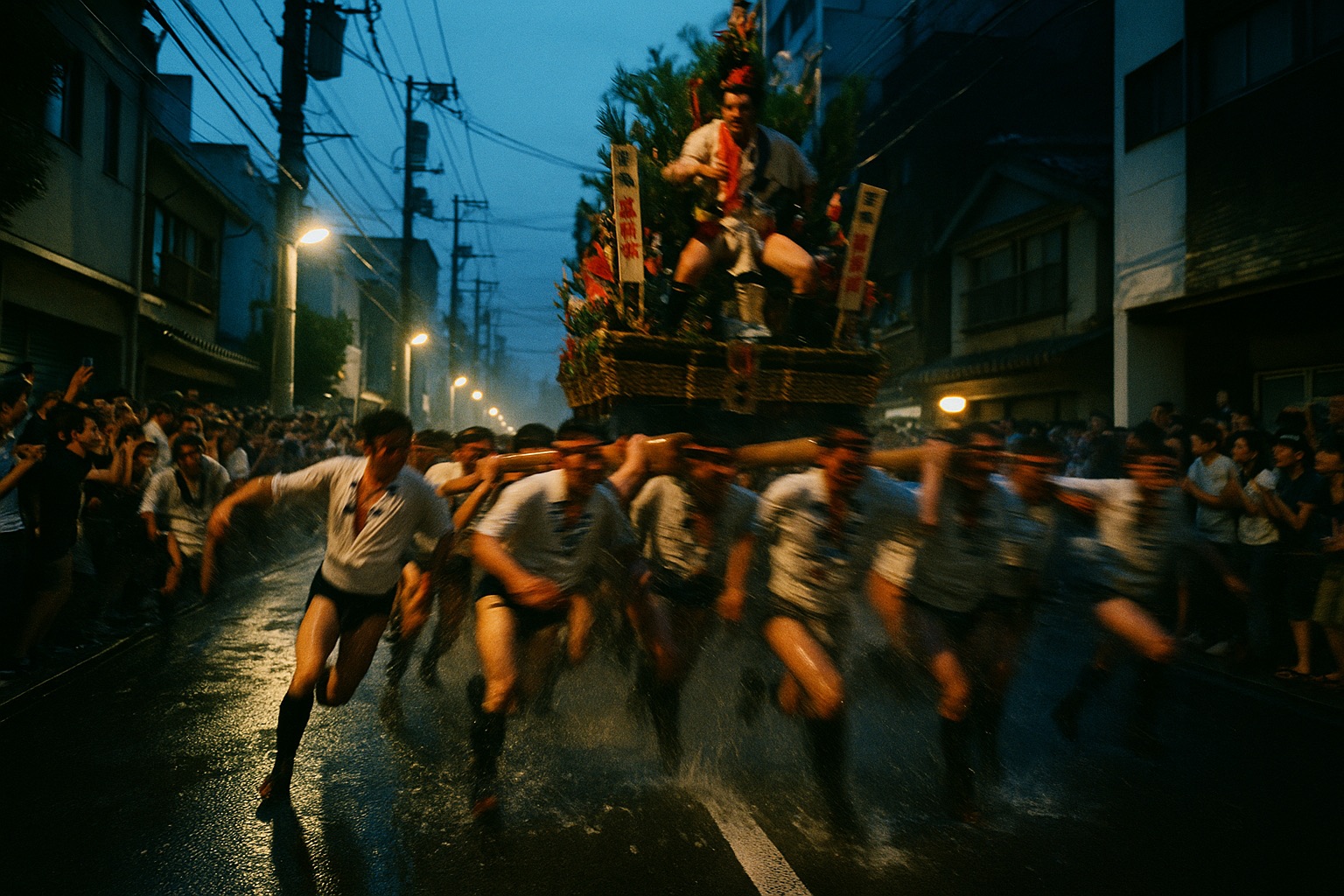
At 4:59 in the morning on July 15th, in the pre-dawn dark of Fukuoka, a drum sounds at Kushida Shrine — and several dozen men explode out of the gate carrying a one-ton wooden float on their shoulders, at a run. Behind them, six more teams follow at intervals, racing the same 5-kilometer course through the old streets of Hakata while tens of thousands watch and buckets of water fly.
This is the climax of Hakata Gion Yamakasa, a festival that has run for nearly 800 years and stops for nothing. If you are anywhere near Fukuoka in the first half of July, reorganize your trip around it. Here's how.
What Yamakasa Actually Is
The festival's origin story begins in 1241, when the priest Shoichi Kokushi was carried through Hakata on a platform, sprinkling holy water to drive out an epidemic. (The same priest, by the way, is credited with bringing udon-making to Hakata — Fukuoka's two great summer institutions, the festival and the noodle, share a founder. We tell that story in our food itinerary.)
Nearly eight centuries later, Yamakasa is a UNESCO-listed intangible cultural heritage and the defining event of Hakata identity. The city's old merchant districts are organized into seven nagare (teams), each fielding a one-ton kakiyamaracing float. Men join their neighborhood team as children and carry into their seventies. For two weeks every July, work schedules across Fukuoka quietly bend around festival duties — it's that deep.
What makes it special for a visitor: this is not a parade. Nothing is performed at you. It's a genuine, ferociously competitive neighborhood ritual that happens to be one of the most thrilling things you can watch in Japan — free, unticketed (with one exception below), in the streets.
The 15-Day Schedule — What Happens When
Yamakasa runs July 1–15 every year, same dates, rain or shine. The intensity builds through the fortnight:
| Date | Event | Visitor Value |
|---|---|---|
| July 1–14 | Kazariyama display floats appear across the city | ★★★ Easy, anytime, free |
| July 10 | Nagare-gaki — first running, within home districts | ★★ First taste of the speed |
| July 11 | Asayama (early morning) & Tanagare-gaki | ★★ Floats visit other districts |
| July 12 | Oiyama-narashi, 15:59 — full dress rehearsal of the race | ★★★ The Oiyama at a humane hour |
| July 13 | Shudan Yamamise — floats cross the river into Tenjin | ★★★ Only day floats enter the modern city center |
| July 15 | OIYAMA, 4:59 AM — the real thing | ★★★★★ One of Japan's great spectacles |
💡 The insider recommendation
If waking at 3 AM isn't happening, the Oiyama-narashi on July 12 at 15:59 is the same race, slightly shortened, in the afternoon. Most travel guides barely mention it. Locals consider it nearly equal viewing — with trains running and coffee available.
The Oiyama — 4:59 AM, July 15
Why 4:59? Tradition — the first float enters Kushida Shrine's grounds at exactly 4:59, performs the Kushida-iri (a timed sprint through the shrine courtyard), and the first team alone earns the right to stop and sing the Hakata Iwai-uta blessing song before bursting out into the streets. The remaining six floats follow at five-minute intervals, racing the full ~5km course through old Hakata to the finish at Susaki-machi.
Each float run is timed, and the times are scrutinized like sports scores. Water flies constantly — team members and households along the course throw kioi-mizu (spirit water) over the runners to cool them. The sound is the thing nobody warns you about: thousands of voices chanting "Oissa! Oissa!" echoing off the buildings in the half-dark.
Where to Watch (And Where Not To)
- ✓Taihaku-dori (the wide boulevard): the floats run a long straight here — space for everyone, good sightlines, and the teams hit top speed. Best choice for a first-timer with no local knowledge.
- ✓The old backstreets of Hakata (Kamikawabata, Nishimachi-suji area): narrow, intimate, water everywhere, float passing an arm's length away. More intense, more crowded per meter — arrive by 4:00 AM for a front-row spot.
- ✓Near the finish (Susaki-machi): see the final sprints and the emotional finishes — teams collapse, embrace, weep. The human side of the festival.
- ✗Right outside Kushida Shrine without a ticket: hopelessly packed from 3 AM, view blocked by the sajiki stands. Walk five minutes up the course instead.
Logistics: trains don't run that early, so stay within walking distance of Hakata old town on the night of July 14 — and book that hotel months ahead. Many spectators simply stay up all night; Nakasu's yatai stalls before a 3:30 AM walk to the course is the time-honored visitor strategy.
The Easy Version — Kazariyama Floats
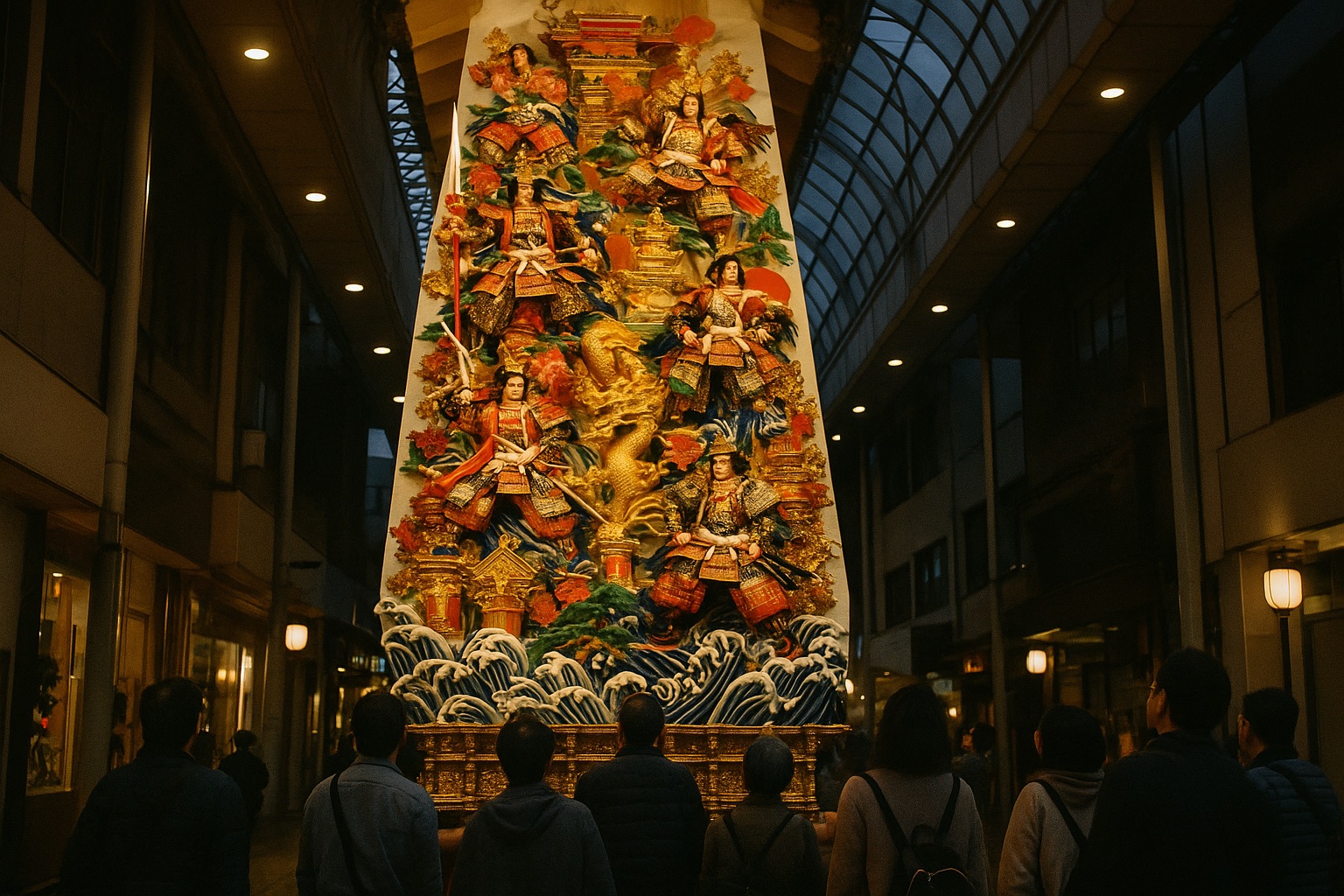
✦ AI-generated illustration — not a photograph of the actual site
Kazariyama — ten meters of samurai, gods, and gold, free to view across the city
Can't be there for the racing? From July 1 through 14, enormous kazariyama— decorative floats over ten meters tall, encrusted with elaborate doll tableaux of samurai legends, gods, and (on the "back face") often anime and pop-culture characters — stand at over a dozen locations across the city: Hakata Station, Canal City, Kawabata arcade, Tenjin, and more.
They cost nothing to see, they're spectacular at night when illuminated, and the Kawabata shopping arcade installs one you can walk right up to, alongside year-round Yamakasa exhibits. One kazariyama also stands permanently inside Kushida Shrine — so even outside July, you can get a taste of the scale.
Survival Tips & Etiquette
💧 You will get wet
Kioi-mizu water flies along the entire course. Don't carry anything that can't take a splash; your phone stays in a zip bag.
🚷 Never cross the course
When a float approaches, marshals clear the road. A one-ton float at a run does not stop. Stay behind the lines, always.
🏨 Book hotels months out
July 14–15 fills Fukuoka hotels well in advance. If beaten, stay near a Kuko-line subway station and walk from Gion Station area.
⛩️ Visit Kushida Shrine beforehand
Go in daylight earlier in your trip — see the permanent kazariyama, understand the geography, pay respects to the festival's home.
🍜 The all-nighter plan
Yatai dinner in Nakasu until late, walk the course at 3:30 AM, claim a spot, watch the dawn race, then first-train back and sleep till noon. Worth it once in your life.
📅 Same dates every year
July 1–15, fixed. The Oiyama is always July 15 at 4:59 AM. Plan flights around it with confidence.
🏮
Most Japanese festivals you watch. Yamakasa, you survive — happily, soaked, at five in the morning.
Eight hundred years, seven teams, one ton, 4:59 AM. If your July trip can touch Fukuoka between the 1st and the 15th, make it happen. This is the real thing.
Continue Planning Fukuoka
🏮 Fukuoka Yatai Guide
The pre-Oiyama dinner tradition
🍽️ 3-Day Food Itinerary
Eat the city between festival events
🛁 How to Use a Public Onsen
Recover from the all-nighter properly
⛩️ Dazaifu Day Trip
The shrine day trip from Fukuoka
🗾 7-Day Kyushu Itinerary
Build July around the festival
🏖️ Kyushu Summer Guide
Cool off after festival season