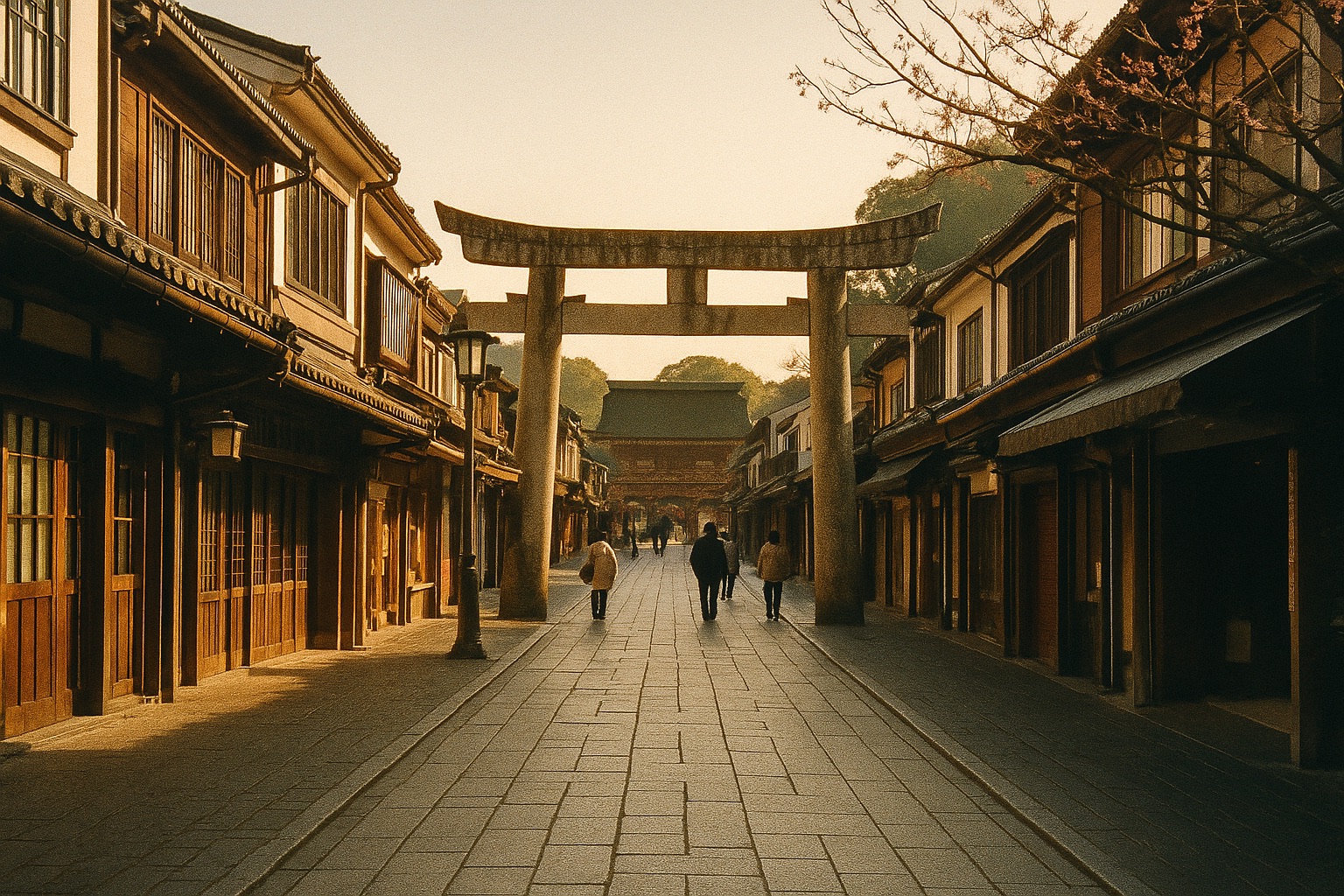
Every visitor to Fukuoka eventually asks the same question: "What's the best day trip?" The answer is 30 minutes away by train, costs about ¥420 to reach, and has been the spiritual heart of Kyushu for over a thousand years.
Dazaifu is where Japan's god of learning is enshrined, where students from all over the country come to pray before exams, and where — right now, until the once-in-124-years renovation finishes — you can see one of the strangest and most beautiful buildings in Japan: a temporary shrine hall with a living forest growing on its roof. Here's how to do it properly.
Why Dazaifu Is the Perfect Half-Day Trip
Over a millennium ago, Dazaifu was the government headquarters of all Kyushu — the "distant capital" that managed Japan's diplomacy and defense toward the Asian continent. Today it's a compact shrine town where everything worth seeing sits within a 20-minute walk of one small station.
That compactness is the point. You need only half a day, the train ride is short and pleasant, and the experience — shrine, gardens, street food, a world-class museum — is completely different from urban Fukuoka. It pairs perfectly with a food-focused city stay: morning in Dazaifu, back in Hakata by lunch (our 3-day food itinerary slots it in neatly).
Dazaifu Tenmangu — The God of Learning
Dazaifu Tenmangu enshrines Sugawara no Michizane (845–903), a brilliant scholar and statesman who rose to the second-highest office in Japan — then was framed by political rivals and exiled to Dazaifu, where he died two years later. After his death, disasters struck the capital so relentlessly that the court deified him to appease his spirit. He became Tenjin, the god of learning, scholarship, and calligraphy.
Today this is the head shrine (along with Kitano Tenmangu in Kyoto) of roughly 12,000 Tenjin shrines nationwide. Around exam season (January–March), millions of students and parents come to pray. The ema (votive plaques) racks, heavy with handwritten wishes for university admissions, are genuinely moving to read.
What to Look For
- 🐂The bronze ox (goshingyu): Michizane's messenger animal. Rub its head for wisdom — you'll see the bronze polished bright by millions of hands.
- 🌉The taiko bridges: three bridges over the pond representing past, present, and future. Don't look back while crossing — local custom says it leaves your past behind.
- 🌸Tobiume, the flying plum: the legendary tree said to have flown from Kyoto to follow Michizane into exile. It blooms first of all 6,000 plum trees here, usually late January.
- 🌳The 1,500-year-old camphor trees: the giant kusunoki near the main hall predate the shrine itself.
Entry is free; the grounds are open from early morning (around 6:00–6:30 depending on season). Go early — by 10:30 on weekends the approach street is shoulder to shoulder.
The Forest-Roofed Shrine — See It Before It's Gone
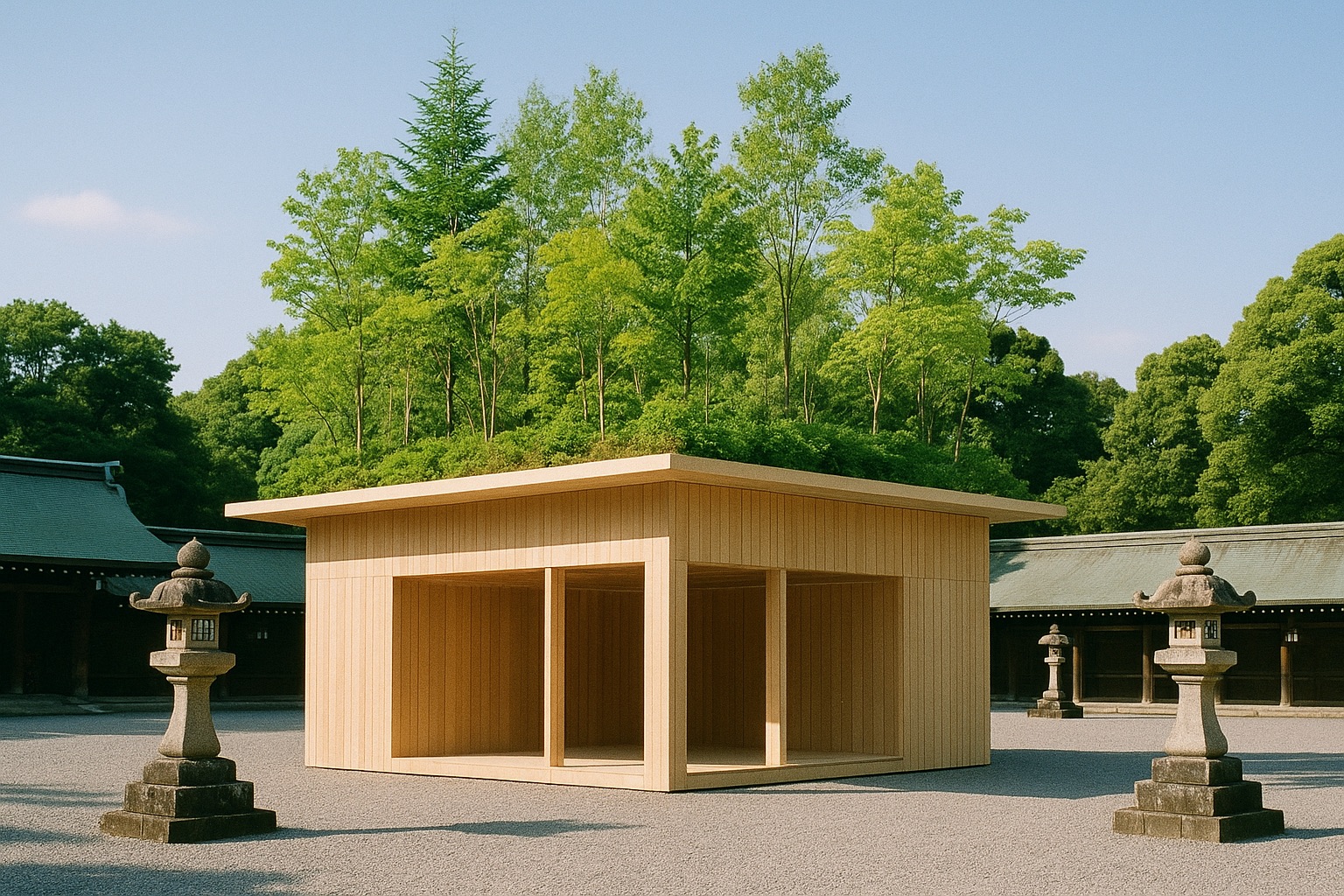
✦ AI-generated illustration — not a photograph of the actual site
The karidono — avant-garde architecture in a thousand-year-old shrine
Here's the time-sensitive part. The main hall (honden) — an Important Cultural Property last rebuilt about 430 years ago — is undergoing its first major renovation in 124 years, ahead of the great 1,125th anniversary festival in 2027.
While the honden is under wraps, the deity has been moved to a karidono (temporary hall) designed by Sou Fujimoto — the architect behind the Osaka Expo 2025 master design. His solution is unforgettable: a minimalist hall crowned with a living forest of 46 plant species, as if the sacred camphor grove had drifted onto the roof. It is one of the most photographed religious buildings in Japan right now.
Umegae-mochi — The One Snack You Must Eat
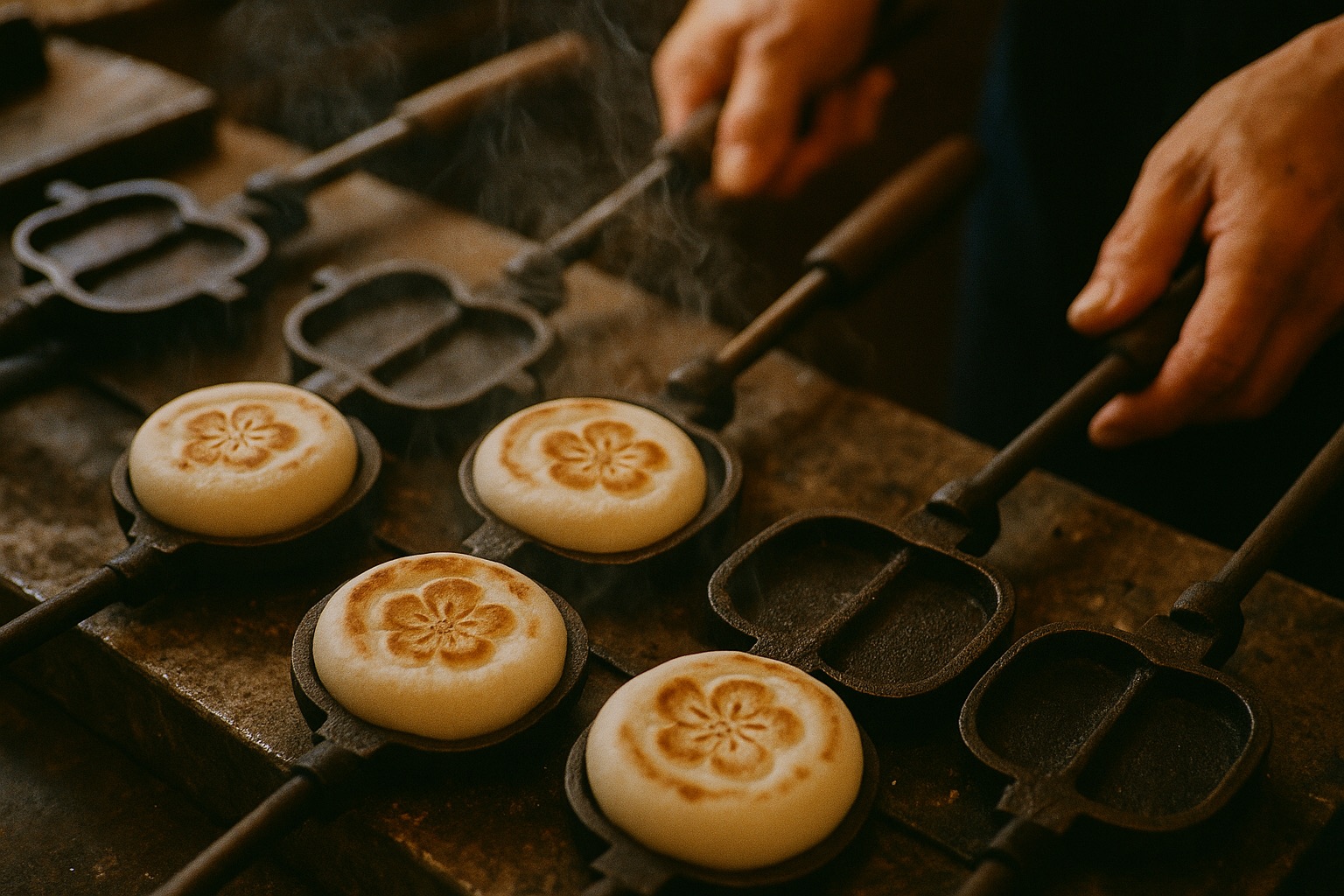
✦ AI-generated illustration — not a photograph of the actual site
Crisp outside, molten red bean inside — eat it hot off the iron
Umegae-mochi is a thin mochi shell filled with red bean paste, pressed in a cast-iron mold stamped with a plum blossom, and grilled until the surface crisps. The legend: when the exiled Michizane was at his lowest, an old woman passed him a rice cake on a plum branch through his window. Twelve centuries later, the approach street is lined with shops grilling them fresh.
- •Eat it hot, standing, immediately. The crisp-soft contrast lasts about three minutes. A bagged umegae-mochi eaten later is a completely different (and lesser) food.
- •Price: around ¥130–150 each. Buy singles from several different shops and compare — every shop's batter and bean paste differ slightly, and locals all have their favorite.
- •On the 17th and 25th of each month some shops grill special versions (the 25th is Tenjin's day — yomogi mugwort mochi appears).
Also on the approach street: the famous Starbucks designed by Kengo Kuma — a tunnel of interlocking cedar beams. Worth a photo even if you don't stop for coffee.
Beyond the Shrine — Komyozenji, the Museum & Pokéfuta
🍁 Komyozenji Temple
A five-minute walk from the shrine, this small Zen temple has Kyushu's finest dry landscape gardens — stones and moss arranged to form the character for "light." Quiet even when the shrine is packed. In autumn the maple foliage here is among the best in Fukuoka Prefecture. (Interior viewing availability varies; the gardens visible from the grounds are reason enough.)
🏛️ Kyushu National Museum
One of only four national museums in Japan — reached by a futuristic escalator tunnel directly from the shrine grounds. The permanent exhibition tells the story of Japan's cultural exchange with Asia, which is literally the story of Dazaifu itself. Allow 90 minutes if you go in; the building alone (a wave of blue glass in the forest) is worth the escalator ride.
⚡ The Three Pokéfuta
Dazaifu has three official Pokémon manhole covers around the shrine area — the easiest Pokéfuta cluster in Kyushu to collect. Locations and the full Kyushu hunting map are in our Pokémon in Kyushu guide.
Getting There from Fukuoka
🚃 Nishitetsu Train (Recommended)
From Nishitetsu Fukuoka (Tenjin) Station: take the Tenjin Omuta Line and transfer at Futsukaichi to the two-stop Dazaifu branch line — about 30 minutes, ¥420total. Direct "Tabito" liner trains also run at certain times. Dazaifu Station puts you right at the foot of the approach street.
🚌 Direct Bus from Hakata
The "Tabito" express bus runs from Hakata Bus Terminal (next to Hakata Station) directly to Dazaifu in about 40–45 minutes (~¥700). Easier if you're based on the Hakata side and want zero transfers.
✈️ From Fukuoka Airport
Direct buses connect the airport to Dazaifu in ~25–30 minutes — making Dazaifu a brilliant first or last stop of a Kyushu trip if your flight times align.
The Perfect Half-Day Plan
Train from Tenjin
Beat the crowds — weekends especially
Walk the approach street to the shrine
Shops are just opening; street is still calm
Tenmangu grounds
Ox statue, taiko bridges, camphor trees, the forest-roofed karidono
Umegae-mochi break
Hot off the iron, from two different shops
Komyozenji Temple
Zen gardens, ten quiet minutes
Optional: Pokéfuta hunt or Kyushu National Museum
Choose your party
Train back to Fukuoka
Arrive in time for a late ramen lunch in Hakata
🌸
Half a day, ¥1,500 including snacks, and a thousand years of history.
Dazaifu asks very little and gives a great deal — which is exactly what the best day trips do. Go early, eat the mochi hot, and see the forest on the roof while it's still there.
Continue Planning
🍽️ Fukuoka 3-Day Food Itinerary
Slot Dazaifu into the perfect eating trip
⚡ Pokémon in Kyushu
The three Dazaifu Pokéfuta and beyond
🍜 Fukuoka Food Guide
What to eat back in the city
🗾 7-Day Kyushu Itinerary
The full island route
⚔️ Fukuoka's Castle History
Warlords, duels & the Star Wars castle
🗾 Japan Travel Tips
20 things guidebooks won't tell you