Every culture has the place where its oldest stories live. Greece has Delphi. Japan has Takachiho — a mountain town in northern Miyazaki where, the myths say, the sun goddess hid herself in a cave and darkness fell over the world; where the gods gathered by a riverbank to lure her out; and where her grandson later descended from heaven to found the imperial line.
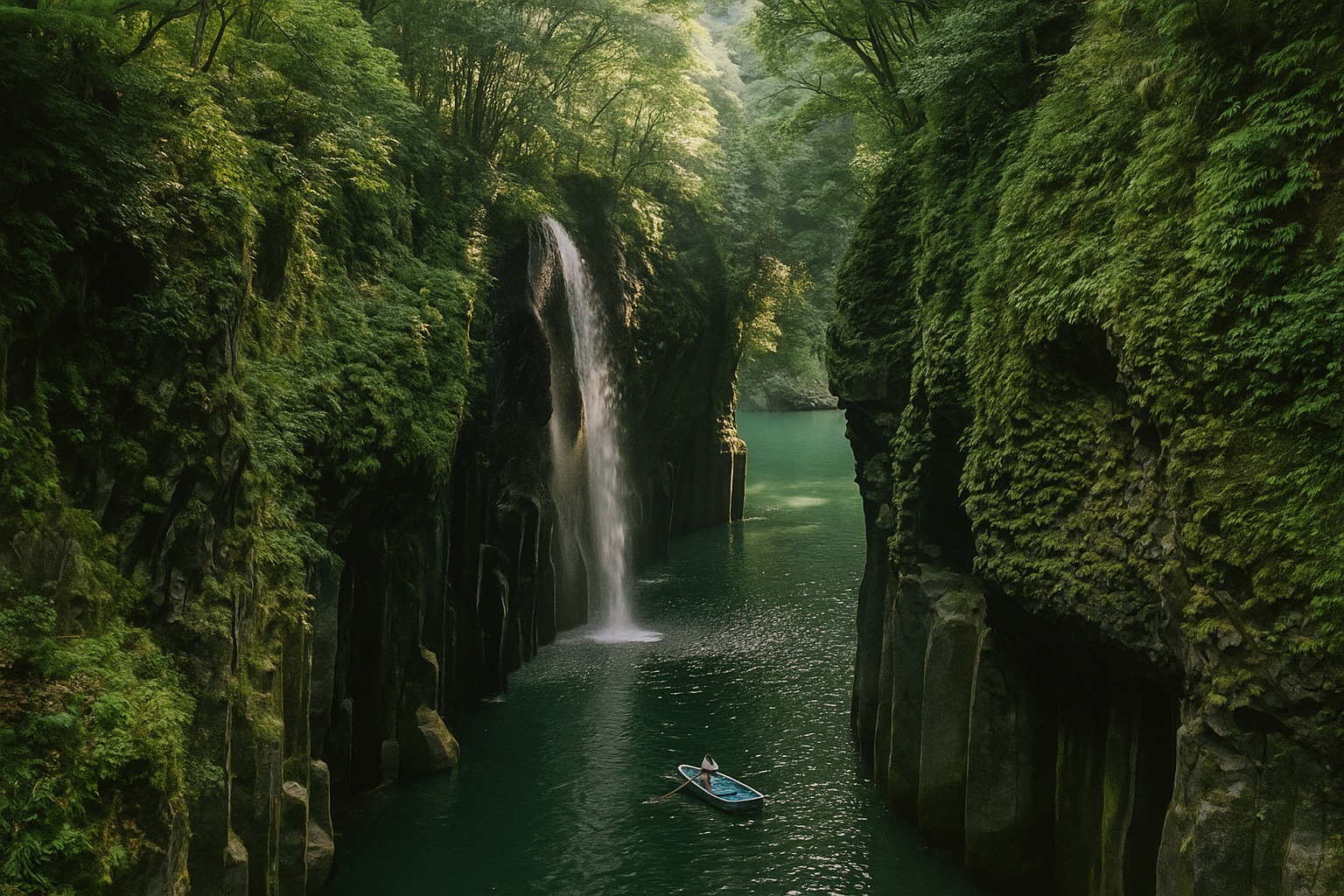
What makes Takachiho extraordinary is that none of this feels like a theme park. The cave is a real cave. The riverbank is a real riverbank, stacked with visitors' prayer stones. The myths are danced, live, every single night, by local farmers and shopkeepers. And the gorge itself — sheer basalt walls and a waterfall you can row beneath — would justify the trip with no mythology at all.
The Myth — Why This Valley Matters
The short version of Japan's most famous myth: the sun goddess Amaterasu, horrified by her storm-god brother's rampages, sealed herself inside the Amano Iwato cave. The world went dark; crops failed; demons stirred. Eight million gods assembled at the Amano Yasukawara riverbank to confer. Their solution was gloriously human — they threw a party. The dawn goddess Uzume danced wildly atop an overturned tub, the gods roared with laughter, and Amaterasu, unable to bear missing a good time, cracked the cave door open. A strategically placed mirror, a strong-armed god, and the light returned to the world.
That story — the original argument that joy, not force, restores light — happened here, in local tradition. Takachiho takes the custodianship seriously and lightly at once, which is exactly the right way to hold a myth.
The Gorge & the Rowboats
Takachiho Gorge is geology as theater: ancient eruptions of Mount Aso sent pyroclastic flows down this valley, which cooled into columnar basalt — and the Gokase River then carved a slot canyon through it, leaving cliffs of stone organ-pipes up to 100 meters tall. The centerpiece is the Manai Falls, a 17-meter ribbon pouring straight into the emerald river.
The famous experience is the rowboat: you row yourself up the narrow canyon, into drifting spray, the falls roaring above your shoulder. It is absurdly photogenic and genuinely fun — first-time rowers ricochet gently off the canyon walls to general laughter.
Go early (boats from ~8:30) for glassy water and the morning light shafting into the canyon — by midday in season, the gorge is a beautiful traffic jam.
The Cave of the Sun Goddess — Amano Iwato & Amano Yasukawara
✦ AI-generated illustration — not a photograph of the actual site
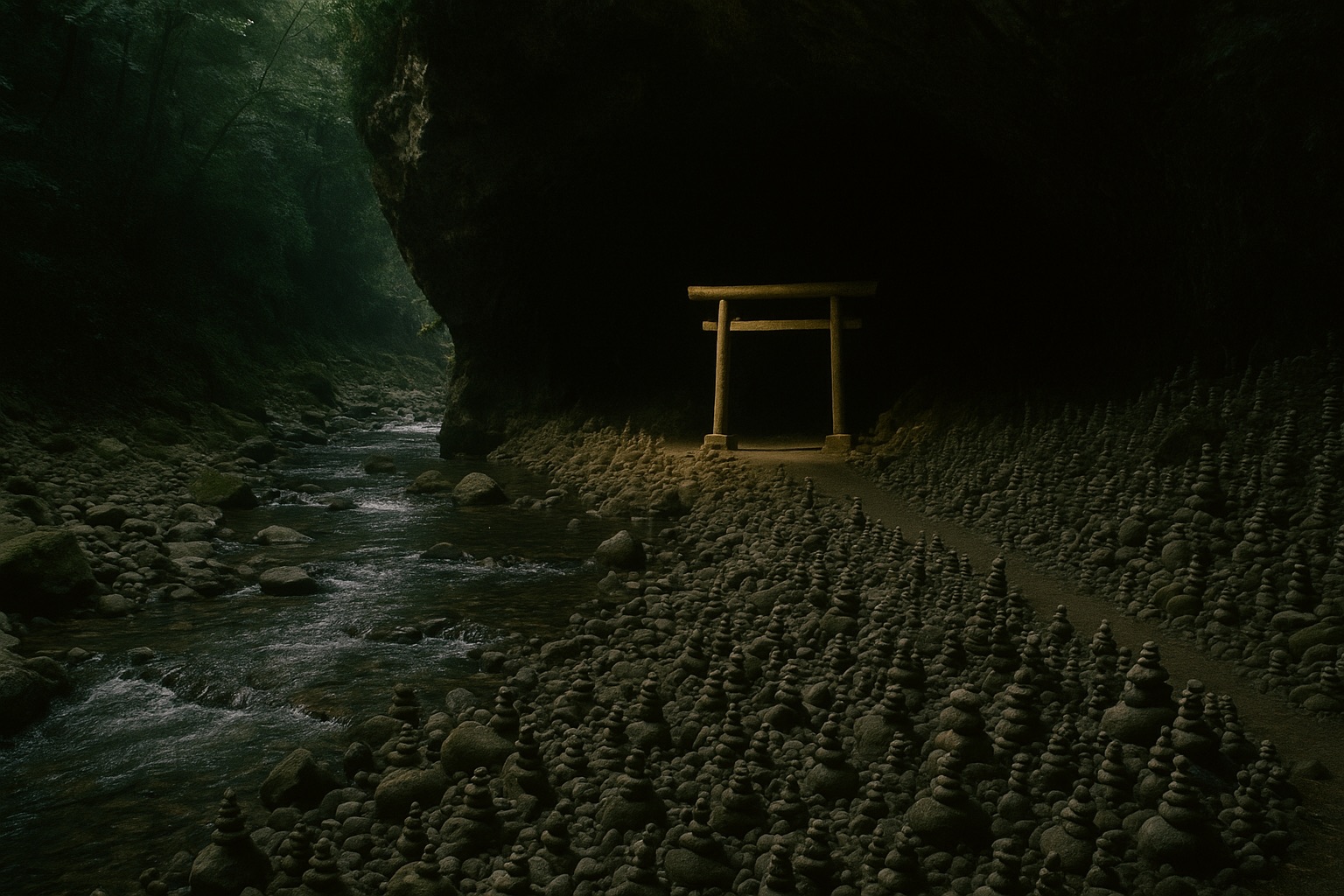
Amano Yasukawara — where eight million gods held the world's most consequential committee meeting
Fifteen minutes from town, Amano Iwato Shrinefaces the cave of the myth across a forested ravine — the cave itself is the shrine's sacred object, viewable from a priest-guided platform (free tours run regularly; no entry to the cave itself, ever).
The walk that stays with people is the ten minutes downstream to Amano Yasukawara — the riverbank cavern where the gods conferred. The approach runs along a boulder-strewn river of impossible clarity, and somewhere along the way the cairns begin: thousands upon thousands of small stone stacks, left by generations of visitors as prayers, covering every flat surface until the riverbank itself seems to be praying. Add your own stone. Whatever you believe, the place hums.
Back in town, Takachiho Shrine — 1,900 years old, cedar-shadowed — anchors the main street and hosts the nightly kagura below.
Night Kagura — The Myth Performed, Every Night
✦ AI-generated illustration — not a photograph of the actual site
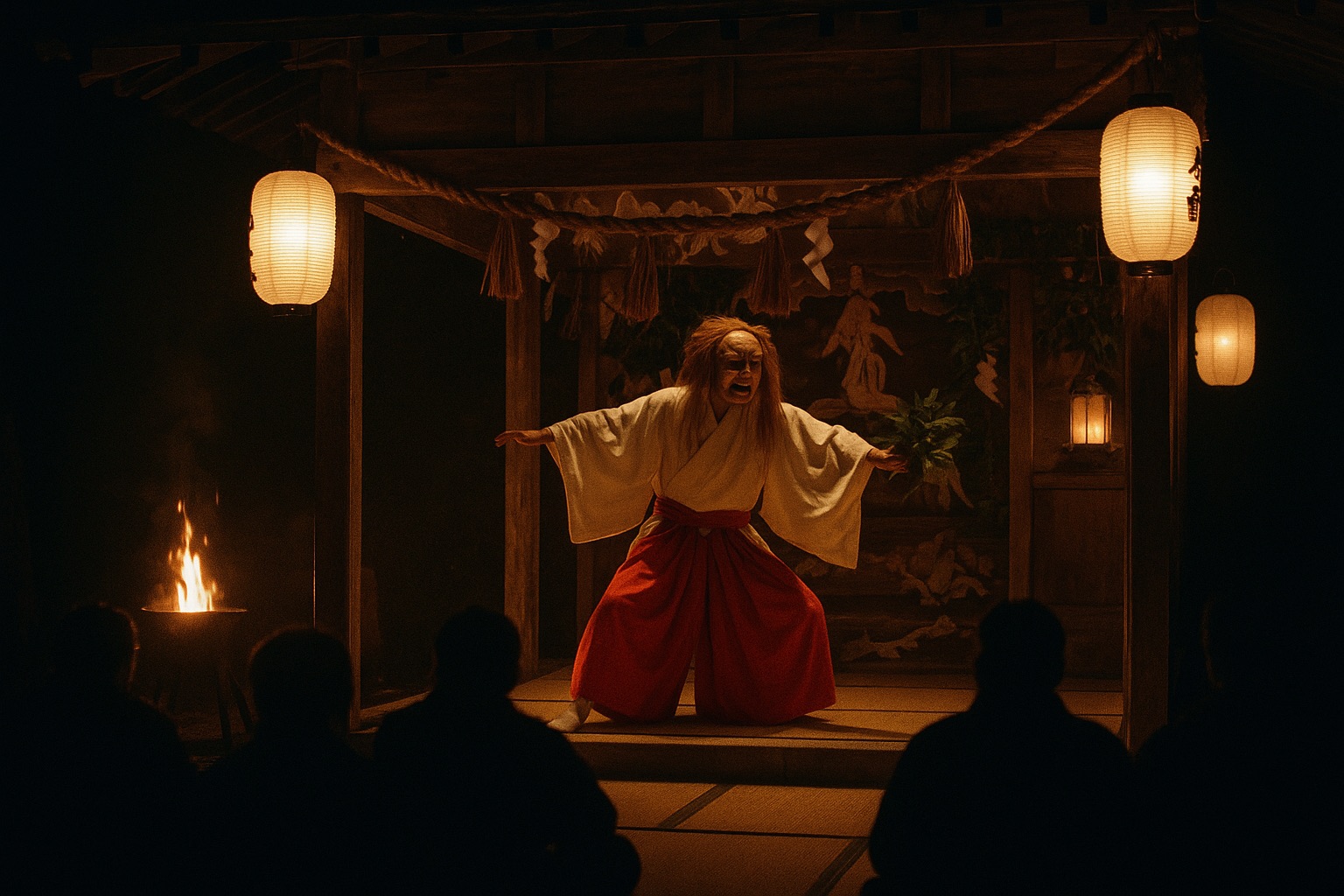
Yokagura — the dance that lured the sun back, still working after a millennium
Kagura — masked sacred dance — is Takachiho's living tradition. Through winter, farming hamlets hold all-night yokagura: 33 dances from dusk to dawn in village homes, a practice so old and intact it's nationally designated cultural heritage.
For visitors, Takachiho Shrine hosts a nightly one-hour highlights performance (typically 20:00, ~¥1,000)— four dances telling the cave myth: the search, Uzume's comic seduction, the hauling open of the door, the return of light. The performers are local preservation-society members — the man dancing the god may have sold you peanuts that afternoon — and that amateur sincerity is precisely what makes it moving where polished shows wouldn't be.
This is the argument for overnighting (see below): day-trippers leave before the town does the one thing no other town in Japan does nightly.
Honest Logistics — Getting There & Around
- 🚗Car is king. Takachiho has no train line. By car: ~1.5h from Kumamoto/Aso, ~1.5h from Nobeoka on the coast, ~3h from Fukuoka. The Aso → Takachiho mountain road is itself a highlight — pair the two in our Aso guide.
- 🚌Car-free: highway buses run from Kumamoto and from Nobeoka/Miyazaki; it's workable with planning, but in-town distances (gorge ↔ Amano Iwato) then need the local bus or taxis. Honest advice: this is the day to rent the car.
- 🍜Eat: Takachiho beef (a serious dark-horse wagyu), nagashi somen — noodles you catch from a bamboo flume of running spring water (summer, touristy, joyful) — and kappo-style dinners at inns.
- 🍂Season: fresh green (May–June) and autumn foliage (mid-Nov) are the peaks — book boats and rooms well ahead for November. Summer brings full water and full crowds; winter is quiet, cold, and the season of true all-night village kagura.
The Overnight Plan
Arrive via the Aso road
Check into a guesthouse or small ryokan in town
Amano Iwato Shrine & Yasukawara
The cave, the river, the ten thousand prayer stones
Early Takachiho beef dinner
The town sleeps early; eat before the kagura
Night kagura at Takachiho Shrine
One hour, ¥1,000, the myth itself
Gorge at opening
Rowboat slot reserved; glassy water, morning shafts of light
Rim promenade & second breakfast
The postcard view, then dango by the parking lot
Onward
Coast down to Nobeoka, or back through Aso to the onsen country
🌅
Takachiho is where Japan keeps its oldest story — and tells it to you nightly, for a thousand yen, danced by the man who runs the gas station.
Row under the waterfall, stack your stone by the river, and stay for the dance. The sun comes out of the cave every time.
Continue the Route